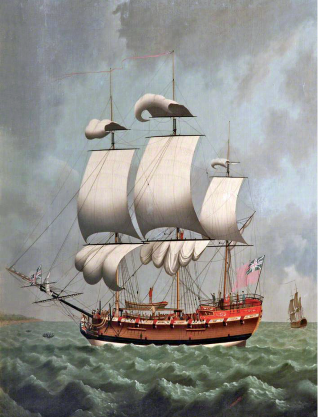
From Pulitzer finalist and New York Times bestselling author Siddharth Kara comes the true story of The Zorg: the notorious slave ship incident that led to the abolition of slavery in the UK and sparked the US abolitionist movement. Read on for a featured excerpt.An 18th-century Liverpool slave ship by William Jackson (c. 1770-c. 1803). Courtesy of Wikipedia. Public domain.
Prologue
If you have heard anything about this story, it is probably that there was an eighteenth-century British slave ship named the Zong, and that its captain, Luke Collingwood, ordered the murder of scores of Africans on board. Although this has been the prevailing account for more than 240 years, virtually none of the information is accurate. The truth is, there was never any British slave ship by the name of Zong. It was a Dutch ship, the Zorg, which means “care” in Dutch— an unintended irony. As for how the Zorg ended up in British hands and the role Luke Collingwood played in the subsequent massacre, there were deeper truths waiting to be uncovered.History is replete with similar inaccuracies— details obscured by the corrosion of time, flawed testimony from biased witnesses, and the missing voices drowned before they could speak. Sometimes the error is an innocent one, but when it is made by someone of consequence, it passes from one generation to the next like gospel. Christopher Columbus thought he had landed in India; therefore, the people he met were “Indians.” The name stuck for centuries.So, too, it was with the Zorg. As handwritten correspondence about the ship emerged, some readers thought the r was an n. A few notable figures in England soon started calling the ship Zong. It was a mark on a page misread, but because the mistake was made by prominent individuals penning accounts of the ship’s journey, the incorrect name passed into history. Calling the ship by its proper name is the first of many confusions about the Zorg that ought to be set right.This book is a journey to uncover the truth of what happened on board the Zorg in the waning days of 1781, as well as a chronicle of the historic consequences that followed. Millions of slaves would eventually be freed because the Zorg showed the world for the first time that the Atlantic slave trade was a morally bankrupt system of greed and violence that unleashed incalculable misery on the people of Africa. It also generated tremendous wealth for the slave merchants who financed the forty- thousand- plus voyages that crossed the Atlantic, beginning in the early 1500s.
𐦋
It took about a century for the Atlantic slave trade to develop after the first European ships ventured south during the Age of Exploration. The waters off the coast of western Africa initially proved impassable to European ships, until the Portuguese developed the caravel, a three-masted vessel with a lateen-rigged sail that allowed the ship to tack more effectively into the wind. The caravel carried Europeans beyond the Canary Islands for the first time, and by the end of the fifteenth century, the Portuguese had circumnavigated the entire African continent and reached India. Spanish explorers took to the seas as well, most notably when Christopher Columbus ventured westward in 1492 looking for a shortcut to India.Following this initial reconnaissance of the Southern Hemisphere, Spain and Portugal signed the Treaty of Tordesillas in 1494, memorializing a decree by Pope Alexander VI that all lands 370 leagues (1,275 miles) west of the Cape Verde Islands belonged to Spain, and all lands east of that line were Portugal’s, including Africa. Had the matter stopped there, much of the Southern Hemisphere would certainly have been subjected to violence and colonization, but it was not a foregone conclusion that the Atlantic slave trade would unfold.As fate would have it, Europeans had acquired a taste for a crystalline substance they first encountered during the Crusades. They called it “sweet salt,” and it only thrived in warm, tropical climates.Not long after arriving in western Africa, the Portuguese established sugarcane plantations on uninhabited islands off the coast, including one visited by the Zorg, São Tomé. To meet the labor requirements of these plantations, the Portuguese erected a network of slave- trading outposts from modern-day Liberia to Gabon. They called this area Guiné (Guinea). From the Guinea coast to the mouth of the Congo River, the Portuguese exploited existing systems of slavery in Africa to fill their nearby island plantations with slaves.The Spanish established their sugar plantations on several Caribbean islands and coastal South America. They struggled to obtain an adequate labor force to work on their plantations, in no small part because they decimated native populations. In 1518, King Charles V ordered the importation of four thousand slaves from Africa to Spain’s Caribbean territories. Since Africa belonged to the Portuguese under the 1494 treaty, they began shipping Africans to the Spanish colonies.Thus began the era of the Atlantic slave trade. The Portuguese ran a near monopoly on the Atlantic slave trade until the formation of the Dutch West India Company in 1621. Within two decades, the Dutch seized most of the Portuguese outposts on the Guinea coast and replaced the Portuguese as suppliers of slaves to the Spanish colonies. The Dutch also established sugar colonies in the Caribbean, including one on the tiny volcanic island of Sint Eustatius, which would play an important role in how the Zorg ended up in British hands.The British made first contact with African slaves during a 1555 voyage commanded by John Lok, the great- great-great-grandfather of Enlightenment philosopher John Locke. Captain Lok touched Africa in modern- day Ghana and returned with gold, elephant tusks, and “certaine blacke slaves, whereof some were tall and strong men, and could wel agree with our meates and drinkes.”The English began colonizing sugar islands in the Caribbean in the 1620s. In 1655, they captured the island of Jamaica from the Spanish and developed it into one of the largest and most profitable sugar-producing colonies in the world. Thanks to sugar, British imports in 1773 from Jamaica alone were worth five times the combined imports from the thirteen American colonies.With its plantation economy thriving, England became the dominant force in a globalized “triangular trade.” British slave ships ventured to Africa, bartered tradable goods for slaves, carted them across the Atlantic, sold the survivors for proceeds that were used to purchase the sugar, rum, molasses, cotton, tobacco, and indigo produced through slave labor, and transported these goods back to England to sell for a profit, which made British slave merchants rich and financed their next triangle voyages.By the late eighteenth century, the slave trade had permeated almost every aspect of British society and helped transform the nation into an economic superpower. “The importance of this trade to Great Britain, almost exceeds calculation,” stated one Liverpool ship captain. A Royal African Company official noted, “The negroe trade on the coast of Africa is the chief and fundamental support of the British colonies and plantations in America.” The British slave trade was “the Eldorado of the time,” and the only force on earth that could slow it down was the outbreak of the American Revolutionary War in 1775.A series of cascading consequences of the Revolutionary War would place the Zorg in the hands of a British crew belonging to the Liverpool slaver the William. These men would commit the deliberate mass murder of slaves on board the Zorg when only the stars could bear witness. By fluke of circumstance, their actions would be exposed for all to see in a legal contest before the lord chief justice of the British Empire. There is a direct line of causality between the public exposure of the Zorg murders and the first movement to abolish slavery in England.“The downfall of slavery under British power,” noted the great abolitionist Frederick Douglass, “meant the downfall of slavery ultimately, under American power, and the downfall of negro slavery everywhere.” It would take decades until the work was done, but the Zorg was the first undeniable argument against slavery.It became the one slave ship to stand for them all.
I
The William and The City That Slavery Built
Luke Collingwood woke on the morning of October 26, 1780, contending with a range of emotions. He would have been saddened to bid farewell to his wife, Sarah, before embarking on a twelve- month, twelve- thousand- mile clockwise journey around the north Atlantic Ocean. He would also have been anxious to leave behind his two children, nine-year-old Robert and seven-year-old Holly. The last time Collingwood departed Liverpool for an Atlantic voyage, he returned home to learn that his youngest child, Luke, had died just three weeks earlier on Christmas Day 1776, at the tender age of nineteen months. Sarah buried the baby in a tiny coffin at the Church of Our Lady and Saint Nicholas near the banks of the river Mersey. Returning to the news of his son’s death would have left a permanent wound in Collingwood, and the decision to leave Sarah and the children to fend for themselves for the upcoming year would not have come easily.Although Collingwood had successfully completed the Guinea voyage at least eight times between 1764 and 1777, there were no guarantees of a safe return. The journey around the Atlantic claimed the lives of almost one-fifth of the British seamen who undertook it, making Collingwood’s survival across so many voyages somewhat remarkable. Each embarkation was like going to war—against the ocean, the elements, and time itself. With each passing day, the probability of catastrophe increased. The ship might get caught in a storm, illness might decimate the crew and its cargo, the enslaved Africans might revolt, the ship might exhaust its supplies of food and water, or it might cross paths with enemy vessels.The risk of enemy seizure had increased dramatically due to the outbreak of the American Revolutionary War. “Every nation in Europe wishes to see Britain humbled,” wrote Benjamin Franklin in 1777, “having all in their turns been offended by her insolence.” French and Spanish squadrons were attacking British vessels bound for Africa, and American warships prowled the waters in the Caribbean on the hunt for British flags. Within a few months, the Dutch would join the attack.Despite the dangers, Collingwood had little choice but to return to work. For more than three years, war had ground Liverpool’s slave- trading economy to a halt. “Our once extensive trade to Africa is at a stand- still,” bemoaned the Liverpool General Advertiser on September 29, 1775, “all commerce with America is at an end . . . survey our docks: count there the gallant ships laid up and useless . . . what become of the sailor, the tradesman, the poor labourer during the approaching winter?”This was likely the very question on Luke Collingwood’s mind— what would become of Robert and Holly in the approaching winter? Crowd diseases such as typhus, tuberculosis, and whooping cough ran riot during the winter months in England, especially in urban areas. Many children, such as young Luke, died in infancy, and one- third of England’s children perished before the age of fifteen. Was it an inability to afford firewood to heat their home that had cost Collingwood’s youngest child so dearly? What might the next winter bring for his family while he was thousands of miles away? Despite the uncertainty, there was only one way for Collingwood to earn a wage after three years of diminished income— back to sea.Collingwood was a slave ship doctor, or “surgeon,” by trade. A prominent curate in Liverpool thought Collingwood was of “a milder and more humane disposition than most who are engaged in the slave trade,” even if he was still “deeply infected with the same unjust prejudices that mark all who are connected with that iniquitous traffic.” Being an experienced doctor on a slave ship made Collingwood one of the most important and well-paid members of the crew. It was his job to keep the sailors and Africans alive during the voyage, a formidable task for which he was typically paid £3–£4 per month ($900–$1,200 today). Dead Africans fetched no price at auction, and deathly ill ones were often sold for a loss as “refuse slaves,” to be patched up for resale in secondary slave markets.Part of Collingwood’s compensation also included one or two “privilege slaves,” the value of which could double or triple his income from the journey. Privilege slaves were handpicked by the highest-ranking officers on a ship to sell for profit on arrival in the Caribbean. Once slave ship owners realized their officers were selecting the healthiest male slaves to maximize their incomes, they altered the system so that officers were paid based on the average price of all the slaves sold. The new system made the job of the ship’s surgeon even more important, as healthier slaves fetched higher prices.Throughout his previous voyages, Collingwood had performed his job well. His last tour in 1776 reached Jamaica with an 8.6 percent mortality rate for the Africans on board. On the other hand, 18.4 percent of the Africans under his care died during his 1775 voyage, probably due to massive overcrowding of 674 slaves in the ship’s hold prior to crossing. Collingwood’s 1773 journey also had an 18.4 percent mortality rate. His best performance was a 1.2 percent mortality rate on his first-ever voyage in 1764, followed by a serviceable 11.2 percent in 1765. Taken together, Collingwood had outperformed the average mortality rates aboard British slave ships during the 1770s (14.8 percent) and 1760s (17.9 percent), which likely played a role in his repeated employment. Beneath these cold metrics lay an enormity of human misery that Collingwood’s next journey would unintentionally expose to the British public for the first time.No matter how anxious he might have felt to leave behind his wife and children, Luke Collingwood needed the paycheck. He was in his mid-thirties, and there would only be so many more Guinea voyages he could undertake. When he finally received word that the financier of his last few expeditions was sending another ship to Africa, there was only one choice to make. After three long years, Collingwood would be sailing the Atlantic once again.
𐦋
The man underwriting Collingwood’s next Guinea voyage, William Gregson, was a Liverpool success story. Born on January 6, 1720, to a humble dockworker, a teenage Gregson found talent working as a rope maker for the deep-seafaring vessels that lined Liverpool’s waterfront. As he braided the cords that functioned like ligaments and tendons to the wooden creatures sailing around the world, a young Gregson yearned for his share of, as one Liverpool historian put it, “the great annual return of wealth” that was being generated by an exciting new enterprise in town: the slave trade. The city’s nascent participation in the slave trade was “increasing the fortunes of the principal adventurers, and contributing to the support of the majority of the inhabitants.” For modest earners like Gregson, “the attractive African meteor . . . so dazzled their ideas” that it was impossible not to dream of becoming rich from the “Guinea cargo.”The profits from a single voyage could be enormous. An investing syndicate led by one of Liverpool’s top slave merchants, William Davenport, generated an impressive 147 percent profit on the journey of the Hawke in 1780. On the other hand, any voyage could end in disaster due to insurrection or shipwreck. To mitigate the risks, wealthier slave merchants typically spread their investments across numerous ships, like a slave-trade mutual fund.After saving his wages for several years, a twenty-four-year-old Gregson made his first slave ship investment with a share in the Carolina. Gregson received a deed on a sheet of parchment commemorating his contribution, “using lawful money of Great Britain,” the receipt of which “assigned and set over” his share of the ship as well as its “goods and chattels.” The Carolina departed Liverpool in 1744 and deposited 284 slaves in Jamaica; however, the ship and its cargo of sugar and other goods were lost at sea during its return voyage to England. Gregson’s first slave ship investment was a loss.Undeterred, Gregson spent the next two years building up his capital once again. The second time around, he spread his investments across two ships that set sail in 1747. One ship disembarked 283 Africans at Saint Kitts and returned home safely, but the other was captured by the French. Using his profits from the successful voyage, Gregson continued financing Guinea voyages at a brisk pace, and by the late 1750s, he had become one of Liverpool’s most prominent slave merchants. As his wealth accumulated, so, too, did Gregson’s prestige. He became one of the forty-one free burgesses who controlled Liverpool’s governing corporation, the Common Council, and in 1762, he was elected mayor of LiverpoolGregson continued dispatching two to three slave ships a year throughout the 1760s and into the 1770s. Despite his multi-decade success as a slave merchant, in 1780, Gregson was feeling the pinch. His empire was measured in slaves delivered, and ever since war broke out with America, the numbers had dwindled. In 1775, Liverpool’s slave ships disembarked 21,212 Africans into slavery. Four years later, the number had dropped to 4,028. American warships captured twenty-three British slave ships in the summer of 1776 alone, sending a clear message to England that her considerable slave- trading revenues were cut off.The Royal Navy tried to protect British merchant ships once war broke out, but by 1777, its forces were stretched dangerously thin fighting the Americans and fending off attacks from European enemies. To expand its fleet, the navy resorted to the notorious tactic of impressment. Armed gangs roamed city streets and rounded up able-bodied men to force them to work on warships. More than eighty thousand British men were pressed into naval service during the American Revolutionary War, helping Britain wage counterattacks on its enemies and defend its merchant vessels.By 1780, the seas seemed just safe enough that William Gregson could contemplate fitting out a ship for a Guinea voyage. He would have been especially eager to return to the Africa trade, as his financial pressures had been intensified by an ill-timed effort to start a slave ship insurance business in 1774. Thanks to conflict with the Americans, the slaving insurance market had dwindled, and the venture ended in bankruptcy in 1778. Unfortunately for Gregson, his first attempt to return to the Guinea trade after the three-year hiatus ended in catastrophe. On September 1, 1780, Gregson dispatched the Swallow from Liverpool. The ship deposited 186 slaves on the island of Tortola, only to be lost to shipwreck during its return journey. With the losses mounting, Gregson’s next slave ship had to be a success. He happened to have a brand-new ship ready to depart, the eponymous William. She was a three-masted vessel, about one hundred feet from bow to stern with a carrying capacity of 120 tons “burthen,” a touch smaller than the average slave ship that departed Liverpool’s docks during the eighteenth century. To finance the William’s maiden voyage, Gregson formed a syndicate of investors that included himself, his two sons, his future son-in-law, and two of Liverpool’s leading slave merchants. To helm the William, Gregson called up his nephew and one of Liverpool’s most experienced slave ship captains, Richard Hanley.
SIDDHARTH KARA is an author, researcher, and activist on modern slavery. Kara has written several books and reports on slavery and child labor, most recently the New York Times bestseller and Pulitzer Prize finalist, Cobalt Red. Kara also won the Frederick Douglass Book Prize. He has lectured at Harvard University and held a professorship at the University of Nottingham. He divides his time between Los Angeles and London.