
Since the beginning of time, animals have risen and fallen from dominance on planet Earth. Had the dinosaurs not been wiped out by a freak asteroid, their time as the supreme animal on Earth would have faded, too. In The Decline and Fall of the Human Empire, award-winning science writer Henry Gee offers a concise, brilliantly-told history of our species–and argues that we are on a rapid, one-way trip to extinction, though we can take steps to delay this fate for a short while. Dive into this fascinating read below, now available in paperback.
PROLOGUE
In a composition of some days, in a perusal of some hours, six hundred years have rolled away, and the duration of a life or reign is contracted to a fleeting moment: the grave is ever beside the throne; the success of a criminal is almost instantly followed by the loss of his prize; and our immortal reason survives and disdains the sixty phantoms of kings who have passed before our eyes, and faintly dwell on our remembrance.
Edward Gibbon,
The Decline and Fall of the Roman Empire
Of all the animals that have risen and fallen in Earth’s long history, it is the dinosaurs that have most engaged the public imagination. They infest our cinemas and comics. Their images are all over clothing and school lunchboxes. They even get into places that they’re not wanted. The word ‘dinosaur’ has such cachet – such pulling power – that it can even sell things that don’t have much to do with dinosaurs. Dawn of the Dinosaurs is the title of a wonderful book about the unjustly neglected Triassic Period (the one before the Jurassic of movie fame, for all that many of the dinosaurs featured therein are from the even later Cretaceous Period), a fifty-million-year interval (between 250 and 200 million years ago) in which many kinds of extraordinary creatures evolved, most of which despite their inherent interest will be unfamiliar to most people, and in which dinosaurs only played a walk-on part near the end. But they got top billing on the title page, nonetheless. Such palaeocultural misappropriation doesn’t stop there. Popular books on prehistoric life are often entitled ‘Dinosaurs’, and then, in smaller letters, as if in apology, ‘and Other Prehistoric Animals’. Play sets featuring dinosaur models might include animals that lived at the same time as dinosaurs but weren’t dinosaurs (the flying pterosaurs, the swimming plesiosaurs) and even Dimetrodon, a toothy, sail-backed creature that lived tens of millions of years before the dinosaurs and was in fact more closely related to us. As if to stick two fingers up at the merest accusation of anachronism, they might even throw in a woolly mammoth, an animal that lived more than fifty million years after the dinosaurs had disappeared. Such is the near synonymy of the word ‘dinosaur’ with ‘clickbait’ that I was tempted to call this book ‘Dinosaurs’ (in large capital letters) with the subtitle (in smaller letters) ‘and Their Role in the Evolution and Extinction of Humans’.
They are not, however, completely unconnected. Whatever else one might say about dinosaurs, they are, indubitably and most definitely, extinct. The fascination that they elicit in the public mind is derived, in large measure, by this single, simple fact. Dinosaurs seemed to be thriving until the very end of the Cretaceous Period about sixty-six million years ago, when, suddenly, they disappeared, along with the flying pterosaurs (which weren’t dinosaurs), the swimming plesiosaurs (and neither were these), the iconic truck-tyre-sized ammonites (armoured relatives of squid, definitely not dinosaurs) and many other creatures.
For many years – decades, even – the reason why dinosaurs perished was a non-question that attracted a wealth of possible answers. More than a hundred have cluttered up the cocktail-party-chat end of the scientific literature. Dinosaurs died out because their eggshells became too thin and fragile for the embryos to reach term. Dinosaurs died out because their eggshells became too thick for the young to hatch. Dinosaurs died out because newly evolved mammals ate their eggs (irrespective of the thickness of the shells). Dinosaurs died out because of indigestion brought on by eating the then newly evolved flowering plants. Dinosaurs died out because of hay fever contracted from the then newly evolved flowering plants and sneezed to death. Dinosaurs died from some other unspecified contagion. Dinosaurs died out because they became too big and heavy. Dinosaurs died because they stopped having sex. Dinosaurs died out because, after 160 million years as the undisputed rulers of creation, they simply ran out of things to do, new worlds to conquer, and got bored (a condition that’s accreted its own technical term, Palaeoweltschmerz), and expired from sheer ennui.
The most outrageous idea to account for the extinction of the dinosaurs was that the world was struck by an enormous asteroid, the impact of which ushered in an interval of global catastrophe. This was the idea that turned out to be true.
Many of the ideas, though, turned on the notion that after a hundred million years and more of tenure on the Earth, the dinosaurs had become outmoded, tired, worn out, that their time was over. This, really, was why extinction was a kind of non-question, for it was once thought that dynasties of creatures came and went as a matter of course, and that departure was inevitable, the creatures having run out of puff. It was called ‘racial senescence’, or, more technically, ‘orthogenesis’. And so it was that the Devonian Period was the ‘Age of Fishes’, after which fishes gave way to the succeeding ‘Age of Amphibians’ in the Carboniferous Period, with each dynasty of creature giving way to something newer, more advanced, more evolved, with each in its allotted station, to each its allotted span. The dinosaurs were the apotheosis and zenith of the ‘Age of Reptiles’, after which there was the ‘Age of Mammals’, culminating in Man. (Capital M. Not, you’ll notice, Woman, capital W.) Dynasties of animals arrived, largely supplanted the existing ones, and were, in their turn, eclipsed. Dinosaurs arrived, fretted and strutted on the stage of life, and then departed when their time was up. So much so that the word ‘dinosaur’ became a synonym for something huge, obsolescent and unsuited to the modern world, like the Ford Edsel or manual typewriters.
Only in the 1970s were dinosaurs reinvented as warmblooded, intelligent creatures, largely thanks to the patient work of the late palaeontologist John H. Ostrom and his swashbuckling student Robert Bakker. A little later, the idea that an asteroid brought the age of dinosaurs to a crashing close gained credence, and it was found that dinosaurs didn’t die out because of some natural cycle, but that they were cut down in their prime. If the asteroid had missed, dinosaurs might still be enthroned on the Earth today.
After this, orthogenesis was dumped in the ‘where are they now?’ files of defunct evolutionary ideas. It was an idea that had had its day, like, well, the dinosaurs. Evolution, you see, doesn’t work that way. The motor of evolution is natural selection, a handy phrase for what happens when inherited variation and superabundant offspring confront environmental change. When this collision is allowed to play out over time, the result is evolutionary change. But at any given moment, natural selection has no memory of things past, no vision for the future, no aim in view. This in-the-moment view was encapsulated by palaeontologist Leigh Van Valen as the ‘Red Queen’ hypothesis. Creatures are forever in competition. Predators develop keener weapons and sharper senses to catch prey that are forever evolving to be more alert, more wary. As the Red Queen says to Alice in Lewis Carroll’s Through the Looking Glass, in Looking-Glass Land you must run as fast as possible just to stay in the same place. From this, Van Valen reasoned that there need be no relationship between how long a species (or group of species) took a turn on the stage of life and the timing or manner of its passing. Orthogenesis – racial senescence – was an illusion.
Except that it wasn’t.
Time after time, palaeontologists found that species (or, more usually, genera, which are groups of closely related species) tended to arrive at one point in Earth’s history, after which they diversified and became dominant, only to fade and dribble away to extinction. If orthogenesis made no sense, what could explain this pattern of entrances and exits?
An answer came as recently as 2017, when a group of palaeontologists from Helsinki came up with a way to finesse the problem. Species appear on the scene for any number of reasons, but their rise to dominance is driven by having to rub up against other creatures, in the same way that it takes a bit of irritating grit in an oyster to create a pearl. Once they’ve reached the top, having run all the competition out of town, they must fight a long and inevitably losing battle against a pitiless foe that will never, ever give up – the Earth itself. After that, the only way is down, until, eventually, the tiny remnant of what is left will be culled by some chance environmental event. The asteroid that mowed down the dinosaurs was a freak event. If the asteroid had missed, the dinosaurs would have died out, sooner or later, because that’s what living things do. To understand when and why species become extinct in the common run of things, you must see what they were doing at their peak.
And so, we arrive at the connection between dinosaurs and humans. If you apply this logic to modern humans, our own species, Homo sapiens, is marked for extinction. Of course it is. Humans, like dinosaurs, and like every other living thing that has ever walked, hopped or crawled on this planet’s face, or has burrowed beneath, or flown above it, or slithered into the ocean depths, are living creatures and cannot claim any special exemption from the rules of the world. On the other hand, Homo sapiens might not be an exception, but it is exceptional, nonetheless, and I think it’s fair to state this even though a human is doing the judging. Humans have achieved, in a remarkably short space of time, a dominance over the fates of all other creatures that none other has managed in the entire history of the Earth, as far as is known. They have managed this with an unprecedented mastery over the forces of nature. Humans have penetrated the secrets of atoms, to exploit their energy. They have unravelled the genetic mysteries of life, to manipulate it. They have scanned to the edges of the Universe. It is reasonable to ask whether, given all these achievements, humans might, uniquely, evade extinction’s great scythe, and persist indefinitely.
The answer is that humanity will perish, along with everything else. The reason, in part, is because of its very success. Humanity has become so pre-eminent, so dominant, that it threatens the functioning of the ecosystem on which it and all other creatures depend. No other single species in the history of creation has ever posed such a threat. In my previous book, A (Very) Short History of Life on Earth, I was coy about precisely when Homo sapiens might vanish. I veered between a few thousand years, to a few tens of thousands, to – well – some vague, hand-wavy time in the future. I think the phrase I used was ‘sooner or later’. In a way, extinction isn’t some uniform daisy-cutter, but affects each species according to its own circumstances. In that book I was proud to have invented the Karenina Principle – that whereas all happy, thriving, abundant species are the same, each species on the brink of extinction will meet oblivion in its own way.
There are, however, rules. According to the principles discovered by the Helsinki group, our species’ inevitable demise was set the moment when, for the first time in the seven-million-year history of the human lineage, only one human species was left standing. That species was Homo sapiens. The moment? At some point between 50,000 and 25,000 years ago. After that, the downward course became inexorable. The only question was when the final curtain would fall.
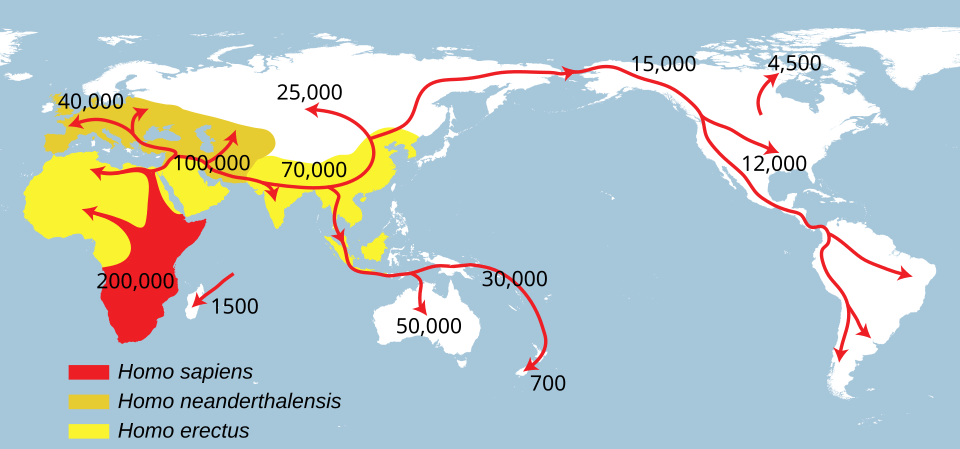
Until about 50,000 years ago, Homo sapiens was just one of many species of human. At that time, it was tropical, living in Africa and southern Asia, with a toehold in island south-east Asia and Australia. In Europe and central and northern Asia, Neanderthals ruled, ruggedly adapted for ice age life. They shared central and eastern Asia with the Denisovans, initially adapted for the high life on the Tibetan Plateau, but which had lately migrated to lower altitudes. Island south-east Asia hosted a remnant of the ancient species Homo erectus in Java, and the unusual, dwarfed ‘hobbits’ Homo luzonensis in the Philippines and Homo floresiensis on the island of Flores, in what is now Indonesia. And these are just the ones we know about. Homo sapiens shared Africa with other species, the existence of which we are barely aware. But by around 25,000 years ago, coincident with the coldest snap of the ice age, Homo sapiens had colonized the whole of Africa and Eurasia and had even made inroads into the Americas. By that time, it had driven all other human species to extinction. From the moment the last human that wasn’t a member of the allconquering Homo sapiens died out, Homo sapiens’ card was marked.
It then had to fight the long, losing battle against ineluctable fate.
This might seem odd given that the human career since then appears to have been one of progressive global domination. Beneath the success story, however, Homo sapiens has been living on borrowed time. It has done so for thousands of years and is now on the verge of collapse.
In this book I shall explain why.
I shall also explain how, if it is wise, lucky and sufficiently ingenious, Homo sapiens might evade this fate, at least for a while. But if it is to do this, it must act now. The reason is that humans alive now, including you, the reader, live at a unique turning point in the long history of the species.
Start listening to an audio excerpt of The Decline and Fall of the Human Empire!
The Decline and Fall of the Human Empire. Copyright © 2026 by Henry Gee. All rights reserved.