
When people think of endangered animals, the Canada goose does not come to mind. In fact today, they are one of the most commonly found birds across America. However, just a century ago, these birds were in dire straits. Author James H. McCommons shares how the rise of the bird conservation movement saved the Canada goose from extinction. He also provides a fun throwback to Frankie Laine’s No. 1 musical hit in 1950, The Cry of the Wild Goose. Please don’t blame us if you listen to this catchy tune and get it stuck in your head.
When I was small boy in the early 1960s, my parents owned a phonograph with a steel needle and box of 78 rpm records. Among those heavy shellac discs (this was before vinyl) was “The Cry of the Wild Goose” by Frankie Laine, a No. 1 hit in 1950. When I played that record, my heart raced and I sprinted about the room, pretending I was hunting, living in a wilderness cabin, or flying away with the flock. In the song, the geese were metaphor for a man’s natural disquiet and restlessness.
“My heart knows where the wild goose goes
And I must go where the wild goose goes”
When Frankie Laine, a show name Americanized from Francesco Paolo LoVecchio, sang of honking Canada geese passing over in the night, it was a rare wonder of nature. There just weren’t that many geese with the long black neck and the white chin strap in 1950; the bird was still recovering from near extinction earlier in the century.
When Europeans first came to North America, the Canada goose resided mostly in southern Ontario and the prairie provinces. It was truly a Canada goose that migrated north and south with the change of seasons. A large bird, good tasting, easy to kill and providing feathers for mattresses and pillows, it was especially sought after by professional hunters shooting for the market.
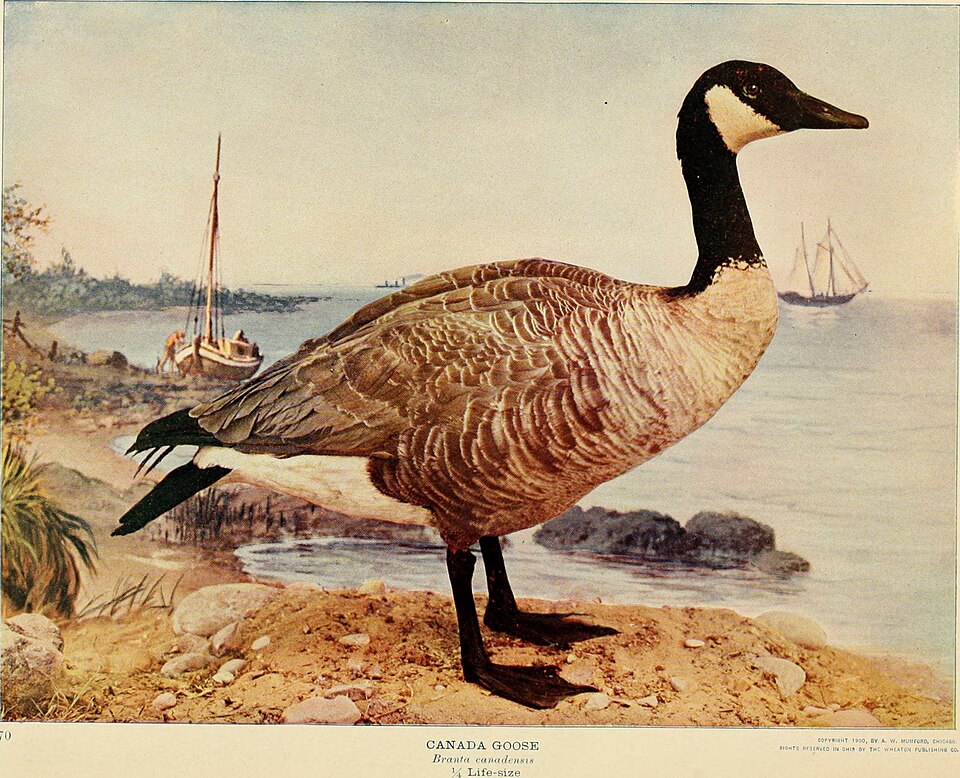
There are seven subspecies of Canada geese and the most endangered was Branta canadensis maxima, a bird with a seven-foot wingspan weighing more than 20 pounds, twice the size of its brethren. Like the passenger pigeon, the Carolina parakeet, the heath hen, Eskimo curlew, and other victims of the 19th century slaughter of birds, the giant goose was believed to be extinct, but in 1962 a biologist determined that members of a tiny flock in Rochester, Minnesota, living in a game refuge owned by the Mayo family (of the famed Mayo Clinic) was the giant Canada goose.
The Migratory Bird Treaty of 1918, which outlawed market hunting, had given Canada geese and other avian species breathing room to recover, but it required intervention by humans for geese to actually flourish. We regulated hunting, restored wetlands drained away for farms, and raised and reintroduced birds to their former haunts. In Rochester, the survivors grew into a flock of thousands.
And so it went in scores of other locations and looking up to see “wild geese winging north in the lonely sky” became a more common sight—an inspiring symbol of wilderness, migration, and the passing of the seasons. Then in the 1970s as suburban sprawl replaced woods, farms, and pastures with housing tracts and malls, lawns, golf courses, business parks, and thousands of water-retention ponds to hold the runoff from parking lots and roadways, we created perfect habitat for geese, a herbivore that grazes on fields and gleans shallow waters for submerged vegetation. The population of the big birds exploded.
Canada geese had been migratory, but many birds found conditions so appealing in towns and suburbs, why leave? Fat and happy with no predators, they’ve become year-round residents. You might even call them sedentary. Today there are seven million geese in North America, having gone from a rare and endangered bird to one of least concern, present in all 50 states, and in places they never were before.
They are a success story, one of the greatest comebacks in conservation history. But, of course, there are problems. An adult Canada goose produces three pounds of waste a day, and their droppings litter parks and lawns. Geese crash into cars and airplanes, hiss and honk and chase people away from their territories, and generally make a nuisance of themselves. Too much goose can be too much of a good thing but they are just being birds.
Perhaps it is only memories of home, childhood, and an old record player, but my heart still feels something when I punch up “The Cry of the Wild Goose” on Spotify or when I hear and see geese passing overhead, flying in that remarkable V formation.
“Tonight I heard the wild goose cry,
Winging north in the lonely sky.
I tried to sleep but it weren’t no use
Because I am brother to the old wild goose”