
On November 11, 1966, NASA launched Gemini 12, the last manned spaceflight in NASA’s Project Gemini, which stayed in space until its crew splashed into the Atlantic on November 15, 1966. Jeffrey Kluger, author of Apollo 13 and Gemini, takes a look back at the Gemini project, the last launch of Gemini 12, and how the Gemini program prepared America to put men on the moon.
The demolition team at NASA’s Cape Kennedy in Florida was busy on the morning of November 11, 1966.
Over the past year and a half, the space center teams had done yeoman’s work, helping to send up two-man crews in the nimble little Gemini spacecraft at the rate of one mission every 10 weeks. Gemini 4, launched in June 1965, was the first of those flights, and the crew—Jim McDivitt and Ed White—made history, with White exiting the capsule and maneuvering about at the end of a gold umbilical cord, performing America’s first walk in space. Gemini 5 was next, during which Gordon Cooper and Pete Conrad set a space endurance record, remaining in orbit for eight days. Next came Geminis 6 and 7, which saw the crews performing America’s first rendezvous, coming within a foot of each other as they tore around the Earth at 17,500 miles per hour—or 4.9 miles every second.
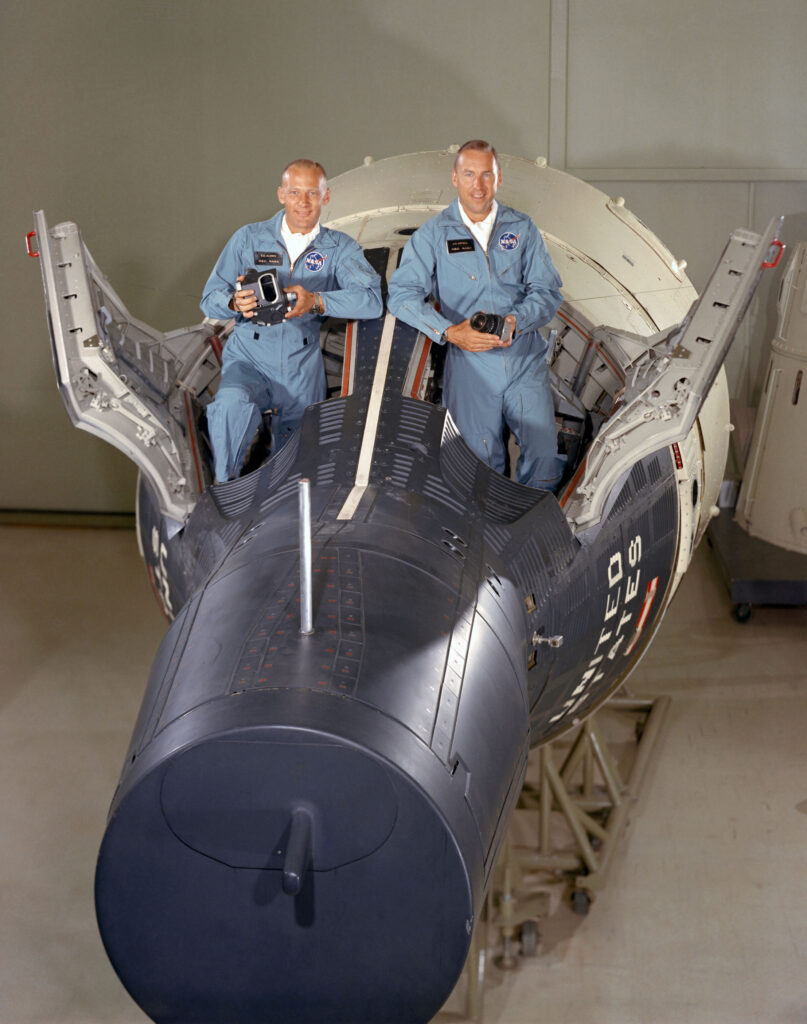
So it went until a Friday in November of 1966—59 years ago this week—when Jim Lovell and Buzz Aldrin climbed into the astronaut van and motored out to launch pad 19 for the liftoff of Gemini 12, the final mission in the 12-flight, 20-month, $1.35 billion Gemini project. A Gemini insignia flag was hoisted at the entrance to the space center to mark the occasion. When the astronauts walked from the van to the gantry elevator, a sign on Lovell’s back read “THE” and a sign on Aldrin’s read “END.” And so it was.
No sooner had the astronauts lifted off than the demolition crew went to work, converging on the launch site with welding guns and wrecking cranes and reducing the gantry to junk, clearing it for the construction of more elaborate launch facilities to come as the glorious days of Apollo dawned and the United States moved on to the moon. If the NASA brass were looking for a capstone mission for the Gemini program as a whole, they could not have done better than the one Lovell and Aldrin flew.
The two men would stay aloft for 94 hours, 34 minutes, and 19 seconds. Aldrin would perform five and a half hours of spacewalks—one of them fully outside the spacecraft and two standing up in his seat. He would also work on what the crew called a busy box—a set of tools and hardware that would help prove that astronauts could do useful work in zero-g. Included in the box was an electric screwdriver, a set of snippers and wires that Aldrin could experiment with, and a torque wrench that would allow him to turn a bolt by squeezing two handles, preventing a twist in one direction from turning his body in the opposite direction.
Lovell would dock and undock with an Agena target vehicle—an unmanned spacecraft with which Gemini crews practiced their rendezvous skills. He would rely on charts and a 59-pound onboard computer to calculate his approach. When the docking radar suddenly failed, Lovell would turn to the exquisite rendezvous computer that was Aldrin himself, who had earned a PhD from MIT in rendezvous mechanics. Lovell would also successfully steer his spacecraft, despite the fact that four of the orbital maneuvering thrusters quit working entirely or turned sluggish.
“Thrusters four and eight are dead completely,” he reported. “Two takes twelve seconds to build up and seven takes seventeen seconds. All the rest of them check out.”
The spacecraft would go fritzy in another way as well, with the fuel cells producing less-than-optimum power. But when it was time for Gemini 12 to come home, the ship would be the first of the Gemini series to reenter entirely automatically. Lovell and Aldrin would splash down a mere 3.4 miles from the aircraft carrier USS Wasp, catching a hard wave on the way into the water.
“Son of a gun!” Aldrin would exclaim.
“Boy, boy, boy!” Lovell would say. “That was a mean one, wasn’t it?”
It might have been a mean one, but it was a sweet one too. Over the course of the Gemini program, sixteen men had gone into space and sixteen had come home. It was lost on no one that the Soviet Union, which had long led the U.S. in the race to the moon, launched no men at all into orbit during the 603 days Gemini had been flying. The U.S. had not won the race. No one knew what ingenious hardware and exquisite missions the communist nation that had given the world Sputnik—the first satellite—and Yuri Gagarin, the first man in space, might be cooking up. More than three years remained until the end of the decade—the deadline which the late President Kennedy had set for the U.S. to achieve a moon landing—and the Soviet Union could easily vault ahead of the U.S. in the cosmic steeplechase.
But America had achieved rendezvous, docking, and long-duration spaceflight, and even now, as Gemini 12 and its still-hot heat shield was hissing in the waters of the Atlantic Ocean, the Gemini program flag over the Manned Spacecraft Center was being slowly lowered. Within three years, Americans would walk on the moon.