
When most people think of North American slavery, they most often think of slavery around the antebellum period when cotton was king and there were tensions between the North and South. They may wonder, “Why didn’t more people try to escape from slavery before the 1850s?” The Escapes of David George author Gregory E. O’Malley reveals the answer below.
When David George ran from the Virginia tobacco plantation where he was born, he went south. Leaving at midnight he ran through the night to get as close to North Carolina as he could before anyone realized he was missing. That choice of direction never fails to surprise modern readers of his story. After all, most American stories about slavery—historical and fictional—involve escape to the North. In the popular imagination, crossing the Mason-Dixon line or the Ohio River, from south to north, means crossing from slavery to freedom.
Understanding why David George ran the opposite way, down to the Carolinas and beyond, requires reckoning with context. That geographic border between northern slavery and southern freedom did not always exist. Paying attention to timing reveals that our famous stories about American slavery are actually about slavery in the 1840s and 1850s.
And there is a reason most stories come from that era. Slavery was embattled. Enslaved people had always resisted the regime, through rebellions, flight, and refusal to be dehumanized. But the combination of enslaved resistance with the emergence of free states and anti-slavery activism in the North proved combustible. Free states gave people fleeing slavery a destination to shoot for. And if they made it, anti-slavery activists gave them platforms to tell or publish their stories, stirring up more activism. The bravery of such escapes and such storytelling stoked the sectional controversy that culminated in civil war and emancipation.
Most stories of slavery emerge from this contentious context. First, there are the historical events and sources. The shipboard rebellion on the Amistad in 1839 (later dramatized on film by Steven Spielberg) stirred up a controversy that reached the Supreme Court. Frederick Douglass published The Narrative of the Life of Frederick Douglass in 1845 and My Bondage and My Freedom in 1855, after escaping to the North from Maryland. Harriet Tubman also escaped from Maryland in 1849. Solomon Northrup published Twelve Years a Slave in 1853 (also later adapted for film), after being kidnapped from freedom in New York, sold into Southern slavery, and eventually returned to freedom in the North. And Harriet Jacobs didn’t publish Incidents in the Life of a Slave Girl, about her escape from North Carolina to the North, until 1861, the year that the Civil War began.
Perhaps because these famous historical sources and stories derive from these last decades of American slavery, most of our beloved fictional accounts (including Toni Morrison’s Beloved) are set in the same decades. Harriet Beecher Stowe published the bestselling Uncle Tom’s Cabin in 1851, featuring an enslaved woman named Eliza escaping across the Ohio River with her son. Mark Twain published The Adventures of Huckleberry Finn after the Civil War, but it is set in slavery’s last decades. When Huck sets off down the Mississippi with the enslaved man, Jim, the plan is to turn up the Ohio River toward freedom in the north. And Percival Everett’s James retells the story from Jim’s perspective, changing their exact path, but ultimately Jim still heads north towards the free states. Morrison’s Beloved is set just after the Civil War but is haunted by memories from before emancipation and the sacrifices made to escape north. Colson Whitehead’s The Underground Railroad bends time but clearly invokes a framework of an Underground Railroad that leads to escape in the North. The list could go on.
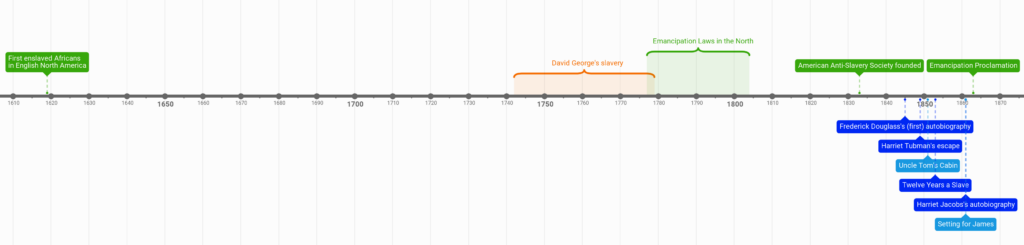
As a result, when most Americans think of slavery, consciously or not, they think of the 1850s. They think of King Cotton, the Underground Railroad, and sectional tensions between North and South. None of these existed for most of slavery’s history in North America.
The first enslaved Africans arrived in colonial Virginia in 1619, more than two centuries before Frederick Douglass put pen to paper. David George was born in 1742, still several generations before America’s famous stories of slavery. The cotton gin had not been invented to make cotton plantations viable. Railroads did not exist to make an “underground railroad” conceivable. And there were no free states. Slavery was legal and practiced in all British colonies—Pennsylvania and Massachusetts included. Free states would only emerge during and especially after the Revolutionary War, usually through gradual emancipation laws that took decades to end slavery.
In light of slavery’s long history, there is a danger in telling only stories from the antebellum era, when slavery was controversial. It can make escape seem less impossible than it was. It can raise a troubling question—one I sometimes hear from students who have learned little about slavery besides the Underground Railroad:
Why didn’t more people escape?
I think that was the logic behind Kanye West’s controversial comments that grabbed attention a few years ago: “When you hear about slavery for 400 years … For 400 years? That sounds like a choice. You were there for 400 years.”
Ignoring the centuries before 1830, we can miss a powerful reason why slavery lasted so long. For most of slavery’s history in North America, there was nowhere to run.
I wrote The Escapes of David George to bring an earlier world into American understandings of slavery. Following David George through years of escape attempts with no obvious destination to seek helps us understand that the antebellum escapes of Douglass, Tubman, and Jacobs were exceptional. They were products of a time when slavery was imperiled. David George (and millions of others) faced an earlier America, more united against them.
Over several years, George crossed North Carolina, South Carolina, and Georgia, working for landowners illegally and avoiding recapture, until he eventually fled pursuers into the territory of the Muscogee Creek nation. Even there he was taken captive. He was then sold to colonial fur traders and ended up back on a South Carolina plantation enslaved for another decade. Only the American Revolution would create a brief window of opportunity for another escape—which he and tens of thousands of enslaved people seized. But in his many prior attempts, we see the reality faced by most enslaved people. There was no safe haven to seek.
For all the danger faced by Frederick Douglass, Harriet Tubman, or Mark Twain’s Jim, their escape was unusually plausible—far from easy, but possible. For millions of prior enslaved people, there was no conceivable place to go. That’s why we rarely have stories from earlier generations of the enslaved in North America, and why David George’s story is so valuable.