
From the time the United States was founded, early Americans assumed that the land’s natural resources, including its birds, were infinite. They were wrong. In the 19th century, with the rapid extinction of the passenger pigeon, a disparate crew of people, from society belles to U.S. presidents to business titans to hunters, began the great crusade to save America’s birds. Read on for a featured excerpt of James H. McCommons’s The Feather Wars, an entertaining and expansive history of the United States told through the lens of the rise of the bird conservation movement.
Preface
Canada Geese
For years when I traveled around the Upper Peninsula of Michigan, I peered at sun-faded Cloverland advertisements on the brick walls of downtown stores, drove on Cloverland Road or Cloverland Drive in a half-dozen towns, and thumbed through vintage Cloverland postcards at yard sales. Even today, there’s a Cloverland Motorsports selling snowmobiles and ATVs; the Cloverland Electric Cooperative, providing power to thirty-four thousand customers; and, not surprisingly, given the proliferation of marijuana dispensaries in Michigan, a Cloverland Cannabis— a name with catchy alliteration and imagery. Yet if you asked the three hundred thousand or so residents of the Upper Peninsula what Cloverland means or what it once was, very few could say.
Clover is a legume that fixes nitrogen in the soil. “Clover land” evokes a scene of grasslands and livestock flourishing under a blue sky, pastoral and productive. And that’s exactly the image the boosters of the Upper Peninsula had in mind in the early 1900s, when they attempted to rebrand this isolated and frosty region as farm country. It seemed a reasonable proposition. In places to the south, white settlers had cleared the hardwood forests, plowed the grasslands, and found soils and climates amenable to agriculture. Popular bromides and slogans of the day promised “Farms Follow Forests” and “Towns Follow Farms.” Why not here? Gone were the stands of Michigan’s virgin white-pine forests, leveled to build the cities and the towns of the treeless Great Plains. Gone, too, were the clouds of passenger pigeons that once darkened the skies and nested in the forest by the hundreds of millions. What remained were stumps, brush, slash, and sawdust piles extending to the horizon. Most summers after the deforestation, the detritus caught fire from lightning, passing trains, or some fool trying to clear land, and exploded into firestorms that incinerated whole towns and seared seedlings and organic matter in the soil. Forests could not regenerate, and the region so lacked timberit was joked that a woodpecker would have to carry his lunch. Veterans home from the Great War compared the cutover, scorched lands of the Upper Peninsula of Michigan to the shell-blasted forests of France.
After leveling the forests, the lumber and mining companies, railroads, and land speculators pawned off the stumplands to farmers and homesteaders, claiming that with the trees removed, modern science and experimentation would make these lands productive. It was simply a matter of determining which crops and animal husbandry were suitable and then applying the proper modern methods.
![Clover-Land Magazine [Northern Michigan University Archives]](https://www.thehistoryreader.com/wp-content/uploads/2026/03/Screenshot-2026-03-13-at-4.07.11-PM.png)
Near the town of Seney—where bars and brothels had lined the streets to serve the shanty boys (lumberjacks)—a syndicate of investors cut canals through the Great Manistique Swamp, diverted runoff into the rivers, and exposed black peaty soils. The company sold the “reclaimed” land and pledged to build “New Seney,” a town where a man could go to church and raise a family. A few shanty boys stayed behind to build farms. Emigrants from Scandinavia, seeing a resemblance to the old country, took out homesteads. And settlers from the cities came north, lured by the prospects of cheap land. For a time, it all seemed plausible. In 1916, boosters launched Clover-Land magazine to market Michigan’s Upper Peninsula as the “greatest dairying and livestock region in the United States if not in the world.” A clever artist drew a cover of a virile young farmer holding the Upper Peninsula in his arms like a cornucopia (the shape of the region actually resembles a horn of plenty) with crops and produce spilling out and raining down on the cities to the south: Detroit, Milwaukee, and Chicago.
But Cloverland was a chimera, all magical thinking and hucksterism. The soils in northern Michigan—Wisconsin and Minnesota, too—are acidic, sandy, and low in fertility. Good for growing trees but not row crops. After a few plantings, the fertile, peaty layer in the former swamps played out, then dried up and blew away. And the Northern winters tested the fortitude of any optimistic agriculturalist. Farming peaked in 1920, and by 1925 Michigan was taking back more than one hundred acres per day for delinquent taxes. When the Great Depression descended, hundreds of farms failed and people fled. In 1935, the federal government purchased seventy thousand acres and used eminent domain to condemn and seize another twenty thousand acres of what had been the marsh near Seney. The land was deemed submarginal, incompatible with farming but suitable for rehabilitation as bird habitat. The young men of the Civilian Conservation Corps established a camp nearby, and the Works Progress Administration hired unemployed local workers. Because it was impossible to restore the original hydrology of the land, the Bureau of Biological Survey (later renamed the U.S. Fish and Wildlife Service) designed a series of twenty-one impoundments, or large pools, connected by pipes, ditches, and spillways that enabled federal biologists to manipulate water levels and vegetation for waterfowl. Crews laid out a hundred miles of truck trails and seeded the embankments and openings with wild celery, rice, and other plants favored by wildlife.
Before it was complete, the new Seney National Wildlife Refuge took on its first mission: to save the Canada goose, Branta canadensis, which had slipped to dangerously low numbers and was nearing extinction. To anyone in the twenty-first century stepping through goose poop on a lawn, on a golf course, or in a public park, it might seem implausible that Canada geese were ever rare, but a century ago the sight of a flying V of geese was as improbable as a flock of passenger pigeons.
Throughout the United States in the nineteenth century, game dealers, who bought and sold wildlife commercially, paid good money—fifty cents to a dollar—for a wild goose that they could sell to housewives or restaurants. Market hunters who supplied the birds to the dealers shot every goose they saw. Settlers killed geese to make feather pillows and mattresses and stole their eggs to make a meal. Farmers draining and plowing up marshes destroyed the bird’s nesting waters and feeding grounds. And despite protection under the 1918 Migratory Bird Treaty Act, the landmark law that made nearly all wild birds wards of the federal government and protected species migrating between the States and Canada, wild geese were not making a comeback. The only substantial numbers were being raised in captivity by amateur aviculturists.
In 1936, the Seney refuge obtained three hundred Canada geese from a farmer fifty miles south of Detroit. They were pinioned—a wing tendon severed to make the birds flightless—and placed in a hastily built pen while a four-hundred- acre pasture and several pools were prepared for nesting. The entire area was fenced, and several plots of corn, oats, and barley planted. The birds required twenty-four-hour surveillance to fend off foxes, coyotes, raccoons, and crows preying on eggs and goslings. During the bitterly cold winter, biologists hacked holes in the ice to provide open water. The birds reproduced well in captivity, and their offspring took flight and migrated. Many returned to Seney, and their presence lured in other wild geese. Over decades, breeding populations were established at Seney and at the Horicon Marsh in Wisconsin. From there, birds were relocated to new territories. As suburbia, with its residential lawns, water-retention ponds, and golf courses, spread after the 1970s, providing a superb habitat for geese and deer as well—the populations of both exploded.
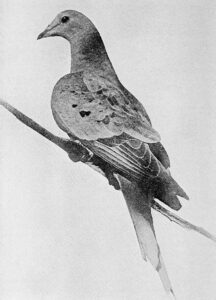
Today, the big black-necked birds with the white chinstrap are listed as a bird of “low concern” and occur in all fifty states. Canada geese, despite their reputation as a national pest, are a great conservation story, as are the wild turkey, wood duck, trumpeter swan, and bald eagle, all brought back from the brink of extinction by human intervention. However, the passenger pigeon, heath hen, ivory-billed woodpecker, Carolina parakeet, Eskimo curlew, and the great auk did not make it. A few others—the whooping crane, Florida scrub jay, and California condor—are just hanging on, their fates still tenuous.
The slaughter of birds in the late nineteenth and early twentieth centuries was executed by humans out of ignorance, hubris, meanness, and greed. Americans in the Gilded Age (those decades of rapid expansion after the Civil War) were a people without constraints. Whether it was trees, bison, deer, fish, or land, the mindset was, Take all you want; there will always be more. And as to an animal so abundant and ubiquitous as birds, they believed there was no chance of killing them all.
Birds perished in so many ways. Southern farmers netted tens of millions of American robins to feed hogs. Bird catchers snared and sold cardinals, mockingbirds, and baby crows for pets. Dreamers with misplaced intentions released house sparrows and European starlings into American skies, and they muscled out native birds. “Eggers” foraged seabird colonies and the nesting grounds of geese and ducks to harvest eggs for food. Hobbyists—so-called oologists—pilfered wild bird eggs to display in curio cabinets. And then there were the feather hunters, the fashion industry and its eager clientele: smart, stylish women. Feather hunters shot breeding herons, egrets, and terns and left the chicks to starve on the nest. Pelicans were shot to make writing instruments from their large quills. Some bird feathers were so valuable, they were worth more than their weight in gold. Women paraded about with hats trimmed with avian body parts, wore earrings and broaches of hummingbirds, and fanned themselves with the severed wings of roseate spoonbill.
Hunters were a significant threat as well. Poor folks and recent emigrants from Europe hunted songbirds and tossed them into the pot for a bit of protein. Market hunters fashioned homemade cannons, paddled into flocks of sleeping ducks, and brought down dozens in a single blast. “Pigeoneers” killed birds by the trainload and shipped barrels of passenger pigeons to buyers in the city who had a taste for wild game. Sport hunters at that time measured success by the number of kills, not caring how the killing was done, only that the body count was high. Towns held competitive hunts during which teams killed every wild animal encountered. On summer evenings, boys and men took target practice on purple martin and nighthawks. Excursion boats in Florida passed out shotguns to passengers so they could plug birds along the waterways. Before the advent of binoculars and field guides, bird-watchers killed vast quantities of birds, felling them with shotguns in order to make identifications and collect specimens.
It took decades for the wastefulness and fog of self-deception to lift—for realization to set in that dozens of species of wildlife were about to disappear forever, along with their habitat. The rapid demise of the passenger pigeon, the scarcity of deer in the East, and the carnage of the American bison on the plains clearly demonstrated there were indeed limits and consequences. The decline of wildlife became self-evident.
What followed could be considered both a spiritual awakening and a great crusade to save birds. The campaign took place on thousands of battlefields: political luncheons in the White House; society teas in Boston; smoke-filled hunt clubs on the East Coast; the sloughs along the Mississippi River, where market hunters and sport hunters faced off in battle; the mangroves in the Everglades, where bird wardens died resisting feather hunters; and in the editorial pages of newspapers and periodicals. The crusade to save birds stretched from the heady days of the Gilded Age to the misery of the Great Depression. Those five decades birthed the conservation and bird protection movements and brought together a remarkable coalition of people and organizations to save the birds of America.