
After the Civil War, many American families moved west seeking new lives, heavily supported by the Homestead Act and the completion of the Transcontinental Railroad. In some areas though, lawlessness still prevailed, which author Joe Pappalardo entertainingly portrays in his book, Boomtown: The True Story of the Wickedest Town in Texas. Read on for a featured excerpt from Boomtown, the true story of the corrupt and violent town of Borger, Texas in 1927―and the legendary Texas Ranger tasked with taming it.
PART ONE
1
The Murder Nest
February 2, 1927
Austin, Texas
Frank Hamer shifts his weight between his feet and stares at the door of Room 924, willing it to open. It’s been an hour since their inside man entered the Stephen Austin Hotel, carrying money to bribe a pair of legislators. When he comes out, Hamer and fellow Texas Ranger Captain Tom Hickman will go in to make two sensational arrests.
Hamer is six foot three and a solid 230 pounds, every ounce of which he can feel on his weary feet. This girth includes plenty of muscle, a thick build earned by long years of ranching, riding, scouting, and fighting. His legs are especially strong, and other Rangers speak of his ability to use a mule kick to knock down opponents. Hamer says he learned the move fighting bullies as a kid. For all this bulk, he still moves “with the ability of a dancing master,” as his friend William Sterling put it. His thick neck, wrapped with a wide tie, seamlessly melds with the back of his head.
Thomas Rufus Hickman is a walking example of what life in the saddle does to the human body. His upper half is that of a slim man, but his legs belong to someone much thicker. He’s a business college graduate—Gainesville, class of 1907—who found himself deputy sheriff in Cooke County by 1910 and a Texas Ranger private by 1919. Hickman’s also an accomplished rodeo man, serving as judge of the first rodeo in England in 1924 and the first held in Madison Square Garden, just last year. Hickman’s three inches shorter than Hamer, with mild brown hair that makes his dark eyebrows seem even bushier than they are. He’s got a small mouth but a wide smile, showing a row of small, straight teeth. His genial manner sometimes makes it hard to remember how capable Hickman is as lawman—and just last year he was part of a shoot-out that cut down two bank robbers in Clarkesville. It was Hickman’s first and only fatal shooting, whereas Hamer has been involved in dozens during his career.
The pair of Rangers are on the hunt again, this time for a different kind of prey—crooked politicians. But this is not the way either man expected this Wednesday to unfold.
Hamer and Hickman were meeting in the office of the adjutant general in the capitol earlier that day when an optometrist named W. W. Chamberlain walked in and identified himself as the legislative chairman of the Texas Optometrist’s Association. And added that he was going to bribe a pair of state representatives by the end of the day.
As the Rangers listened, they came to understand how thoroughly Chamberlain had set up the statehouse politicians. Last week Chamberlain met with Representative F. A. Dale, from Bonham, and Representative H. H. Moore of Cooper with concerns over a new bill charging brick-and-mortar optometrists the same fee applied to transient ones. Dale solicited a payoff, noting that the other side had agreed to an amount and that Chamberlain would have to beat their bribe. Chamberlain conferred with his association’s leadership. They gave him the money, and with it a mission to burn the legislators for graft. Chamberlain is now inside a room of the Stephen Austin Hotel, with $1,000 cash in small denominations, each bill number officially recorded by a bank in Oklahoma.
Hamer is impressed with the optometrist’s thoroughness. All he and Hickman have to do is tag along, wait for the money to exchange hands, and then arrest both legislators while they are in possession of the marked bills. It’s a tempting offer, since arrests like these could deliver the Texas governor an early-term win of some significance. The corruption of the previous regime of Miriam “Ma” Ferguson was legendary, and combating it is a central plank of the new administration of Dan Moody.
Moody achieved statewide recognition as district attorney of the 26th Judicial District for prosecuting and imprisoning Klansmen. Ferguson made him attorney general, where he unearthed state highway-contract scandals and plotted his successful candidacy against her.
Now sympathetic newspapermen are declaring that law and order is returning to Texas. Delivering the scalps of crooked politicians would reinforce this message, and also establish Hamer and Hickman as primary agents of the governor’s mandate.
The high-profile nature of the opportunity also made Hamer hesitant to leap at Chamberlain’s setup without the sign-off of their boss, Brigadier General Robert L. Robertson. However, the man is out of town. Chamberlain, whose cleverness must have made him a good choice to be his association’s legislative chairman, suggested they confer with Brigadier General Jacob Wolters, the Houston-based head of the Texas National Guard, who happens to be in another Austin hotel. Hamer phoned the Driskill, and Wolters agreed to meet there.
Hamer and Hickman donned their hats and checked with Wolters to “see how far we could go, legally,” as Hamer will later explain. Wolters saw no problem with arresting the representatives if the sting went down as planned.
The next stop was to reunite with Chamberlain and follow him to the Stephen Austin Hotel. The Rangers took the elevator to the ninth floor, and the wait started. When porters arrived to deliver three meals—from the smell, fried chicken—the Rangers knew they were in for a long one.
Hamer has been in law enforcement for more than half of his forty-two years and, with the exception of seven years, he’s served as a Texas Ranger since 1906. Yet he has something to prove to the new governor. Hamer was reinstated as a Texas Ranger captain just last week. Although he made captain for the first time in 1921, Hamer reenlisted as a private in 1925 to take a special investigator’s gig with the adjutant general’s office in Austin. Now, with a change in the political weather, he’s a full-time Texas Ranger captain again. He’s assigned to co-captain Headquarters Company, where Hickman’s been the head since 1925.
Being assigned to the Rangers’ Headquarters Company means being stationed in Austin, but it doesn’t mean the men have been working in the city. During this transition, Hickman and Hamer’s responsibilities aren’t defined by geography as much as political urgency. They are the ones who are available to act on the governor’s order when something unexpected happens anywhere in the state.
Hickman is technically the senior captain, but the truth is that he could be fired any day. Moody is even now in the midst of a purge of the Rangers who worked with his defeated opponent, Ma Ferguson. Moody’s already gotten rid of one captain, W. M. Ryan, who was sacked in January to make room for Frank Hamer.
If Hickman’s let go, Hamer will become the senior captain of Headquarters Company, the sole authority over the men and the governor’s go-to lawman. These politics have primed Hamer and Hickman for a rivalry, but these particular Rangers have decades of experience with each other and large enough accomplishments—and egos—to handle the awkward situation. And this isn’t the first case the pair have partnered on.
After an hour, the door to Room 924 opens and Chamberlain emerges—with Representative Dale. The politician’s presence with their informant is not expected or welcome—he’s emerging to see two large men, each over six feet tall, lurking in the hotel hallway. Usually a Texas Ranger leverages his size to establish control over other men, but today Hamer wishes he could shrink a foot or so.
A voice calls from the room, presumably Representative Moore, and Dale retreats from the hallway to respond. Chamberlain seizes the moment and steers the Rangers to the elevator, saying, “He hasn’t delivered yet, but he will. Follow us.”
Dale is just returning when the elevator doors close on Hamer and Hickman. The pair loiter near the lobby’s doors, wondering if the money is being exchanged in the elevator. When Chamberlain and Dale step out of the elevator, they head directly for the hotel’s southern exit. As the optometrist passes Hamer, he turns his head and mouths, “Follow.”
The Rangers tail the two men into the street—the exchange hasn’t happened yet. They leave the hotel’s southern door, onto West Seventh Street. Chamberlain and Dale are chatting, just two men amid the throngs of downtown Austin. Hamer and Hickman ease along behind them, watching as they slip into an alley.
Hamer and Hickman creep after them, quickly enough to see Chamberlain hand an envelope to Dale, who stuffs it into the left pocket of his trousers before walking away, alone.
The Rangers close the distance between themselves and the oblivious representative. It’s clear he’s heading back to the Stephen Austin Hotel—the Rangers intercept him just as he’s about to enter the lobby. Looming over the shocked legislator from either side, they identify themselves and Hamer intones, “I have reason to believe you’ve accepted a bribe. I’m going to have to search you.”
Hamer makes a point to go straight for the pocket with the $1,000 cash, in hundreds, fifties, and twenties. Dale does his best to explain it away. He’s not here as a state representative but as a lawyer, and this is a retainer. “I just made the deal in Representative Moore’s room; he can explain this.”
“Oh, that’s just where we’re going,” Hickman says. Before they head inside the hotel, they arrest Dale on the spot.
Back on the ninth floor, Hamer knocks and enters to deliver the bad news to H. H. Moore while Hickman babysits Dale in the hallway. Hamer takes in Moore—soft features, hair carefully peaked in a wedge over his forehead with some greasy product, his normally downturned mouth even more sour.
“I know nothing of this deal,” Moore says, and with that Hamer arrests him for bribery.
Hickman and Hamer don’t toss the men into jail. Instead, they head to Sheriff Horace Burleson’s office to wait for a justice of the peace to process them. Reporters find out what happened—too many eyes in Austin—and corner Moore. He assures them the whole thing is a misunderstanding: “You boys aren’t going to play this stuff up, are you?”
It hits the newspapers the next day, hard, and not just in Texas. Moody is happy about a headline-grabbing corruption case, led by his handpicked Rangers, but the opposition is already rallying for a courtroom fight.
By the time people are reading the articles, Hamer has moved on. On February 3, the adjutant’s office receives a telegram from California. There’s a swindler wanted there who’s known to be in Austin, and California authorities want him to be scooped up.
Hamer feels his pulse increase. There will always be a gun on his hip—his .45, “Old Lucky”—but this is a more civilized form of manhunting.
He could get used to chasing outlaws who don’t carry weapons.
February 14, 1927
Borger, Texas
Herman Frederick Betke steps out of the Jim-Jo Club and sucks in a lungful of fresh air. The cigarette and cigar smoke inside is thick as fog; it’s a wonder anyone can see the ring.
Every Monday the club offers either boxing or wrestling, and this week it was the boxers’ turn. Still, it’s a good idea for a wrestler with an empty schedule to show up at the Jim-Jo to show his face to fans and be available to respond to new challengers, either impromptu or set up as a promotional stunt. But it’s past 11 pm and there’s nothing left but the main card, so there’s no reason for Betke to stay. Lingering longer will risk problems with the crowd, including fistfights between gamblers and post-decision riots. More than that, his wife expects him home. So he pulls his cap onto his head, over two cauliflower ears, and tromps off onto the unpaved street.
His manager and trainer, fellow wrestler “Scotch Bobby” McCulloch, will linger to work the room for opportunities. But it seems that as of tonight, no one is coming forward to face him. Betke remains unbeaten in the ring—in Borger, at least. That makes the thirty-four-year-old the preeminent middleweight pro wrestler in town.
The three-mile-long, unpaved Main Street is thick with truck and car traffic, wafting exhaust fumes in clouds as thick as the tobacco in the Jim-Jo. Both sides of the street, and the center, are lined with parked vehicles, many of which have no license plates. Yet none of the Borger cops or county deputies work traffic beats. They’re too . . . busy with other things.
Throngs of overalled workers stagger alone or in groups, whooping from the shadows like Indians or shuffling in trances like voodoo victims. The streets at night are louder than during the day. Fellow resident John H. White, local attorney and head of the local American Legion, describes “the pop of opening beer bottles, the roar of escaping gas from wells a few hundred feet away, the sound of a siren on an ambulance tearing by as fast as traffic will permit.”
Some legitimate businesses, like stores and restaurants, stay open to midnight to cater to the nocturnal crowds. But the sin industries dominate Borger from sunset until dawn. Betke passes gambling halls ringing with slot machine chimes, dance halls screaming live jazz, and raucous saloons playing familiar songs on self-playing pianos. Drugstores like Field Drug on Main Street transform into speakeasies, vending booze and operating slots in the back. Other pharmacists cater to the dope crowd by selling opium. There are also underground beer joints on Main Street, run by bottom-feeders like Jim Thomas, Curtis Black, and Johnnie and Nellie Jones.
Overnight visitors bumble from their grimy hotels onto Main. (One on the corner of East 4th tries to distinguish itself from the rest by calling itself the Klean Hotel.) Betke notices most of the men are heading north, no doubt destined for the real center of the action in Borger—Dixon Street. The density of saloons and dance halls there is staggeringly high, and there are literally thousands of prostitutes offering their services there.
But there are working girls on Main Street, too, dangling from windows and calling out for customers like desperate cats. One visiting newspaperman estimated two hundred women on Main plying the sex trade, a detail that supported the reporter’s contention that Borger was “Sodom of the plains.” Some of these women spot Betke, recognizing the locally famous wrestler and teasingly calling him out by name.
They call Betke lots of things in Borger. To his face, people call him “Dutch.” Which is funny, because he was born in Germany. On official documents he claims to be born in Texas, but in 1914 he jumped ship illegally in Beaumont and blended into the oil fields’ itinerant workforce.
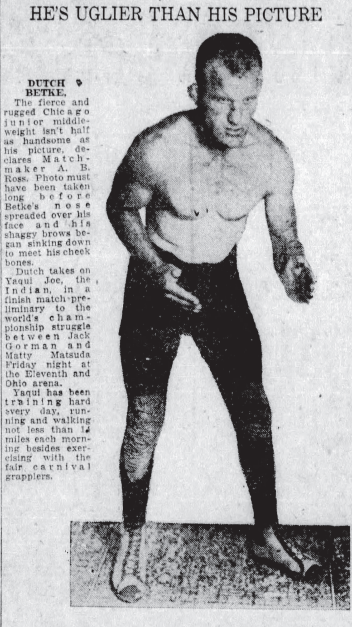
Some newspapermen, including Borger Daily Herald editor and columnist Victor Wagner, call him the “Ape Man of the Panhandle.” This moniker speaks to his physical strength, but also to his notoriously battered face. Last year a newspaper in Wichita Falls ran a large photo of him in his wrestling shorts under the headline: “He’s uglier than his picture.” If that wasn’t bad enough, the newspaper explained that the “photo must have been taken before Betke’s nose spreaded over his face and his shaggy brown brows began sinking down to meet his cheekbones.”
This is an exaggeration, especially the eyebrows. But even an unbiased observer would have to admit his face is challenging to the eye, with a flat, square chin and full jawline. His brown hair bends in a severe widow’s peak, making his shovel-shaped face seem even longer.
Bobby McCulloch, his promoter and fellow wrestler, finds that his crude looks are a marketing tool. People will appear to watch a character in the ring, and nothing gets that across like a catchy nickname. McCulloch is using the fearsome ring persona to entice worthy challengers from across Hutchinson County—and hopefully, cities beyond.
Professional wrestling in the 1920s is as big as boxing, but it’s at a turning point between sport and entertainment spectacle. It’s always been both, but in the early 1920s the scales began to tip toward the showmen with the rise of a troupe called the Gold Dust Trio. After one of their number, Wayne Munn, won the championship, they fell to rigging matches between designated heroes (babyfaces) and villains (heels). But forces of wrestling legitimacy struck back in a 1925 bout between Munn and Ed “Strangler” Lewis, when an actual grappler defeated the premier Gold Dust champ.
On the spectrum of legitimacy, Betke is aligned with the actual sportsmen. Having said that, he‘s not above stoking interest with over-the-top newspaper interviews, canned public challenges, and contrived rivalries.
The problem is that legit wrestling can be very boring. Matches can last for hours with little to see but two men writhing on the ground. For any sort of legitimate wrestling to thrive in a 1927 market with boxing, movies, and dance halls, promoters offer a peppier kind of bout. These are limited to three “throws,” counted anytime a wrestler is tossed to the ground or pinned there. Painful holds are adopted to end matches with quick surrenders.
Betke ducks off Main Street, heading west. The streets away from the central drag are dark without the headlights and glow from powered establishments.
Each alley between the buildings, shacks, and tents hosts a unique stink. “A walk through the alleys of Borger is a liberal education in the way things ought not to be,” the Borger Daily Herald opines in a March column. “Surface toilets, mere shacks set on top of the ground without any pits under them, are overflowing into miniature swamps of poison. Garbage is dumped into them, which makes the condition worse . . . If Borger does not clean up, it will die.”
As he walks west, the din of the crowds eases and he can better hear the hiss and bump of the nearby twenty-four-hour oil operations. In Borger, the oil infrastructure and residential homes evolved side by side. Rows of shacks and tents are interrupted by wooden derricks and the occasional steel rig. An oil derrick sits just four blocks from his home on Coble Street.
Nine years ago, Dutch Betke was living in Tulsa and working as a rig builder, a skill he learned while wandering the Panhandle states after he disembarked in Texas. In Tulsa he met Esther Scotty Walker, from Arkansas, and the pair married there on April 24, 1919. The pair bounced around to follow the demand for labor, including a long stint in Okmulgee, Oklahoma.
By then, Betke was putting his strength to the test at carnivals, where “catch as catch can” wrestling bouts were drawing crowds to the tents. As he learned, he took his lumps. Wrestling with amateurs, in matches that can quickly become brawls, spoiled his face and fattened his ears. Professional wrestling quickly became his passion: He loved the attention, the sense of purpose, the dedication to training, and the extra money.
Betke got good enough to solicit road matches. On October 4, 1921, “Sailor Betke” entered the ring in Okmulgee. Although he was virtually a local, he was billed as “an invader” coming into town after bouts in big cities like St. Louis and Chicago.
Betke was a good wrestler and he knew it, but it didn’t pay the bills. This became more important in 1922 when Esther gave birth to Joan Betke. By 1924 the trio was living in Tulsa, and he listed his profession in city directories as a “broker.” Tulsa was booming and brokers of all levels of competency bought and sold oil leases; Betke’s experience in the oil fields should have given him an edge, but the job proved unfruitful “and frustrating. There was only so far he could go with his brawler’s looks and high school education.
Betke’s family life got rocky. Legal notices appeared in Tulsa newspapers in October 1924 announcing Esther was divorcing him for abandonment. It took nearly a month before he came home, but whatever peace he made, it didn’t involve quitting wrestling on the road. Some of his matches earned newspaper ink. In 1925 “Dutch Betke from Tulsa” lost a match in El Dorado, Kansas, and newspapers reported he lost another in Springfield, Missouri, by succumbing to a vicious toehold.
This is when Esther issued an ultimatum. She had enough of his chasing inconsistent oil work and wrestling bouts; she demanded the family settle down. They agreed they needed a place to make a new start away from Tulsa, but they had little money to put down.
Then came news of a new town in Texas called Borger.
The Betke family arrived at the very start of the land purchases in early March 1926, but even then hundreds of people were milling around haggling land deals. There was no auction; the frenzy of sales and resales were done individually. Most arrivals were interested in the coveted spots on Borger’s Main Street and designated business districts, which were to one day soon have sewers. (They’re still waiting—in 1927 outhouses are everywhere, identifiable by sight and smell.)
It was easy for the Betke family to secure a small plot away from the action. Early sections could go for $25, but that price soon shot up to more than $1,000 within days as the town swelled to more than 10,000 residents. But by then, the Betkes had pitched a tent on their own patch on Coble Street.
Dutch Betke envisioned a grim life here building rigs in the oil fields, but the sudden rise of a bona fide boomtown brought entertainment venues. Now he can wrestle in his hometown, splitting the difference” between his love of the sport and his wife’s demand to stay rooted and employed.
When he met “Scotch” Bobby, his future as a wrestler here immediately improved. McCulloch’s a World War I veteran, divorced and remarried with a three-year-old named Hilda. He also has a gift for public relations, and quickly became the best-known boxing and wrestling manager in Borger, next to Eddie Beall, the barber and (by some measures) a wrestling featherweight champion. McCulloch also gets into the ring, wrestling as a lightweight. In Dutch Betke he found a junior middleweight who can hold his own against all comers.
For all their local popularity, there’s something that all Borger wrestlers want: out-of-town challengers. These will bring in the crowds and solidify their reputations, maybe enough so to become a draw in larger cities. Quality challengers also please Claude Marshall, the local fight promoter, who splits his attention between wrestling and boxing.
McCulloch also arranges for the occasional out-of-town bouts. In October 1926 Betke traveled to Wichita Falls to face Yaqui Joe the Indian. This was the ring name of José Francisco Carlos Close, born in Chihuahua. He was a 201-pound, 5-foot- 8-inch talent on the rise, being trained by welterweight champion Matty Matsuda, called the “El Paso Jap” or sometimes “The Wonder Jap.” The Borger Daily Herald regarded Matsuda as “one of the most famous wrestlers in the southwest.”
Yaqui Joe was well respected for his calm disposition and use of minimal violence, while Betke was being touted as a “mean boy” in a fight preview in the Wichita Falls’ Times Record News: “Betke is said to be a rough and ready person, the type who tries to win regardless of what methods he may find it necessary to resort to . . . If so, Betke will never gain the popularity with Wichita Falls fans. On the other hand, though disliked he probably will provoke a great drawing card. They flock out to see the rough customers in action with hopes of seeing them catch a licking.”
Betke may have filled the role of designated villain—the classic “heel” of scripted matches—but the bout was real. Yaqui Joe proved to be as wily and well groomed as advertised and beat Dutch in a two-throw undercard match.
Vanquished on the road, Betke remains undefeated in Borger. That makes him the man to challenge in the eyes of emerging local talent and, hopefully, visiting championship contenders and even title holders. It will be up to Scotch Bobby and Claude Marshall to drum up interest; all Dutch Betke has to do is prepare for whoever steps forward. In that, his career now is not so different from his nights in carnival tents waiting for a chance to toss around cowboys and roughnecks.
Seeing his home at 429 Coble Street brings Betke a surge of pride. It’s grown from a tent to a permanent frame house in a matter of months. Some hire local lumber companies to build a shack in a day, but Betke went more slowly and, using his skills as a rig builder, homebuilt it with care. It’s been created chiefly from the proceeds of personal combat, making Dutch Betke a warlord admiring his castle. That is, until he opens the front door. Then he’ll have to tell Esther that there’s no paying bout scheduled for him next week.
Betke is poised to enter when the air around him seems to tremble. The sensation is replaced by a giant roar, the concussion of a blast so forceful that Betke can feel it rumbling his internal organs. As the wave recedes, hail patters into the street and bounces off rooftops. A falling object caroms off a nearby parked car, and Betke realizes the sky is dropping fractured rocks onto Borger.
It can only mean one thing—something nearby has exploded. In the aftermath he can hear everywhere the sound of broken, tinkling glass.
Boomtown copyright © 2026 by Joe Pappalardo. All rights reserved.
