In A Biography of a Mountain, Matthew Davis shares a comprehensive narrative history of Mt. Rushmore, written in light of recent political controversies, and a timely retrospective for the monument’s 100th anniversary in 2025. Read on for a featured excerpt.
Prologue
Chaos
Two nights before my second son was born, UH-72 Lakota helicopters buzzed above my house in northeast Washington, DC. These helicopters are named after the Lakota Nation and are deployed for national emergencies. They were one element used by the DC Army National Guard following the dispersal of peaceful protestors—demanding justice for George Floyd’s murder—outside the White House. The afternoon of June 3, 2020, when my wife went into labor, we saw the others. Alcohol, Tobacco, and Firearms police guarded roadblocks at Pennsylvania Avenue, our most direct route to the hospital. Tanks lingered on Constitution Avenue where tour buses usually idled. And young men in National Guard uniforms slung assault rifles under the cherry trees across the National Mall.
In the turmoil of my wife’s third trimester of pregnancy, as the world shut down because of Covid-19, we had girded ourselves for an uncertain delivery. But we had not factored in the helicopters and tanks.
The month following Henry’s birth, we had largely taken refuge in our home. My wife, Laurel, was recovering from delivery, and Henry wasn’t going anywhere. I mostly entertained Aiden, our two-year-old, with long drives into bucolic Virginia where he could run around in open space. On July 3, though, we took a cautious family walk to a nearby park and then dined on meatball sandwiches a friend had dropped off. Before his bedtime, Aiden built Magna-Tile towers and plucked flowers from our small backyard, where Laurel and I sat that evening when the kids were asleep. The pop and smoke of store-bought firecrackers mingled with the heat and humidity to create an almost physical film, our beer bottles beaded with sweat. Sluggish from the heat, the sleeplessness of caring for a newborn, and the nonstop parenting of an energetic toddler, this quiet moment with my wife, infrequent as they had become, was its own minor gift. In the cocoon of our backyard and growing family, we paid little attention to what was happening across the country, in the Black Hills of South Dakota, where President Trump was speaking at Mount Rushmore and protests were being organized to greet him.
The early summer had felt chaotic and existential, not solely because of the pandemic or the protests. Through debates over American history and how to memorialize it, deep fissures in national identity were exposed, revealing a country unable—and in some quarters unwilling—to confront the darkness of our national past. So that night, providing his answer to those debates, President Trump gave a speech with a singular vision of American history, its narratives, and its role in our democracy. He had chosen Mount Rushmore as the setting, and when I read about the event, his speech’s tenor and tone, I wondered what it was about the four granite faces that reflected his version of American history.
For most of my professional life, I had spent time living in, writing about,and working with countries and cultures different from my own. Mongolian. Syrian. Deaf American. When I founded an international literary organization in 2016, my attention often turned to writers across the world and the issues their prose and poetry explored. I wasn’t uninterested in American history, politics, or culture, but I preferred gazing abroad instead of within.
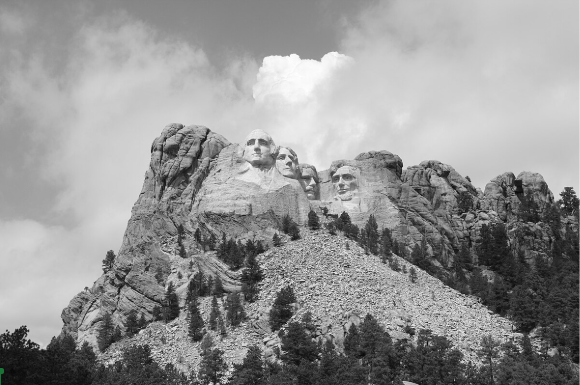
The summer of 2020 altered my focus, and Trump’s visit to Mount Rushmore captivated me. I did some cursory research: how Rushmore’s place in the Black Hills of South Dakota has served as a point of pain for generations of Native Americans, especially those belonging to the Oceti Sakowin and the Lakota Nation; how its sculptor, Gutzon Borglum, was a famed though flawed artist with controversial politics and a combative personality; how Rushmore’s construction was a publicly funded feat of engineering and endurance.
I would learn more in the coming years—rustle through archives and books; spend time in South Dakota and the Greater Plains; and, most importantly, hear the stories of women and men who have influenced Rushmore’s evolving meaning today: an Oglala and Sicangu Lakota woman who leads an effort to remember the children who died in the Rapid City Indian Boarding School; the president of the Mount Rushmore Society whose family’s roots in the Black Hills originate before Dakota statehood; the first Native American superintendent of Mount Rushmore; and the Oglala Lakota leader of an organization who champions the Land Back movement. Men and women who, that July 3 evening, as I sat on the patio with Laurel, were congregating in different ways in the Black Hills, an evening that would forever change their lives and that of the memorial.
The mile-high shelf of Harney Peak granite, which was forged billions of years ago miles below the earth, and which now stands as our most visible piece of Americana, deserves to have its story told in full. This book is that attempt.
During the time spent with this project, I have kept firmly centered the images of my two sons. Their arrival spurred my interest in this topic. Every American generation faces unique challenges, but the American children of this pandemic era have been born into a fast-moving narrative whose current stakes are the future of our democracy. This book has given me the opportunity to think about what it means to be American at the quarter point of the twenty-first century, poised on the cusp of our 250th anniversary. To think about our past, how we represent that past in memorials, and to consider the United States we are developing for our children.
To echo Emerson, if all history is biography, then what can we learn about our country from a biography of a mountain?
A Biography of a Mountain Copyright © 2025 by Matthew Davis. All rights reserved.