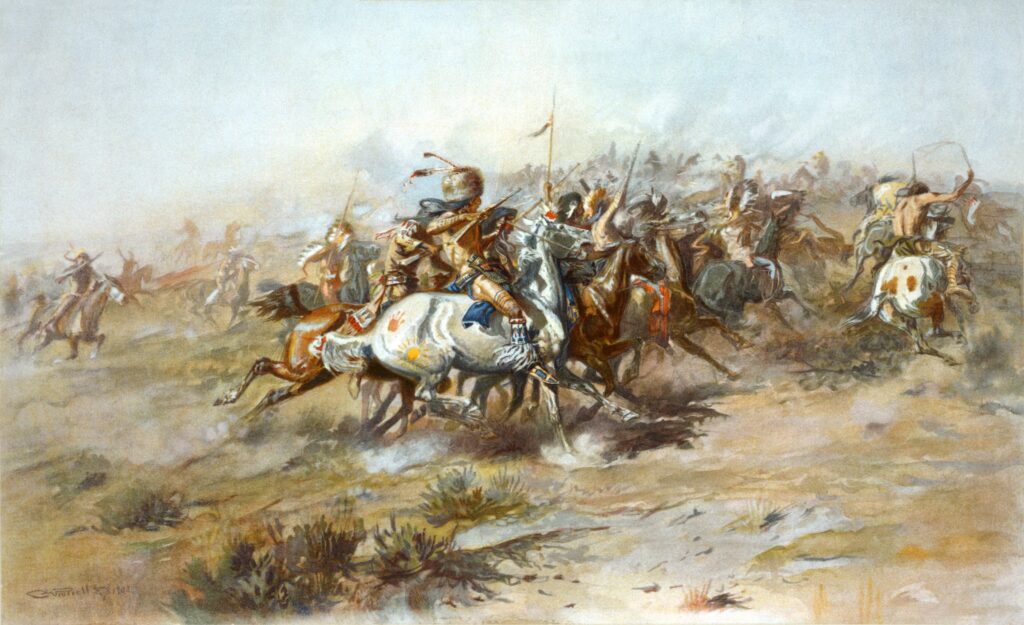
Just in time for the 150th anniversary of the Battle of the Little Bighorn, New York Times bestselling author Tom Clavin takes a dramatic, new look at Custer’s Last Stand, which was fought on June 25-27, 1876, between combined forces of the Lakota Sioux, Northern Cheyenne, and Arapaho tribes and the 7th Cavalry Regiment of the United States Army. Read on (or scroll down to listen) for a featured excerpt of this thrilling read filled with action, legendary characters, and poignance for the impact this battle had on Native Americans and the shape of the American West.Lithograph showing the Battle of Little Bighorn, from the Native American side. Public domain. Courtesy of Wikimedia Commons.
1: The Sioux Ascend
As was true for many of the violent engagements involving whites and Natives in America since the sixteenth century, to some soldiers the Washita River attack in 1868 was an act of vengeance. It was time to pay the Plains Indians back for the Fetterman Massacre in Wyoming two years earlier. It was of little consequence that the revenge was exacted in Oklahoma and the victims were Cheyenne instead of the Sioux led by Red Cloud and Crazy Horse who had annihilated Captain William Fetterman’s eighty-one-man command. An Indian was an Indian, and any diminishing of their population meant more land and riches for the wasichu.
Before the invasion of the American West by white people of mostly European descent, Indigenous tribes invaded one another’s lands, gaining and ceding territory over decades. The Sioux were more wide-ranging and aggressive than most.
In the sixteenth century, the Sioux migrated up the Mississippi River Valley to the river’s headwaters in the forests of northern Minnesota. Their warring abilities enabled them to carve out a wide swath of territory and keep at bay competitors for hunting grounds.
But the Sioux sovereignty did not last. European ships entering Hudson Bay carried crates of guns, powder, and ball that traders happily exchanged for hides and pelts provided by members of the Cree tribe. The stunning leap in death-dealing arms took the power away from the Sioux. They went into exile, melting into the forests and swampy wastelands, where they could only grub for acorns, roots, and edible plants. Once-proud warriors did more hiding than hunting.
According to Stephen Ambrose in Crazy Horse and Custer: “The gun gave eastern tribes great advantages over their western neighbors—its noise had a psychological effect; the bullet had more hitting power than the arrow; the range was greater. With the gun the eastern tribes drove their enemies westward. As the white fur traders penetrated farther into the interior of the continent the process was repeated. Most of the famous Plains tribes were pushed out onto the prairie by military defeats, the Crow, Arapaho, Blackfeet, and Cheyenne among them. The last major tribe to arrive on the plains was the Sioux, trekking out of the woods of Minnesota.”
The Sioux did not cross the Missouri River until the summer of 1776. This was a sort of independence time for them too as they migrated to the Great Plains. They found that the horse was there in abundant numbers, and fortuitously, the vast region of the plains, teeming with buffalo, was ripe for conquest. The Mandan and Arikara had been decimated by epidemics of smallpox. The Sioux tribes—Blackfeet, Brule, Hunkpapa, Miniconjou, Sans Arc, Two Kettle, and Oglala—acted more or less in concert, while the Crow, Cheyenne, Pawnee, and other tribes could not or would not combine their forces for defensive purposes. By 1800, the Sioux had acquired more than enough horses to take control of a vast region stretching from the Missouri River on the east and north to the Black Hills on the west and the Platte River on the south.
And what a beautiful and dangerous region it was. “The Great Plains, on a cloudless day, stretch out forever under an infinity of bright blue sky,” writes Ambrose.
TOM CLAVIN is a #1 New York Times bestselling author and has worked as a newspaper editor, magazine writer, TV and radio commentator, and a reporter for The New York Times. He has received awards from the Society of Professional Journalists, Marine Corps Heritage Foundation, and National Newspaper Association. His books include the bestselling Frontier Lawmen trilogy—Wild Bill, Dodge City, and Tombstone—and Blood and Treasure, The Last Hill, and Throne of Grace with Bob Drury. He lives in Sag Harbor, NY.