A glance at Dame Laura Knight’s Nuremberg Trial painting might lead an observer to believe that only men filled Courtroom 600, which is far from the truth. In The Nuremberg Women, bestselling author Natalie Livingstone introduces readers to eight women who were pivotal in the trial’s outcome. Read on for a featured introductory excerpt of this fascinating read which restores these women to their proper place in history.
Introduction
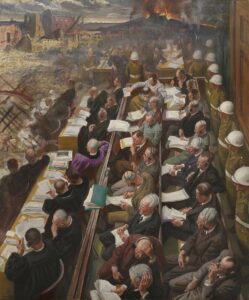
In the solemn galleries of London’s Imperial War Museum there is a simply framed six-foot oil painting depicting the dock of Courtroom 600 in Nuremberg’s Palace of Justice. It portrays twenty of the twenty-one Nazi leaders who appeared there between 20 November 1945 and 1 October 1946 to face charges of crimes against peace, war crimes, crimes against humanity, and conspiracy to commit these crimes.
The defendants do not look like killers but weary bureaucrats. Their aging heads are weighed down by cumbersome headphones, they wear ill-fitting suits, and their shoulders are hunched as they pore over sheaves of papers or stare off into space. One figure in the center foreground clutches his head. The gesture is ambiguous: is he dismayed, racked with guilt or shame, or simply exhausted and defeated? Two rows of lawyers in black robes sit just in front of the defendants. They too bow their heads, to study their papers, and frown as they listen to the evidence being translated and relayed through their headphones. Behind the prisoners stands a line of white-helmeted guards in smart green uniforms. They look young and upright, morally and physically, by comparison with the slumped ranks of officials and defendants.
The true power of the painting lies farther into its background. The far wall of the courtroom has been obliterated to show fire and ruin, heaps of bodies, starvation, grief, and despair the catastrophe wrought by the men in the dock. Smoke rises over twisted metal and the rubble of bombed-out houses. On the horizon, the war is still blazing. And just in front of the unseeing men, on the defense’s benches, are piled naked corpses: their victims. On the very front bench, a thin white arm (corpse or survivor, we cannot know) slips into the courtroom.
This painting was commissioned to capture an unprecedented moment: the first time in history that former leaders of a regime would be held to account in an international tribunal. Its mood is desolate and yet curiously mundane. It depicts a working court, but this is no ordinary workplace. It shows a reckoning with years of systemic horror, a procedural effort to ascertain whether justice can find the words to describe evil and the mechanism to punish it. Because there is evil in the room. You can see it in the stricken expressions of the lawyers, in the flat gazes of the accused. It hangs in the air along with sour sweat and anxiety.
I have seen reproductions of this painting so many times that the image is seared on my mind. This is the Nuremberg I have come to know: a courtroom crammed with lawyers, Nazis, and military. This Nuremberg features a roll call of famous and infamous men. There is the American chief prosecutor Robert Jackson, whose opening speech was broadcast all over the world; the principal defendant Hermann Göring, whose mendacious charisma observers found endlessly compelling; there are celebrity writer-reporters like John Dos Passos and groundbreaking legal theorists like Hersch Lauterpacht. But the more familiar I became with the image, the more I found it impossible to see beyond a glaring absence.
There is not a single woman in the picture.
Not in the dock, nor in the row of military personnel behind it; not on the benches full of lawyers, nor the crowded tables that linger hazily in front of the disappearing back wall. The painting presents the story of a modern Armageddon conducted by men, fought by men, inflicted on men, prosecuted by men, and, ultimately, judged by men. It’s a picture of the bloodiest catastrophe in human history with half of humanity painted out.
The Second World War, more so than any other war before it, was also fought, suffered, endured, chronicled, and, as I hope this book will show, ultimately witnessed and prosecuted by women. Roughly 350,000 women served with the US armed forces in the Second World War, and about one in five of the French Resistance were women; 640,000 women served in the British armed forces as part of organizations such as the Women’s Royal Naval Service, the Women’s Auxiliary Air Force, and the Auxiliary Territorial Service. Journalists who were women made their way to the front lines in the course of the conflict, demanding the right to report from wherever men did. And growing up as the granddaughter of Holocaust survivors, I was intensely aware that the crimes the Nuremberg war trials prosecuted were as painfully relevant to women’s history as men’s. The numbers barely tell the story of female victims of the Holocaust: 2 million of the 6 million who were murdered were women; there were camps, like Ravensbrück, where only women were murdered. Within the Third Reich, at least 35,000 women were trafficked and raped via a network of 500 brothels, while the number of women raped in the occupied Soviet Union alone may have been as high as 10 million. And yet, when it came to the Nuremberg trials, the moment of accountability for these barbarous crimes, I was met by the same male cast. Countless books, films, and documentaries told the story of Nuremberg. I never asked why there were no women among their number.
Confronted by the painting, I looked again. In what would later feel like an uncanny foreshadowing of everything I learned while writing this book, I had to lean in and look carefully in order to see the signature at all. The painting was the work of Laura Knight, a British woman. She had painted the scene from life.
Laura Knight was sixty-eight when she arrived in Nuremberg. A highly successful painter sent there by the War Artists Advisory Committee to record what was happening in the courtroom, she arrived feeling awestruck by the magnitude of the task. As well as capturing the scene in oils, she meticulously documented her experience in a diary. Stored in her archive in Nottingham and composed in blue ink on loose sheets of paper, it recounts her personal experience at the trial in vivid and gripping detail. It set me on a path to find the other women who, like her, had been left out of the picture.
I found the reporters first. Many of the writers and journalists who came from across the world to cover the trials were housed in a castle belonging to the Faber-Castell family on an estate in Stein, just a few miles southwest of Nuremberg. In a neat accident of history, those professionally tasked with writing the story of the Nuremberg trials were housed on the estate of a family who had become rich by manufacturing pencils. The men were accommodated in the castle, the women in an old dower house known as the Faber-Castell villa, where they shared a single derelict bathroom plumbed with a urinal. They drank each other’s vodka, edited each other’s copy, and debated the biggest issues of the day, including justice, gender, and the postwar order. If journalism is the first draft of history, then the first draft of the history of the Second World War and the Holocaust was written at the Faber-Castell estate, and plenty of it by women.
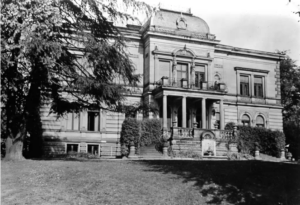
Some of these journalists were household names-Erika Mann, Rebecca West, and Martha Gellhorn all stayed at the villa. Others were lesser known. As I began to explore their writings, I realized that many had observed the way in which the trial was built for men, by men. Rebecca West’s articles from the trial include the refrain “a man’s world, a man’s world.” Arriving in Nuremberg, the Argentine writer Victoria Ocampo noticed that the courtroom, like the warring elites it had sprung from, was overwhelmingly male. “Everything in the [court]room proves to me that this is a matter for men alone,” she wrote in a section of a Nuremberg article entitled “Among Men Alone.” The trial reminded her of the Dakota airplane in which she had been brought to the city: “This tribunal, that plane, did not foresee the presence of women.” This was not just an observation but grounds for protest. How was it that women, who had borne so many of the burdens of the war, could be so briskly and summarily excluded from attempts to reckon with its horrors? Certainly “the Hitlerian plot has been a matter for men,” and there were “no women among the accused.” But was this “a reason to exclude them from the judges’ benches?” She continued:
Should it not be, rather, a reason for them to be there? If the outcomes of the trial at Nuremberg are going to weigh on the fate of Europe, would it not be equitable for women to have a say in it? Have they been spared from the war? Have they shown themselves to be unworthy comrades in the moments of danger? Until now the failure of men to prevent war crimes and war-which is always a crime-has been resounding. Asking women what they think about these matters, allowing them to participate in them, does not amount to any danger and can offer unexpected benefits.
While I agreed wholeheartedly with what Ocampo had written, I could not help noticing the paradox in it. Ocampo had depicted a scene totally devoid of women. And yet her own presence behind the text, like Knight’s on the other side of the canvas, was a clue that while the trial had doubtless been built for men and by men, women were not totally absent. There was a painter, and several writers. What other women had been there in Nuremberg, secretly forging and shaping what appeared at first glance to be “a man’s world, a man’s world”?
As I searched, many more women began to emerge from the shadows. There were women in the back rooms of the courthouse preparing legal briefs and writing translations of documents, and in the booth where witness testimonies were translated live for the courtroom audience. Out of over 100 witnesses who took to the stand in the courtroom, only four were women, but the testimonies they gave were transformative to the trial and had the impact of tens of statements given by men. At the main International Military Tribunal (IMT, 1945-6) there were no women among the defendants and no female lawyers had presented cases to the court, yet during the three years of cases that followed, known as the Nuremberg Military Tribunals or Subsequent Nuremberg Trials (I946-9), there were both female counsels and women in the dock.
At Nuremberg there was a whole world of women playing every role except that of judge. The standard historical picture of the trial-the one I had found represented in contemporary news reports, paintings, and photographs, as well as in many fictional and historical representations since was wildly wrong. In overlooking the women who were there, the established account has omitted one of the most important and compelling aspects of the Nuremberg story, and erased experiences and sight lines and opinions that can help us see the trial very differently.
This book tells the story of eight women whose lives intersected in Nuremberg, at a pivotal moment in history. Each will accompany us through a phase of the IMT, which will unfold chronologically, beginning with frantic preparations for the opening in November 1945 and ending with the verdicts in the autumn of 1946.
I begin with Harriet Zetterberg, a brilliant lawyer who was one of the most consequential brains on the American prosecution team. Though she assembled the file that led to the conviction of a notorious indicted Nazi, as a woman she was barred from speaking in court: in fact I found Harriet in a literal footnote, in assistant trial prosecutor Telford Taylor’s memoirs. As a woman in an overwhelmingly male legal team, Harriet had to fight not only for her position at the trial but also for recognition of what she achieved while occupying it. Even after offering a stunning proof of her abilities in the prosecution of Hans Frank, the Nazi governor of Poland, she would find herself exposed to forms of gendered prejudice that would eventually spill over from the trial into her life back in America.
Even before arriving in Nuremberg, the German journalist Erika Mann, daughter of Nobel Prize-winning writer Thomas Mann, had lived an extraordinary life. She had raced cars, staged cabarets, written several books, struck a marriage of convenience with the English poet W. H. Auden, and taken a string of glamorous lovers, including a photographer, a dancer, and a charismatic actress. Throughout the 1930s Erika had been a scabrous polemicist, warning of the Nazi threat. When war broke out, she became an unrelenting political activist in exile. She came to Nuremberg full of anger at her fellow Germans, and desperate to find some hope for the future buried beneath the legal process of Courtroom 600.
Hungarian Countess Ingeborg Kálnoky kept her three children alive as refugees while the war was raging and gave birth to her fourth child in Nuremberg. Highly cultured and multilingual, she was informed by the American authorities just one day after giving birth that she had been chosen to run a house accommodating trial witnesses. Because the Nuremberg prosecutions were highly selective, many of those brought to the city as witnesses were themselves Nazis who would later be prosecuted in other trials: in her “witness house,” Ingeborg therefore hosted some of the most notorious perpetrators of the Holocaust alongside survivors who were now called to testify to the horrors they had experienced. Ingeborg found herself caught between the need to maintain her reputation as a hostess and to be honest with herself about the guilt of the men she hosted. It was a tension that generated multiple crises during her year in Nuremberg, and one that she would continue to reflect on for the rest of her life.
For all the overwhelming preponderance of male voices in Courtroom 600, the statement that most eloquently expressed the scale of Nazi crimes belonged to a French female witness: Marie-Claude Vaillant-Couturier. Before the war, she looked set for a dashing life as a photojournalist. With the outbreak of war, she joined the French Resistance, countering Nazi propaganda and transporting weaponry. She was arrested in 1942 and transported to Auschwitz the following year. At the trial in Nuremberg, she described that experience indelibly, explaining the gas chambers, the deaths she witnessed due to starvation and cold, the brutality of the infirmary, the systematic cruelty to women, and, leaving no one with any room for doubt, the calculated, methodical determination of the Nazis to exterminate Jews.
In January 1946 Tatiana Stupnikova was just twenty-two years old. As an interpreter for the Soviet team of lawyers, her voice at the trial was an echo, translating the words of others in real time. Her recruitment into the Soviet team, her journey to the courtroom, and the delicate task of balancing Moscow’s agenda with the requirement to convey the evidence before the court all offer a distinct and different lens on Nuremberg. If I had initially thought she was simply a cipher for the speeches and statements of others, I reconsidered my opinion when I came across Tatiana’s haunting autobiographical account of Nuremberg, Nothing but the Truth, which was published almost half a century after her time at the trial. Tatiana also had perhaps the most romantic love story of any of the women of Nuremberg.
If Erika Mann wrote from the victors’ perspective, then the German journalist Ursula von Kardorff was her dark mirror image, trying to make sense of the trial from the perspective of a defeated nation. The daughter of an eminent Prussian family, Ursula had opted to stay in Hitler’s Germany through the war. In her diaries she reassured herself that she had cultivated wartime links with anti-Nazi figures in the German establishment. The truth was somewhat more complex: she had spent many years working for a newspaper that was integral to the Nazi propaganda machine. As a German, she experienced Nuremberg as a second-class citizen offered inferior access and support, and left to fend for herself in food and accommodation. In her reporting from the trial, she saw herself as walking a line between two extreme ideologies: that of the Nazis and that of the occupying Allies. To most, she merely looked uncomfortably sympathetic to those in the dock, and at one point this led to her banishment from the courtroom. “Nowhere is it so painful to be German as it is in Nuremberg,” she wrote.
Four years before reporting on the IMT for the New Yorker, Rebecca West published Black Lamb and Gray Falcon, a monumental account of Yugoslavian history, politics, place, and people that many now consider to be not only one of the twentieth century’s greatest pieces of travel writing but one of its greatest literary works in any form. By the time she arrived in Nuremberg, West was fifty-three and had spent the wartime years in relative seclusion: to come to the city on such an assignment felt like returning to life. Nuremberg would prompt some of Rebecca West’s finest work, cementing her reputation. In 1947 Time magazine called her “indisputably the world’s number one woman writer and the following year President Harry Truman presented her with the Women’s Press Club Award for Journalism. In her writing from the trial she forged the idea of Nuremberg for posterity, focusing on the exhaustion and absurdity of legal life in a courtroom she famously described as a “citadel of boredom.” One American judge, Francis Biddle, appears to have agreed: he wrote her love letters from the bench.
Each of these eight women brought to the trial their own complex history, their own insights and motivations, and each would be changed in different ways by what they saw and experienced in Nuremberg. They represent only a few of the women I would discover to have been present at the IMT, and will be accompanied through this story by an eclectic supporting cast of other Nuremberg women: research analysts, secretaries, artists; German civilians finding ways to eke out a survival in the occupied city; Nazi filmmakers dragged to the trial to pore over incriminating footage; and Nazi wives whose unbridled hubris remained unshaken, even in the face of downfall.
The city of Nuremberg was not just a backdrop for these women’s lives; it was an active participant sometimes an antagonist and sometimes an accomplice, sometimes adored and sometimes detested. Some women found freedom and inspiration among the devastated city while others felt threatened or oppressed by it, and struggled to survive there. Like the women themselves, the city brought to the trial its own complex history. After Hitler’s election as Reich chancellor in 1933, it was selected as the home of Nazi ceremony and propaganda not because it was Nazi-sympathizing but rather because, as a stronghold of social-democratic politics in the middle of Nazi-sympathizing Bavaria, it was an obvious site for Nazi conquest. Mayor Willy Liebel marketed it as the “City of the Nazi Party Rallies” a slogan that soon appeared on postcards. The rally grounds to the southeast of the city center were remodeled and expanded as part of Nazi architect Albert Speer’s plan for a festival complex that would include a 400,000-capacity stadium, a parade ground for military exercises, and a congress hall for 50,000 delegates.
Although the master plan was never completed, the rallies were nevertheless central to the development of Nazi military and political power. In 1934 700,000 members of the party attended. Speer installed an awe-inspiring backdrop of 152 military searchlights with their beams directed into the sky, creating what he termed a “Cathedral of Light.” Displays of power at the rally grounds and within the city government went hand in hand, with Nuremberg becoming a testing ground for antisemitic measures such as boycotts, the destruction of synagogues, and the confiscation of Jewish property. On 15 September 1935 it was announced, after a special meeting of the Reichstag at the rallies, that antisemitism would be enshrined in what became known as the Nuremberg Race Laws. The Reich Citizenship Law defined a citizen as a person who is “of German or related blood,” thereby defining Jews as a separate race and stripping them of full German citizenship; the Law for the Protection of German Blood and German Honor banned anyone “of German or related blood” from marriage or sexual relationships with Jews, defining either of these things as Rassenschande or “race defilement.”
The city and people of Nuremberg were repeatedly forced into submission, first by the Nazis and then by the soon-to-be victorious Allies. Approximately 90 percent of the medieval and Renaissance town center was destroyed by bombing toward the end of the war. When the Allies selected Nuremberg as the site for the trials, the city or what was left of it was again commandeered. Accommodation and basic amenities for participants had to be found, supply chains established. The surviving local population were sidelined as their city became the site of an international legal event of unprecedented significance.
When I visited Nuremberg for the first time more than half a century later, I found that the center of the city had been painstakingly reconstructed, sometimes with original materials that had been saved and salvaged, but mostly through a process of rebuilding that verged on pastiche. Unlike in Dresden also flattened by Allied bombs-Nuremberg rejected a new city plan that would have acknowledged the ruptures inflicted by conflict, and opted instead for historicist restoration, one that allowed the Nazi rally grounds to molder largely untouched while restoring the center to a pristine medievalism. Street-level stonework was carefully repaired with textured cement to make the damage inflicted by war virtually invisible, half concealing the scars. The effect was uncanny. Though at first I noticed it only in minor errors and falsities, it now jumped out at me from every block. On that drizzly day, as I walked up to the Kaiserburg the Imperial Castle I could barely make out the rally grounds beyond the artfully reconstructed skyline of the “old” city’s new gables and church spires.
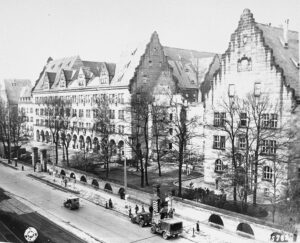
The Palace of Justice, where the trial had taken place, stood somber and still imposing on Fürther Strasse. It is still a working courthouse, and people came and went quite casually. Entering Courtroom 600, I was taken aback by how different it looked from the images with which I had become familiar. After the end of the Subsequent Trials, the room had gone back to normal domestic operations until the end of the century, and had been maintained and renovated accordingly, with new lights and fittings and floors. And yet there were still features I recognized from photos I had seen of the tribunal: the small, almost concealed door from which the defendants emerged to sit in the dock, released from their cells each day; the carved wooden paneling that still lined the large room. The curtains which had been closed during the trial to allow filming to take place under artificial lights—were pushed open, and, even on this overcast day, light flooded in. A simple low table lined the right-hand side where the judges of the four prosecuting nations once sat. The flags had gone, as had the rows of tables where delegations of lawyers and interpreters had sat. Fittingly enough, one thing that had not changed was the decoration pedimented over the main north door: a bronze frieze depicting Eve handing Adam the apple—the founding myth of gender blame.
To see the trial of the major war criminals at Nuremberg from the perspective of the women is to see a very different trial. While many men enjoyed the attention afforded by the courtroom, with its press presence and audiovisual recording, women’s lives played out for the most part behind the scenes. Though that meant their work was more easily effaced, it also meant that they engaged in intimate and sometimes shocking ways with the processes of the trial: evidence gathering, case building, linguistic translation, journalistic representation, and geopolitical wrangling. One recurring criticism of the trials is that they were closed, elite, and unrepresentative— that this was clubbish justice masquerading as popular reckoning. There were, of course, many ways in which the IMT was closed and elite. But the presence of these women—from many different backgrounds, classes, and nationalities—suggests a legal event that grew from a broader base than has been imagined, and which generated more diverse experiences than has previously been recognized. There is no doubt that the Nuremberg trial had many contradictions and flaws. Yet seeing it through the eyes of the women left me in no doubt that in a time of renewed urgency surrounding international law, it remains an event with the power to instruct and inspire.
The Nuremberg Women Copyright © 2026 by Natalie Livingstone. All rights reserved.