
CHAPTER 2: PEARL HARBOR
While America struggled to emerge from the Great Depression, momentous events were unfolding across the globe. Spurred by rising nationalism and a desire for territorial expansion, Japan was perpetrating a brutal war of conquest in China that would ultimately result in the deaths of nearly twenty million people (including 200,000 to 300,000 in the city of Nanjing alone). Wary of further aggression in the region, President Franklin Roosevelt imposed a series of economic sanctions and trade embargoes intended to cripple the Japanese war machine. For a trade-reliant nation that received 90 percent of its oil from the US, this left two options: withdraw from China or go to war with the United States. The answer came without warning on the morning of Sunday, December 7, 1941, when a formation of 183 Japanese planes arrived over the American Pacific Fleet moored at Pearl Harbor, Hawaii. Among the unsuspecting servicemen on duty was a young Marine from Butte, Montana, named Ray Garland. Private Garland was standing on the fantail of the USS Tennessee, preparing to raise the American flag as a member of the color guard, when the first flight descended.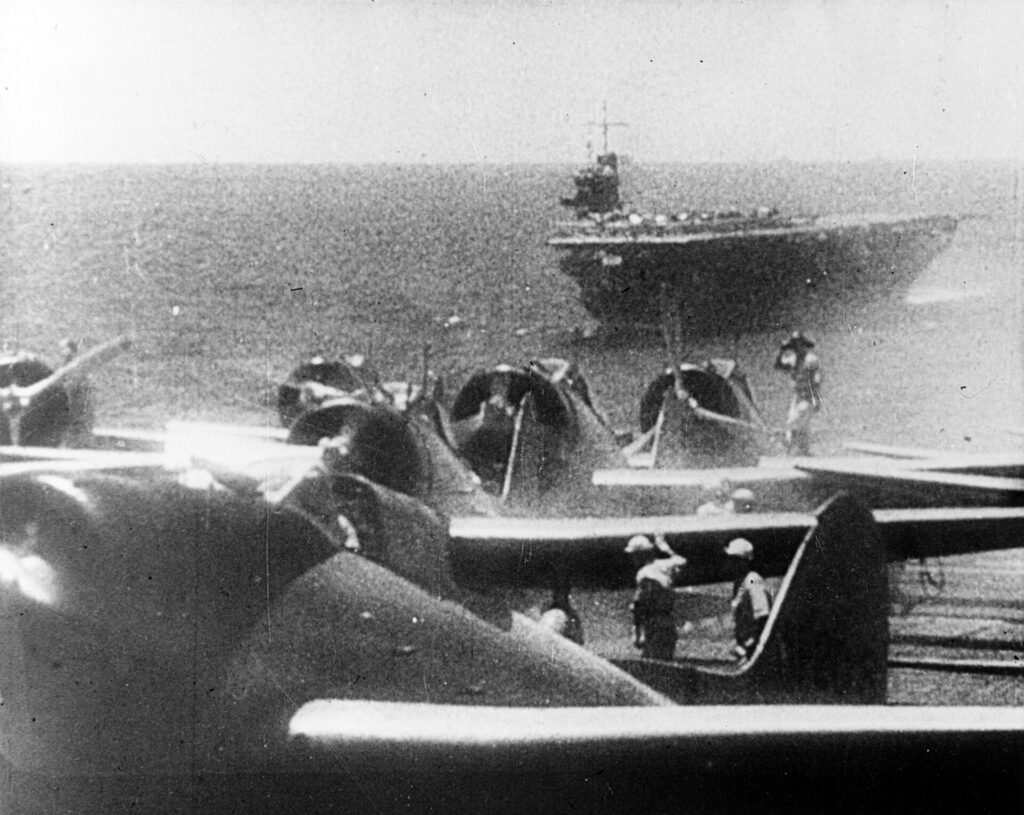
Ray Garland, 96, USS Tennessee: I happened to look over my shoulder and I saw these planes coming down. The corporal in charge said, “Turn around, Private Garland, we’re getting ready to make colors.” About that time, a Japanese Val dive-bomber dropped its bomb on Ford Island and started coming down “Battleship Row.” The rear machine gunner was shooting as he came by. He was close enough that I could see his goggles. I ran to my station, but we couldn’t shoot our five-inch gun because Ford Island was next to us. Then a one-ton bomb hit one of the fourteen-inch guns and killed some sailors there. I went up and—it was a mess. We mopped up pieces of people. It was not good to look at.
After that, I was assigned to a fire hose on the quarterdeck to keep burning oil away from the ship. Someone opened up a hatch and a sailor and I went down the ladder. I glanced over and saw what I thought was a fire. So, I turned the hose on it. But it wasn’t a fire—it was a sparking electrical cord. That’s the last thing I remember. The electricity hit me, and I ended up in sick bay. I couldn’t see for a couple of days. That was the end of Pearl Harbor for me.
At the same time, across the international date line, Japanese forces struck American bases at Guam, Wake Island, and the Philippines. On Guam, a small bastion of Marines and sailors offered several days of paltry resistance before Naval Governor George McMillin surrendered the island. A mixed defense force of Marines and civilians on Wake Island repulsed an invasion on December 11, but eventually surrendered when further opposition became untenable. In the Philippines, American forces mustered a desperate defense but were also crushed by the Japanese juggernaut. Back in the United States, news of the Japanese attacks spread rapidly across the country.Burt Withee, 95: I was up at the Laurelhurst Playfield in Seattle, playing football. The ball went across the street, and I went to retrieve it. Suddenly, a guy stuck his head out the door of his house, and yelled, “The Japs just attacked Pearl Harbor!” I said, “Where in the hell is Pearl Harbor?”
Donald Brown, 95: We didn’t even know where Pearl Harbor was. Never heard of it before.
Howard Rieckers, 100: I was milking cows in a barn in Chewelah, Washington. Dad and I thought the world was coming to an end. We walked out the door and looked up.
Lee Robinson, 97: I’d been out skiing with a friend, and we were on our way home when we heard that the Japanese had bombed Pearl Harbor over the car radio. It was very surprising because I’d grown up in a calm atmosphere with very little fear. I had lived a mellow life. That kind of shook me into reality because I was seventeen at the time.
Donn Thompson, 95: That December, we were all in shock when the Japanese hit Pearl Harbor. We all, as young men, looked at each other and said, “Well, it won’t be long before we’re in it.”
John Marx, 97: I was excited. I don’t know, as a kid, I was excited.
Luther Hendricks, 96: I was in school in Los Angeles when they attacked. I went down the next day, wanted to join up. I was sixteen. The response I got: “We don’t take coloreds in the Marine Corps.” What the hell have I been living here for? This is America. This is my home. But they don’t want me to fight? I went back home and said, “Must be something I could do.” I went to Vallejo to work at Mare Island. I worked there from ’42 until August of ’43. Then I went back when I found out they were taking Negroes in the Marine Corps, and I joined up.
Les Anderson, 97: There were about a dozen Japanese kids in my high school graduation class. The school took the salutatorian and valedictorian titles away from the Japanese kids and gave them to white kids. My Japanese friends from school were all interred in a—I call them concentration camps, at the Puyallup fairgrounds. I was amazed that the kids weren’t terribly upset at our government. They were born here, and they were as American as I was; and they proved that later in the Nisei military groups.
Raymond Lewis, 95: I was in the ninth grade at a high school in Clarksdale, Mississippi, on December 7, 1941. They broke into the auditorium and said that Japan had bombed Pearl Harbor. I was fifteen at the time and that enraged me. I had a homelife that I’m not particularly proud of—my dad was an alcoholic. So, I got my mother and him to sign papers saying I was seventeen, and I joined the Marines.
Harold Rediske, 94: I graduated from school in 1942. Billings, Montana, was our nearest recruiting station, so I went down there to join the service. They told me to go home and grow up. I was fifteen.
Tom Shields, 93: I was only seventeen years old. My mother and dad had to sign for me.
Bob Ehrlich, 94: I wanted to get into the service so bad, but my mother made me finish high school first. Once I was seventeen, I was in.
Robert Brutinel, 100: My mother said, “No way!” She said, “I don’t care how mad you get, I’m not signing!” My dad said, “For God’s sake! Sign that thing! I’m tired of hearing you and him arguing all the time!”
Francis Stanger, 92: I came out of school and worked at a dairy farm in Ronan, Washington, but I got bored. I thought I might as well join up. I was only seventeen. They called me “Chief” because I was the only Native American there.
Milton “Red” Cronk, 98: I could have stayed home on the farm—I had the chance. But I didn’t want to. I wanted to go in with the Marines and do my patriotic duty.
Eldon Cedergreen, 96: Me and my brother were deferred from the draft because we were farm boys. But we saw all our high school buddies going, and that kind of got to us. We asked our folks, “Can we go?” They let us go, so we joined up.
Clayton Narveson, 99: Mother had seven children: six boys and one girl. All six of us went into the service and all six of us served overseas. I went into the Marine Corps in October of 1942.
Melvin Gribble, 95: I was working for the Forest Service when they called me up for the draft. I came out of the forest, went to Spokane, and enlisted in the Marine Corps. I wanted to get over there and fight; didn’t have sense enough to know it was dangerous.
Les Anderson, 97: My brother was in the Army, and he didn’t like it. A good friend of mine was in the Navy, and he didn’t like it. So, I picked the Marine Corps. I figured you had to have a college education to be in the Air Corps.
Elburn Cooper, 95: Like a lot of other kids my age, I received a draft notice while I was still in high school. I was afraid I might not be able to finish school, so I bid a hasty retreat to the center where they enlisted people. I went to the Air Force first: “No, we can’t take you because you don’t have enough math.” Then I went to the Navy: “No, we can’t take you because you don’t have enough math.” Then I went to the Army: “No, we can’t take you because you don’t have enough math.” Then I went to the Marine Corps and—bang! They just wanted cannon fodder, I think.
Wallis “Wally” Hamlin, 100: Nobody seemed to know anything about the Marine Corps, so I said, “I’m going to join that.” And I did. I signed up in Orofino, Idaho.
Jack Becker, 99: I was riding home on a bus and there was a Marine sitting in the back, all decked out in his dress uniform. I thought, Oh fuck, this guy looks good! I want to look like that!
Lee Robinson, 97: If I could blame it on anything, it would be the uniform. I thought that uniform was great.
Elwin Hart, 93: My stepmother was influential because she loved the Marine Corps for some reason; the uniform or whatever it was.
Gordon Black, 94: I don’t know why I joined the Marine Corps. It must have been Tyrone Power or some other actor that played a Marine in the movies. My buddy, who went into the Air Corps, said, “Why’d you pick the Marine Corps?” I said, “I don’t know, must be the uniform.”
Marvin Strombo, 95: I wanted to join the Marine Corps because I saw a movie. When I went into the service, a lot of the other guys had seen the same movie. That’s the reason we went in.
Frank Wright, 96: The scuttlebutt was, if you got in the Marine Corps, you could get duty aboard ship and wear those beautiful dress blues. I was really excited about it. There was a movie out—I can’t remember the name of it—that was a recruiting type of movie. But they wouldn’t take me because I was too young and too light. I only weighed 128 pounds. So, I went over to the Navy. I figured that was close to the Marine Corps. Same thing—I was too light and too young. I figured I could increase my weight quickly, so I bought a lot of food; bananas and stuff like that. I got my mother and her sister to agree to give me a delayed birth certificate. Then I went back to the Marine Corps and got ahold of a different recruiting sergeant. By that time, it was January, and I’d gained enough weight. A few weeks after Pearl Harbor, I was accepted and quit high school.
Lee Robinson, 97: On my way home from Coeur d’Alene, Idaho, I happened to pass down Main Street in Pocatello. There, on a second story window, I saw this fellow in a blue uniform with a white hat. And he yelled, “Semper Fidelis!” I thought he said, “Seventy-five dollars!” So, I went in and signed up to become a Marine.
Jim Palmieri, 103: I did not want to fight Italians in Europe. So, when I was drafted, I picked the Marines. I didn’t like the Navy because I wasn’t too happy with the water.
James Shriver, 98: There was a Civil War veteran in a small hotel up in Portland, Oregon, where my mother was working as a telephone operator. He and I would sit in the lobby of the hotel, and he would tell me stories about the Civil War. One day, he told me, “Why don’t you go into the service!” I said, “My mother won’t let me.” A couple of days later, he talked me into walking across the street to the courthouse, up to the Marine Corps recruit office. I signed up.
John L’Abbe, 97: I tried to sign up with the Free French before Pearl Harbor, when the Germans still had France. But the Japanese bombed Pearl Harbor, so I thought, Hell, I’ll join the Americans. My mom said, “Oh, yes! That’s better!” I ended up enlisting in the Marine Corps. I had to stand in line to get in.
Walter Spuck, 95: I was in the merchant marines for about six months, but I couldn’t take it because I was seasick most of the time. I came out and lived with my two sisters for a while. But that wasn’t working out either, so I tried to get into the Army. The Army said, “Try the Marine Corps, you’re too young.”
Mike Ladich, 96: When I got back from the merchant marines, like an idiot, I joined the Marine Corps. I thought, Enough of that shit, getting torpedoed over there!
Robert Hall, 95: I was so “Gung Ho” that I wanted to join the best fighting outfit that the US had. I’ve never regretted it. I still think they’re better than other service. But we’re all prejudiced, of course.
Chuck Meacham, 96: I understood that the Marine Corps was the best, from what little studying I did. Therefore, I chose the Marine Corps.
Frank King, 100: I was scheduled to go into the Army Air Corps as an Air Cadet. But when I was taking my final exam at March Field, the interviewer asked me about my medical history. “Have you ever had TB, diabetes; anything like that?” I said, “Well, when I was a kid, I had hay fever.” That was the end of the interview—they kicked me out. Oh, I was pissed! The next day, I went down to LA and signed up with the Marine Corps. They gave me a departure date of February 9, 1942. I went home and told my parents. My dad broke into tears; just sobbed. He said, “My God! Do you want to get yourself killed? Do you know what Marines do?”
Robert Evans, 97: I wanted to work at Farragut Naval Training Station, but the guy in charge said I was too young. I said, “Oh no, I’m old enough to work!” I was seventeen. He said, “I can’t hire you. You’re too small.” I said, “Well, the hell with you.” I went and joined the Marine Corps. There were fourteen of us that went in, but only two passed the exams. The other guy—his folks wouldn’t sign for him. But mine would, mine signed for me. They were glad to get rid of me.
Milton “Red” Cronk, 98: When I went into the Marine Corps, my mother told me: “I hope, if the Japs get you, that you can kill yourself before they torture you.”
John L’Abbe, 97: The last thing my father said: “Don’t ever surrender.”
Elburn Cooper, 95: My mom was sad that I was leaving, but everyone else was going. They sent us off to what was called a V-12 program, which was a pathway for future officers. I went to a little college called Gustavus Adolphus in the Minnesota River Valley. I took trigonometry the first term and I passed that fine. But the second term was solid analytical geometry, and I flunked that. I immediately packed my seabag, and I was on my way to boot camp.
Walter O’Malley, 98: I graduated from high school in June, then went up to Dartmouth College for the V-12 program on July 1. We were supposed to be in for sixteen months, four semesters. But after about two months, going into September, this fella from Worcester said, “You know, I’m passing on my books. If we stay here, this war’s going to pass us by.” Guess what we did? We flunked out on purpose. They sent us to Parris Island for Marine Corps basic training. But it was full, so they put us on a train, sent us out to San Diego.
The Last of the Old Breed Copyright © 2026 by Scott Davis. All rights reserved.