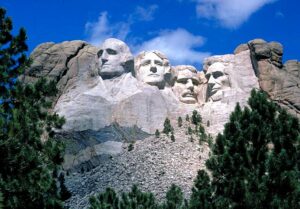
Mount Rushmore has become one of the most influential and important works of political art in the United States, and many assume that the force behind the memorial’s creation was either its controversial sculptor, Gutzon Borglum, or the federal government. However, the original idea of creating monumental art in the Black Hills of South Dakota came from a mild-mannered state historian named Doane Robinson.
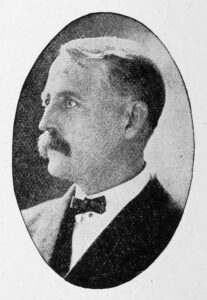
Jonah Leroy Robinson was born in Wisconsin in 1856. His younger sister could not pronounce his name and called him, “Donah,” the name eventually settling at Doane. Robinson was raised and schooled in Minnesota, where he attained a law degree before eventually moving to Watertown, South Dakota, to practice law. Pictures of Robinson at this time show a man who resembles Wyatt Earp—hair combed and parted, a distant stare, sharp jaw, and an impressive moustache with twirled waxed ends.
Though Robinson’s profession was the law, his passion was journalism. He published a magazine in South Dakota from 1898-1904 that featured poetry, history, and artwork, and he wrote the first Western history of the Sioux in 1904. When he became state historian in 1901, his interests grew beyond the literary to include state matters of practical and economic importance. Robinson concerned himself with the design of the state flag, the technology of bridges meant to span the Missouri River, and the new kinds of alfalfa farmers grew on their farms.
In the 1920s, when Robinson was gracefully aging into his older years, he began to concern himself with the state economy.
South Dakota commodities and agricultural markets had boomed during World War I, as European agriculture suffered from the impacts of war. But in the early 1920s, as European fields and markets recovered, the markets of South Dakota and many other Midwestern states cratered. Prices slumped, farms foreclosed, and banks shuttered their doors in a presaging of the national Great Depression that was mere years away.
Doane Robinson was attuned to these changes and challenges, and he began to think of ways to diversify South Dakota’s economy from its reliance on agriculture. On January 22, 1924, during a speech to the Black and Yellow Trail Association—a group affiliated with the Black and Yellow Road that connected the Black Hills to Yellowstone National Park—Doane Robinson publicly proposed South Dakota build sculptures into the Black Hills. He wanted to attract the growing number of regional car tourists, and he thought a sculpture in the Hills would divert travelers willing to spend money in Black Hills communities.
Robinson envisaged a sculpture similar to the Eternal Indian, a large, concrete sculpture along the Rock River in Oregon, Illinois. Chicago artist Laredo Taft, who had literally written the book on American sculpture, had created the Eternal Indian, and Robinson wrote him in 1924 to gauge his interest in creating a sculpture in South Dakota. Robinson suggested sculptures carved into the granite pinnacles of the Black Hills that featured characters associated with the American West—Red Cloud, Custer, Lewis and Clark, Sacagawea.
Taft declined the commission because of poor health, but it is a sliding doors moment for what would become Mount Rushmore. What would the sculpture look like if Robinson’s initial idea had been carried through? If Taft would have taken the commission?
Instead, Robinson turned his attention to another prominent American sculptor, a man who was then carving the Confederate Memorial at Stone Mountain, Georgia, just outside Atlanta. When Robinson telegrammed Gutzon Borglum, the sculptor knew this was an idea and artistic possibility for the ages. He sent an encouraging reply to Robinson and soon planned a trip to the Black Hills.
On that trip, in September 1924, Borglum studied both Robinson’s idea and the landscape of the Black Hills. Together, the two men hiked to the top of the tallest mountain in the Hills, then named Harney Peak, which offered an uninterrupted view of the granite and pine forests. “Here is the place,” Borglum reportedly said, “American history shall march along the skyline.” Borglum had already begun to transform Robinson’s idea into something both more grand and more political. And by the time he left the Black Hills, the sculptor handed the historian an initial sketch, a pencil drawing of George Washington in colonial garb, his hat angled off the front slope of his head.
Doane Robinson didn’t know it at the time, but his place in the Rushmore story was largely complete. He had originated a far-flung artistic idea to improve South Dakota’s struggling economy and hired a force of personality to implement it. Now, that personality was poised to create the most ambitious piece of political art in the United States.