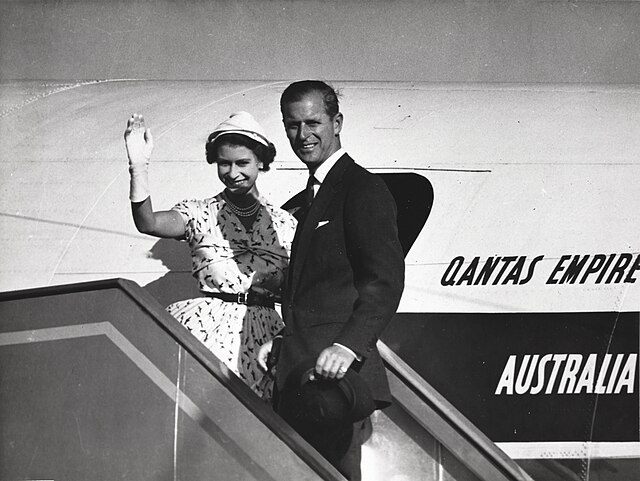
For the woman who became the longest-serving monarch in British history, the circumstances in which Queen Elizabeth II discovered her new destiny were hardly propitious. As Harold Nicolson quipped, “She became Queen while perched in a tree in Africa watching the rhinoceros come down to the pool to drink.” This was an exaggeration, but it was true that when the king died in the early hours of 6 February 1952, the heir to the throne was one of the last members of the immediate circle to know, because of the intrinsic difficulties of contacting her in Kenya. Not only were she, Philip and their entourage staying at the isolated Treetops Hotel in Aberdare National Park, but the mixture of grief and panic that had greeted the news of the king’s death in Britain was only exacerbated by the knowledge that telling his daughter – the new monarch – was a far harder undertaking than it ever should have been.
The news reached Philip’s equerry, Mike Parker, from Martin Charteris, who had heard the tidings from a journalist as a news flash. At quarter to three in the afternoon, Parker informed the prince, who looked “absolutely flattened” at his father-in-law’s death and the realisation of the responsibilities that would now overwhelm both his wife and him; Parker later recalled that “I never felt so sorry for anyone in my life.” Philip then broke the news to Elizabeth, and they walked up and down the garden for a few moments. When they returned, the new queen was composed and calm, and said to the assembled ladies-in-waiting and other staff, “I’m so sorry. It means we’re all going to have to go back home.”
Leaving aside the shock and grief that any young woman would inevitably feel at the sudden death of a parent, the queen now returned to a country she had only left a matter of a few days before, but that had altered existentially. Although she managed to remain businesslike, she summoned Charteris on the return flight and asked simply, “What’s going to happen when we get home?” Had her private secretary been honest, he might have replied, “Your life will change beyond recognition, Your Majesty.” Instead, he simply offered her what comfort he could, as the plane came in to land and she was greeted by the solemn phalanx of Churchill, Attlee, Eden and other political worthies. Philip followed behind her once she was on the ground, as was now expected of him. While her father had lived, these people had meant little more to her personally than they did to most of the country. Now they would become men – exclusively men – she would have to deal with on a daily basis.
The queen’s first official task was to attend the Accession Council, which took place on 8 February. Lascelles had written a speech for her back in September 1951, and it was with the assurance that had typified her previous public utterances that she now spoke. She alluded to her grief, and declared that “at this time of deep sorrow, it is a very great consolation to me to have an assurance of the sympathy which you and all my peoples feel towards me, to my mother, and my sister, and to the other members of my family. He was its revered and beloved head, as he was of the wider family of his subjects; the grief which his loss brings is shared among us all.”
Yet it was her concentration on the idea of duty that would be of greater relevance to her reign. She stated, in an abbreviated version of the prepared text, that “My heart is too full for me to say more to you today than that I shall always work as my father did throughout his reign.” In the original version, she would have gone on to promise “to uphold constitutional government and to further the happiness and prosperity of my peoples everywhere . . . I know that in my determination to follow his shining example of selfless service and tireless devotion, I shall be given strength by the loyalty and affection of those whose Queen I have been called to be, and by the wisdom of their elected Parliaments . . . I pray that God will guide me to discharge worthily this heavy task that has been laid upon me thus early in my life.” Yet it was not the time to do so.
Her speech, which she delivered with considerably more confidence than her father had at the same point in his reign, was a success, and reassured anyone who might have doubted the young woman’s ability to handle the public responsibilities that were concomitant with her new title, even if she did later weep in the car that took her back to St James’s Palace. Yet as her biographer, Ben Pimlott, later wrote, “there was also a peculiarity about the prostration of old gentlemen before a twenty-five-year-old Queen who had no choice but to accept the part she was asked to play.”
Queen Victoria had been just eighteen when she had inherited the throne in 1836, avoiding the need for a regency by a month, but she had been beset by counsellors both welcome and unwelcome from the beginning of her reign, jostling for position and influence. The next queen had no ambitious John Conroy to fear – the Duke of Windsor’s musings on a quasi-regency would have been given short shrift indeed by Philip if they had ever been known – but nor did she have a Lord Melbourne on hand to guide her. Instead, she had the now seventy-seven-year-old Churchill, whom she barely knew and now had to rely on as a guide through the Byzantine paths of political skulduggery. He was not, perhaps, the man she would have chosen in this situation.
Power and Glory copyright 2024 by Alexander Larson. All rights reserved.