Glancing at Dame Laura Knight’s painting of the Nuremberg Trials below, you might assume the historic pursuit of Nazi war criminals was a strictly male affair. However, as author Natalie Livingstone reveals, that depiction is far from the whole truth. Sparked by her personal connection as the granddaughter of Holocaust survivors, in her new book, The Nuremberg Women, Natalie Livingstone reveals the story of eight forgotten women who played vital roles in bringing the Nazis to justice. Read on for a piece from the author about what inspired her new book, which is already an instant Sunday Times bestseller in the UK.
Sitting in the bar at Nuremberg’s Grand Hotel, I tried to imagine what this room had witnessed. It was dark, with low lamplight and polished grey floors. Everything was symmetrical: the square tables placed with geometric precision; the glossy grey bar stools arranged in charmless ranks. But as I looked harder into the detail, some of which had not changed, for a moment I was taken back. Eight decades previously, for almost a year after the end of World War II, this hotel had not welcomed business people visiting for conferences as they do today, but a numerous cast all coming together for one of the world’s most vital reckonings. And many of those I had discovered were women.
I could see famed writer Rebecca West, chin up with an uncompromising gaze; celebrated painter Dame Laura Knight, older but wide-eyed and giddy on the company she was keeping; Erika Mann—daughter of a Nobel-Prize-winning writer—thin, stern and androgynous, standing aloof, watching.
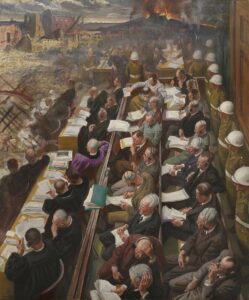
As I grew up, I thought I knew about the Nuremberg Trials. As the granddaughter of Holocaust survivors, this momentous legal undertaking had loomed large. What I had read and seen of the trial had left me believing it was a distinctly male affair. This I came to realise as I researched was wildly wrong. The first woman I discovered was Laura Knight, whose magnificent painting of the dock I knew from its depiction in numerous books, and which shows not only the male Nazi defendants but a sea of men filling the courtroom. Other names I knew, like Rebecca West and Erika Mann, but I did not know the significance of their contributions to Nuremberg’s International Military Tribunal. Many others—not well-known at the time, and less so now—I found pushed to the margins of history.
One such woman was brilliant Yale-educated lawyer Harriet Zetterberg—who I found as a literal footnote in the memoirs of assistant US prosecutor Telford Taylor—and I begin my book with her. Tasked with writing the brief to prosecute the ‘Butcher of Poland,’ Hans Frank, Harriet worked tirelessly, day and night, in terrible conditions, to construct an airtight case that led to his conviction. However, when presented in court, Harriet was forced to hand her work to an American male colleague to read, as to advocate in court then would have necessitated obtaining a waiver of disability: the disability being that she was a woman. When Harriet became pregnant, her brilliant legal brain and painstaking work did not matter, and she was shipped home to return to an unfulfilling suburban life.
Drawing on overlooked archives, letters, diaries, and little-noticed sources, I found women at Nuremberg in almost every capacity: as lawyers like Harriet, and also as linguists, researchers, secretaries, courtroom artists, writers, and witnesses. I was fortunate to meet family members who spoke of their relatives who had been there, and who made them come to life to me, as I pored over material that had been kept by them with pride.
In my book, The Nuremberg Women, I wanted to throw open the backrooms where female lawyers directed the work of female researchers, the bars and hotels where women of every vocation mingled, drank and danced, and the villa where dozens of female journalists shared a single bathroom—plumbed, naturally, with a single urinal.
From this vast and vital cast, eight remarkable women emerge. Alongside Harriet Zetterberg, I chose others through whom I now view the trial more clearly, and I think more accurately. Erika Mann, the anti-fascist daughter of Germany’s most famous novelist, arrived as a journalist, burning with fury at the ‘alien homeland’ she had fled in the 1930s. Hungarian Countess Ingeborg Kálnoky presided over a guest house where victims and perpetrators of Nazism, summoned as witnesses, slept in adjacent bedrooms and dined in the same room. Marie-Claude Vaillant-Couturier, a fearless French resistance fighter who survived Auschwitz, gave testimony that shook the courtroom and the world beyond it, while 68-year-old British painter Dame Laura Knight managed to capture the atmosphere of Courtroom 600 in what would become the most iconic and enduring image of the trial. Tatiana Stupnikova interpreted the trial in real time for the Soviet delegation while navigating political perils unthinkable to her Western colleagues. Ursula von Kardorff hoped to report on the trial from a German perspective—while remaining in denial about her own chequered past under the Third Reich. And Rebecca West, reporting for The New Yorker, came to Nuremberg in personal crisis, seeking escape and renewal—and found both in the most unexpected places.
Through these eight lives, I wanted to reveal Nuremberg not as a rarefied historical idea but as a world fizzing with life, drama, complexity and contradiction: a story of lofty legal concepts and grubby human realities, of deep sobriety and chaotic abandon, of century-defining enmities and briefly burning love affairs, of suspicious deaths and unexpected new life. Above all, it is a story about the search for truth among falsehood, hope among ruins, and what it means to pursue, against all odds, justice.
These women helped deliver justice to the world—and then the world forgot them. I wrote this book to bring them back, and be sure their pivotal contributions are not forgotten.