
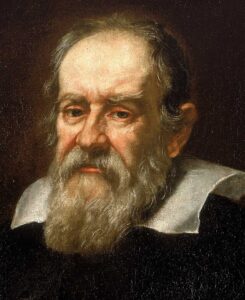
If you’ve ever pictured Galileo Galilei as a lone genius staring at the heavens while everyone else fumbled with astrology, that’s not entirely true. Yes, he had a telescope. Yes, he could spot things in the sky that made other scholars spit out their wine. But the reality is that Galileo didn’t just do science, he managed it. He expertly navigated egos, institutions, reputations, and the kind of political quicksand that makes modern office politics look like a friendly game of charades.
His real political challenges started with comets because nothing says “career development” like arguing about flaming balls of mystery streaking through the sky. In 1618, three bright comets showed up and everyone got excited. Orazio Grassi, a Jesuit mathematician in Rome, published an explanation that the comets were fiery bodies moving in a huge circle at a fixed distance from Earth. Galileo disagreed. His findings indicated that Earth was moving around the sun, which was heresy.

Yet, Galileo’s rebuttal (Discourse on Comets) didn’t just disagree, it vigorously attacked Grassi, criticized the famously accurate Tycho Brahe, and insulted prominent Jesuits. In essence, he wasn’t so much starting a scientific debate as he was initiating something akin to a comment thread on Reddit about whether cats or dogs are better companions. Galileo knew full well that his response was going to make him some serious enemies, so he pulled a classic PR maneuver and published the work under the name of his longtime ally Mario Guiducci (who was a respected consul at the Florence Academy). In other words, Galileo invented “posting from a friend’s account” four centuries before the internet.
Was that ethically pristine? Hardly. However, it was socially cunning and shows how well Galileo understood that in science (especially the kind that threatens powerful institutions) how you speak can matter as much as what you discover.
Of course, Grassi retaliated (also under a pseudonym). Galileo responded with Il Saggiatore a work that focused on factual nitpicking. Galileo effectively eviscerated Grassi’s methods by pointing out that his arguments weren’t backed by mathematical evidence. To this day, Il Saggiatore is widely considered the first book detailing how the scientific method ought to function. Yet, Galileo again did not just stick to science.
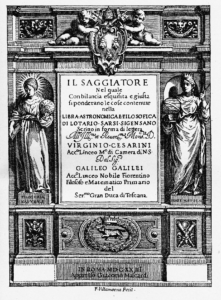
Books come with dedications and Galileo used his to gain favor with his intended audience. Unlike most popular books today that seek huge audiences, Galileo was focused on a much smaller audience. It wasn’t a grant committee. It wasn’t a group of peer reviewers. No, his was an audience of one: Cardinal Maffeo Barberini. While Barberini was powerful as a cardinal in Rome, he became even more so when he ascended to become Pope Urban VIII in 1623.
Galileo definitely saw this coming and knew that Barberini had enjoyed reading his work in the past. He was also well aware of the theocratic situation around him. He knew the religious and political reality that would crush him if he sounded too much like he was promoting heresy. This was why his dedication to Barberini was one of the best political moves of his life. Indeed, his decision was social intelligence in its purest form. Galileo wasn’t guessing at the physics of planetary motion so much as he was calculating the trajectory of human power. He knew that ideas don’t travel through society on logic alone. They travel through relationships, credibility, and who’s willing to shelter you when things go sideways.
Baberini becoming pope led Galileo to believe that he would have more freedom to challenge the notion of Earth being the center of the universe. This led him to gently question the old views with his next text, which he entitled Dialogue Concerning the Two Chief World Systems. While Dialogue didn’t outright argue that Earth went around the sun, it did make arguments for and against the idea. Galileo figured that structuring Dialogue in this open debate-like manner would keep the Inquisition off his back. He was wrong. Fortunately, he made a second dedication that saved him.
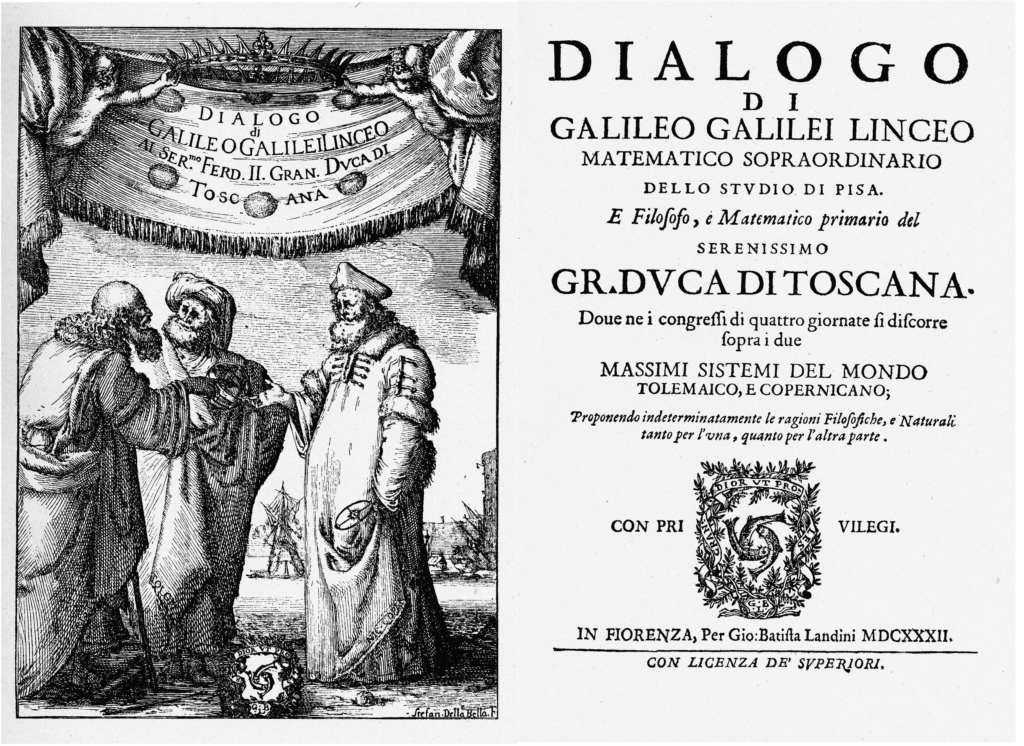
He knew that dedicating Dialogue to the Pope again wouldn’t help, so Galileo dedicated it to Ferdinando II de’ Medici, the Grand Duke of Tuscany and ruler of Florence. Yes, Galileo was a friend of the Grand Duke but he also understood that the de’Medici family was very powerful. Afterall, it had produced four popes and two queens of France by that time. In essence, his dedication was not so much patronage as it was protection. Galileo knew that if the Inquisition came after him and Pope Urban VIII didn’t intervene, having Ferdinando on his side would be crucial.
As predicted, the clergy objected and Galileo was forced before the Inquisition. He argued that Dialogue was analysis rather than advocacy. The documents produced by the Inquisition state that he was exposed to “rigorous examination,” which was code for torture back then. This was a lie.
Letters found in 1775 indicate that the de’Medici family intervened. Ferdinando directed his ambassador in Rome, a fellow named Francesco Niccolini, to speak with Pope Urban VIII and defuse the situation. Niccolini, who was also a close friend of Galileo’s, is documented as having had regular amicable meetings directly with the Pope about Galileo’s custody. Through his work, the Inquisition allowed Galileo to stay at the luxurious Tuscan embassy, and when he had to be at the Inquisition palace, he was lodged in a comfortable six-room apartment with meals brought to him from the embassy kitchen. Crucially, Niccolini convinced the Pope to let Galileo off lightly.
In essence, Galileo’s is not so much a story of a scientist who saw things that others did not (although there certainly are elements of that) as it is the story of a scientist who survived because he built relationships strong enough that powerful people picked up the phone for him… except that the phone back then was diplomacy and the voicemail was in Latin.