
“Few members of Congress have ever stood more alone while being true to a higher honor and loyalty” are the words that former president John F. Kennedy shared on Jeannette Rankin. As the first American woman to hold a federal office, Rankin knew how to talk to people and unite them around a shared vision for America. She brought forward the bill that would later become the 19th amendment, granting women the right to vote.
Jeannette Rankin was an incredible woman and one sadly overlooked in U.S. history. She realized that by helping women unlock their full potential, it would benefit the entire country. In Winning the Earthquake, author Lorissa Rinehart brings her to light in the first major biography ever published of Rankin. Read on for a featured excerpt and be sure to watch the book trailer for it at the end.
On May 2, 1914, women all over the country took to the streets demanding their right to vote. From Chicago to Pittsburgh, Boston to Minneapolis, Washington, D.C., to Cleveland, they marched by the thousand carrying yellow banners of women’s suffrage and singing songs of freedom and justice. In Montana alone, suffragists organized rallies in Butte, Helena, and Missoula as the official kickoff to their statewide campaign for the ballot.
With sunny skies and temperatures in the seventies all over Big Sky Country, the day must have seemed preordained by the fates. Crowds in each city spilled out onto the sidewalks to watch these women advocate for their rights. In Helena, a brigade of automobiles filled to the brim with suffragists waving American flags traversed the length of Last Chance Gulch while well-wishers heartily cheered them on. In the rough and ready mining town of Butte, demonstrators clad in cowboy hats and yellow suffragist sashes rode horses down Main Street to tepid applause but rapt attention.
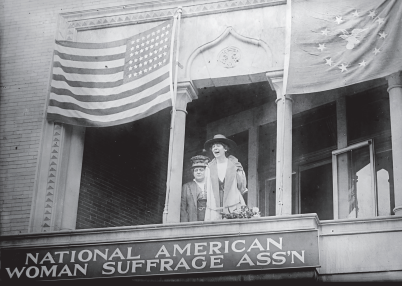
True to her roots, Jeannette Rankin chose to appear in her hometown of Missoula at the county courthouse, an inspiring neoclassical building made from native sandstone that looked almost like Roman marble on that sunny day. A full band belted out songs of America and its promised freedoms while hundreds gathered around. Two speakers appeared before Jeannette, making their case eloquently for women’s enfranchisement. But the people had come for her, and a reverent hush fell as Jeannette took the stage in a Model T tonneau.
“This is one of the grandest days that ever happened for women,” she began to thunderous applause. “All over the country, women are asking for the vote, and you know that what a woman asks for, she usually gets. And we should have the ballot. We are a force in life,” she intoned and then insisted. “The women of the United States are joining in this demonstration today to show that they are ready for the next step in the evolution of democracy.”
The band struck up once more as she climbed down in the gathering darkness. Rather than the pomp of patriotism, a solemn note fell over the crowd as they sang the suffrage movement’s unofficial anthem.
Though the way may be hard, Tho’ the battle be long,
Yet our triumph is sure; put your heart into song,
Into cheering and song: Votes for Women!
On such a day, it seemed like they could not fail. Yet history would throw the whole of its weight against their effort. Nevertheless, they persisted.
As usual, Jeannette went barnstorming across the Treasure State. In the space of a month, she spoke at theaters, churches, and community picnics in Cascade, Sanders, Teton, Flathead, Park, and Lincoln Counties. She led rallies in Big Timber, Reed Point, Clyde Park, and Rock Creek. Everywhere she went, she heard the refrain votes for women because everywhere she went, people were hungry for change.
They had good reason.
The promise of the Progressive movement had yet to come to fruition. Though the labor movement had made precious gains, working conditions remained largely the same as they were at the turn of the century. And though reform-minded representatives had managed to gain a majority, they had not yet offered a substantive challenge to the robber barons and industry titans who pulled the purse strings, and therefore the puppet strings, of politicians. Once more, Montana functioned as an all-too-accurate reflection of the nation’s larger challenges.
Since capturing the last of Montana’s major mining interests, Anaconda Copper had tightened its stranglehold on the state. Now entirely in control of management, Anaconda banished unions from its mines, removing any form of worker protection. In their place, they introduced the “rustling card” that mine workers needed to work in any of the company’s mines. If a worker even spoke of reform, rights, or unionizing, he lost his rustling card, and his means to earn a living would be revoked permanently.
Roughly 20 percent of all Montanans lived in Anaconda’s two company towns of Butte and Anaconda, which it controlled entirely. This itself represented a broad swath of the population. But Anaconda’s coils extended further into the state’s rivers, plains, and mountains as they seized control of all but one of Montana’s major newspapers. Unflinchingly, Anaconda leveraged its omnipresent information network to pursue its corporate interests. Then, in 1912, Anaconda sought to monopolize Montana’s power grid by merging the small and scattered plants already operating around the state.
In control of Montana’s economy, information, and power, Anaconda’s presence slithered into every home in this state that once prized itself on being the Union’s most free. In summing up public sentiment, one observer commented that Montana’s population “feels it has no stake in the company’s prosperity but suffers from the company’s exploitation of every natural resource and profitable privilege, its avoidance of taxation, and its dominance of the political and education life of the State.” In this fertile field of revolt, Jeannette planted her seeds of reform through the women’s vote.
Once more, she spoke not only of why women should have the vote on moral grounds but also of what the women’s vote could do for the common man. If granted access to the ballot, Jeannette promised women would vote to empower unions, regulate corporations, and ensure that worker protections were codified in law. This time around, Jeannette added another stroke to her portrait of a more democratic union.
The idea arose from long nights alone on the train and beside hotel room fireplaces where Jeannette devoured the histories of the United States, women’s suffrage, and, as she put it, “all the movements for the betterment of mankind.” She considered this knowledge the most significant advantage that she and her fellow suffragists had over their opponents.
To these chronicles of the past, she added imaginations of a more just and equitable future envisioned by progressives who, like her, strove for a more perfect realization of America’s foundation, “We the People.” In magazines, newspapers, and books, many of the era’s foremost thinkers, including Congressman Victor Berger, Judge Louis Brandeis, and Secretary of State William Jennings Bryan, advocated for the laws and constitutional amendments that would fundamentally democratize elections by taking power out of the hands of the wealthy few and putting it into the hands of the many.
Reading by flickering shadows of candles and the searing luminescence of electric light, Jeannette began to envision how the women’s vote could not only enfranchise women but all Americans by altering two significant facets of the electoral system that were denying the people their right to a true voice in government. The first carved America into pieces with the slanting and snaking lines mendaciously delineating congressional seats across every state in a process known as gerrymandering, defined by Jeannette as “the practice of manipulating the boundary lines of electoral districts, so that every district in the state may include a majority of Republican votes or Democratic votes, as the case may be.” The solution Jeannette would eventually propose was to do away with these squiggles of greed and replace them with a geometric grid that equally divided the state by population regardless of the political ideology within.
From this localized problem, Jeannette’s mind widened to the Electoral College, which determined who occupied the Oval Office. Rather than “one man, one vote,” this antiquated system dictated that if a presidential candidate failed to carry the majority of any state, he would lose all of its electors, even if the margin of votes proved to be razor thin. To Jeannette, the Electoral College represented an autocratic holdover from a European past that dampened the will of the people and silenced millions of Americans. The best and most logical course of action would be to eliminate the Electoral College and allow for direct presidential elections. From soapboxes, car trunks, and even the plat-form of a train’s caboose, she began to road test her ideas on changing the nature of American democracy, a dream she would chase for the rest of her life.
Watch author Lorissa Rinehart discussing Winning the Earthquake.