
Prologue
Although summer’s days were numbered, on September 15, 1776, a dirty, unwelcome heat still blanketed the region around New York City. Men sweated in their wool uniform coats; women, in their stays and gowns.
Americans were in their second year of war. The conflict that had begun accidentally at Lexington, Massachusetts, in April 1775 had initially seemed to many a continuation of the disturbances that had roiled the colonies for a decade. Americans had endured the Stamp Act riots, the slaying of five Boston patriots by regular troops, the dumping of the tea, the boycotts and the debates.
With the bloody battle at Bunker Hill, the patriots’ ultimately futile invasion of Canada, and George Washington’s successful effort to drive the British army out of Boston in March 1776, the war had taken on a more serious aspect. But most citizens still felt that it would ultimately be settled by reconciliation with the mother country.
Then came Common Sense. In January 1776, the pamphlet became the fastest-selling publication ever distributed in the colonies. It did not mince words or argue for compromise. It stated flat out that monarchy, the dominant form of European government for centuries, was an artifice by which a small group of dishonest men gained ascendency over the majority. The king was a fraud. The tradition of hereditary aristocracy was a device that robbed common people of the fruits of their labor and of their rightful inheritance. The goal of Americans should not be to find accommodation with Britain, the author insisted, but to permanently break all bonds and declare themselves free and independent states. The blood of the slain, the weeping voice of nature cries, ’Tis time to part.
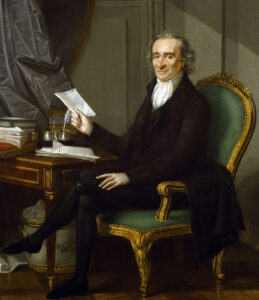
Thomas Paine, the author of this remarkable document, had spent most of his life in England. Yet since having crossed the Atlantic two years earlier, he had embraced the American cause wholeheartedly and had shaped in prose the thoughts and aspirations of many ordinary citizens. His words electrified the colonies. George Washington, who was struggling to shape diverse militia units into a new Continental Army, praised “the sound doctrine and unanswerable reasoning contained in the pamphlet Common Sense.” He hoped the argument would push the timid delegates in Congress to declare the colonies independent.
It did. The essay was circulated as a pamphlet and copied in the newspapers of every city. It was discussed over farm fences, debated in taprooms, and argued about in colonial legislatures. Barely five months later, Congress took the momentous step of declaring the colonies independent. A government of our own is our natural right, Paine had written. On July 4, 1776, the delegates asserted that American colonies were now “Absolved from all Allegiance to the British Crown.”
The reaction of the British government was to attempt to bring the colonies back into the empire by force. The king ordered two armies to descend on America. Ten thousand professional fighters would occupy Canada and invade the rebellious territory from the north. Forty thousand more would sail directly to New York. The troops would include thousands of hired soldiers from Britain’s allies among the German principalities.
Now the war had taken on a new meaning. Now it was no longer a dispute over taxation or representation or the duty owed to a monarch. If Americans won their freedom, it would mark a new epoch in the world. And now New York was at the war’s epicenter.
Part One
September 15–September 16, 1776
Chapter 1
By September 1776, Thomas Paine had done more than any other individual to convince Americans to break their ties with England and to declare themselves independent. He well understood that dispensing with the centuries-long tradition of monarchical rule was a dangerous and daunting endeavor. But even he did not fully grasp the sacrifice that would be required or the depth of the crisis that now loomed over his adopted homeland.
One who had heeded his words was a young Connecticut lad named Joseph Martin. He may have read Paine’s delicious phrases in a pamphlet, or he may have heard them repeated in the town square. We have it in our power to begin the world over again. Yes! It was the shining hope of the young. Remake the world. The words had stirred Martin, sounding a chord in his heart like an organ in church.
So, on a hot July 6 in the year 1776, four months shy of turning sixteen, Joseph had said to a young friend, “If you enlist I will.” To himself he whispered, “I may as well go through with the business now as not.” Independence in the air, he went through with it. He signed up for six months to “try out sogerin’.” He had become a musketman with Peck’s Third Company of Douglas’s Fifth Battalion of Wadsworth’s brigade of Connecticut new levy militia. He had joined a revolution.
When he had first put on the uniform, Martin had felt his soul expanding. He sensed his frail body growing larger, tougher. As he marched in step with his fellow soldiers, he gloried in a greater sense of life. He and the men of his regiment were a muscular creature, more powerful, more forceful, far grander than any individual man. He was part of an army.
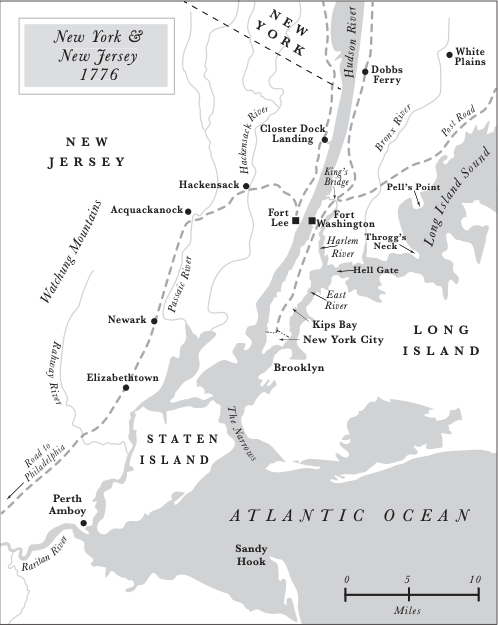
His regiment had ridden a sloop down Long Island Sound through Hell Gate and along the dirty river to the wharf at New York City. At the time, the entire city extended barely more than a mile north of its southern tip at the Battery. Martin and his fellows had paraded proudly on Broad Street. They had joined the mass of armed men commanded by George Washington, men who would fend off the onslaught of the king’s forces.
***
That was then. Now, in mid-September, the sluggish Sunday morning found Martin and his regiment stretched out along Kip’s Bay, a cove two and a half miles north of New York City.
Now he lay in a ditch behind heaped dirt along the bank of the East River. He had been on duty all night, his eyes peering into blackness till they ached. He had watched the starlight flash on the black water. Now the heavy air and an empty fatigue pressed against him. The smell made him think of a freshly dug grave. He wiped his mouth with his sleeve, swatted at the age-old insects pestering his face.
He allowed a deep pity for himself to suffuse his breast. He was hungry and morning had brought no food. The predictable rhythms of his childhood had gone awry. He had to go where he was ordered, but he sensed that the officers did not know what they were doing. They were pulling strings to make him jerk this way and that.
The unseasonable heat made it hard to concentrate. At dawn, four British warships had heaved into sight. They stopped directly opposite the American troops. Their clanking anchors dropped with mighty splashes. The chains rattled out. The rising sun became tangled in their rigging.
Martin and his fellows stared at these looming vessels. They were close enough to let the recruits exchange banter with the tars, who were busy attaching spring lines to the cables so that they could revolve the ships with capstans and point their gaping cannon at the shore. Close enough for the Americans to read Phoenix on the stern of the largest. Blessed Jesus, forty-four guns on two decks run out for action.
Tom Paine’s War copyright © 2026 by Jack Kelly. All rights reserved.
