
In The Sea Captain’s Wife, New York Times bestselling author Tilar J. Mazzeo reveals the true story of the first female captain of a merchant ship and her treacherous navigation of Antarctica’s deadly waters. Read on for a featured excerpt!
This story begins in another place, another time, in a world of which only fragments remain.
Close your eyes and imagine, first, a cold and angry emptiness. The emptiness roars around you. You are on a sea, hurtling where the wind and water take you. You fall and you rise in darkness. The falling is fast and unforgiving and twists your gut as you count the seconds downward. The rising is worse. The sea towers forty feet above you, and you know only the terror that comes before falling.
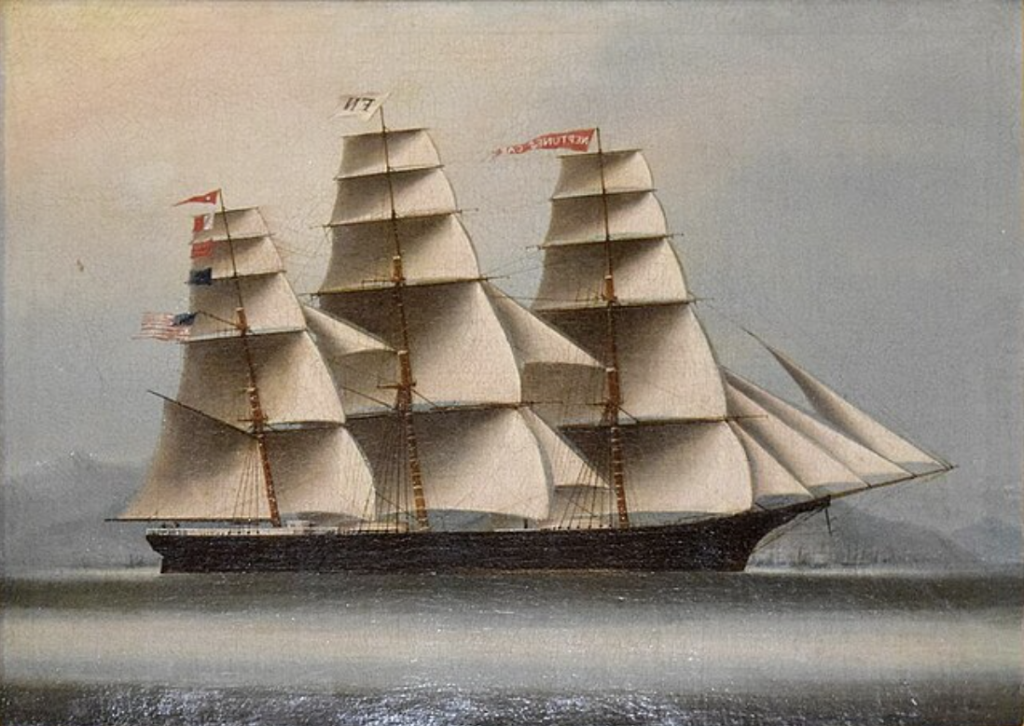
Into this emptiness, build yourself a ship. A mighty, ghostly clipper. She is long and lean. Two hundred feet or more from bow to stern, painted coffin black to ride this darkness. You stand on her deck, held aloft with each angry swell by a million board feet of pitch pine laid out in planking, which moans and bends with the force of the ocean: her flesh and muscle. A forest of timber ribs is her backbone. Above this hull, three barren masts rise, a hundred feet above the sea. In fair winds, these ancient, empty trees are strung with 3,500 yards or more of crackling stiff canvas to carry you with unimagined speed around the globe and home again if you are lucky. This night, her yardarms are howling, empty crucifixes. This ship is Neptune’s Car—the mythic chariot of a jealous god of storm and sea. Her name: a tribute to appease a fickle master.
Let the globe of our world spin slowly. Set this chariot upon a point, a latitude, a longitude. Turn west to the New World. Follow the line south from New York City and south some more, past Brazil, to the very last reaches, a place called Tierra del Fuego, the land of fire. Put your finger somewhere in that furious passage, between the end of the Earth and the frozen land of ice, Antarctica. Here is our tempest. Trace your finger around the tip of the continent, westward again, past the fearsome headland of Cape Horn and then past Robinson Crusoe Island. Let your finger take you, following a point somewhere in the great Southern Ocean, back northward, up the coast of two continents, along the edge of the Pacific, until you reach San Francisco: your destination, the city of gold dust.
We are on a dangerous journey. A journey in which wealthy shipowners pit young men against each other with the promise of riches, urging them on to reckless dangers, in the name of another man’s lucre. The year is 1856. The season is early September: just before spring in the southern hemisphere, too early for this voyage. Somewhere in the darkness, three other ships, our competitors, careen the waves with us. Not all of us will survive this journey.
At the helm of our ship is a man, the captain, Joshua. He is twenty-nine, but his face is already weather-beaten and tired. The headaches blind him. He castigates himself now. He had misgivings before he saw this ship out of New York’s harbor. He has been ill. He feels his force draining. Sometimes there is a cough; sometimes a fever. He has stood on this deck, sleepless, vigilant, for eight days and nights fighting the blast and the water. At the ropes and in the rigging far above the twisting sea are his crew. Men and boys, barefoot on icy decks too slick for shoe leather. They, too, are frightened, tired. One among them, shackled in chains below these decks, is angry, vengeful.
There is a woman, too, the sole female inhabitant of this bark. She is small and plump, and her black, plaited hair cannot be contained in this tempest. She is the sea captain’s wife and just nineteen: Mary Ann. Her wide skirts and oilskin cloak, her only defense against a polar wind, disguise for the moment the warm, gentle swell in her belly.
She wants desperately for them to win this race. The prize means, for her and Joshua, freedom. With this purse, with the sale of this cargo, destined to fuel a gold rush making more men rich in distant California, there will be enough. Enough to imagine a different future for them and their baby. Enough to buy a share of a ship and chart one’s own course. Enough, they said to each other when they dreamed, to build a little farm on their land in Maine, where the Weskeag River meets the sea and the salt marshes stretch beyond for many acres.
But, first, they must survive.
For eight days and nights Joshua has stood on the quarterdeck and fought the sea. In the gray half-light of the ninth morning, there is no fight left in him. He slips to the deck and lets the darkness take him. There is a cry from somewhere among the crew: “Captain!” In the shadows below the deck, the angry, vengeful officer waits, indignation swelling, also expectant. His eyes narrow. Mary Ann understands. There will be no safe harbor in San Francisco, no freedom, no farm running down to the banks of the Weskeag River unless she fights for them.
This is the moment her story begins.
The Sea Captain’s Wife Copyright © 2025 by Tilar J. Mazzeo. All rights reserved.