A Peking spring is always brief but can be glorious. Temperatures rise after a long, deep winter, the skies are blue and cloudless, the distinctive citrusy scent of magnolia perfumes the air in the hutongs, or alleyways. Peking residents shrug off their padded greatcoats and feel the sun on their skin once again.
Dominating the heart of Peking is the Forbidden City, a walled citadel surrounded by a wide moat, home to China’s emperors since 1420. A complex of great halls, elaborate pavilions and formal gardens, at 178 acres the imperial palace is roughly twice the size of the Vatican City. The northern portions, known as the Inner Court, were traditionally the preserve of the emperor and his immediate royal family, assorted concubines, dowagers, close relatives and clan members as well as the most trusted servants and palace eunuchs. Within the Inner Court, the Imperial Garden (Yu Huayuan) lies in the shadow of the Palace of Earthly Tranquillity (Kunning Gong), where traditionally the Qing dynasty held weddings and other imperial ceremonies. The gardens themselves are not overly extensive but are private; secluded pathways twist and turn alongside small streams traversed by miniature footbridges.
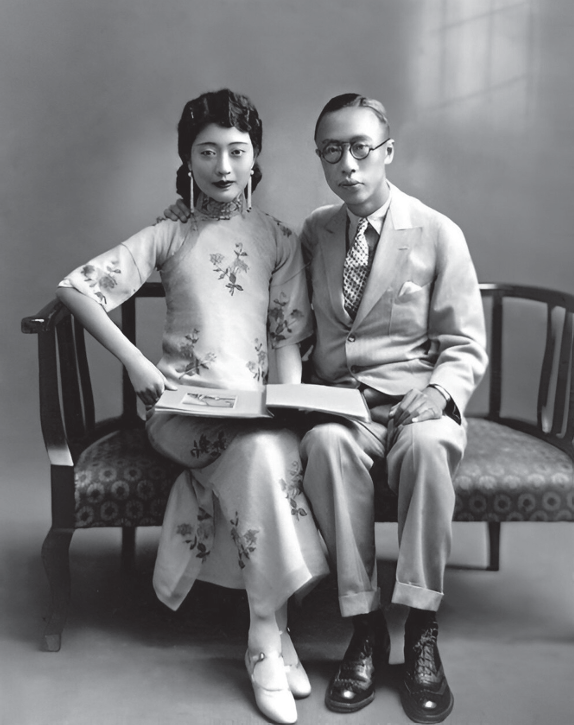
It was here, in the fine spring of 1923, that four very different but intimately connected individuals gathered for midday picnics. Of the four, two were Manchu royalty, the Emperor Puyi and his new Empress Wanrong, fated to be last in the line of the Manchu Qing dynasty. Accompanying them were Reginald Johnston, the young emperor’s tutor, and Isabel Ingram, the empress’s English teacher.
A seemingly unlikely group – a Manchu emperor who would never rule his kingdom, his arranged bride, a fifty-year-old Scottish colonial official and a young American woman, the daughter of pious Pennsylvania missionaries. Yet Johnston, a highly capable sinologist and a linguist with a deep appreciation of Chinese tradition, was a broad-minded and affable man who thanks to Puyi’s regard had risen to great importance within the imperial household. Ingram, from the start of her employment the previous year, had become a close friend of the empress. She was nearer to the royal couple in age and brought a refreshing vitality and modernity to the ritualistic and hidebound Forbidden City.
Puyi and Wanrong were, in 1923, cognisant of their position as the end of the Qing royal line. China had been a republic since 1912, just over a decade. Puyi had been anointed in December 1908 at barely two years of age and forced to abdicate at six when he was demoted to emperor in name only, confined within the high walls of the Forbidden City ever since. In 1922 the couple’s wedding was celebrated; it was to be the last burst of imperial pageantry Peking would ever see. Thousands lined the streets at dawn to see Wanrong enter the Forbidden City to become empress. They were both just sixteen.
Puyi and Wanrong were forced to live a sequestered existence in the gilded cage of the so-called ‘Great Within’ (Da Nei). Only the noises of the city breached its ramparts, but Puyi knew little of its tumultuous society, or his country’s cacophonous mix of fractious politics.
Since then the young couple had sought to build a life together, isolated but for the remnants of the imperial family – Puyi and Wanrong’s brothers, some ageing dowagers who had been concubines of long-deceased emperors and Puyi’s own consort, Wenxiu. Serving them were their closest courtiers, a detachment of the palace guard, approximately a thousand palace eunuchs and the two royal tutors. It was a strange, cloistered life while outside China’s young republic sought to establish and consolidate itself against foreign interference and the internal chaos of warlordism.
That spring of 1923 the impromptu picnics in the Imperial Garden were a new pastime. Wanrong spent hours dressing Ingram in Manchu costume, styling her hair in the traditional liangbatou (two-handed headdress), where two bunches of hair were arranged over a frame to create a wing-like structure. Puyi and Johnston would join them for tea and dim-sum, often both clad in classical scholar’s robes. They ordered in cream cakes from a German bakery in the nearby Legation Quarter of Peking where the city’s foreign population clustered. When Peking’s notorious humidity kicked in they would sip barley water instead of tea. They posed for photographs, a hobby Johnston had introduced to Puyi and which became a shared passion among the four. They snapped each other constantly and took group photos too, often joined by consort Wenxiu. They appear at ease, comfortable, taking what pleasure they can despite their isolation and political impotence.
Johnston termed the years between 1919, when he started to tutor Puyi, and the emperor’s expulsion from the Forbidden City in 1924 ‘the twilight period’. He related his version of events at length in the oft-reprinted memoir Twilight in the Forbidden City (first published in 1934). Johnston was brought to life in a sympathetic portrayal by Peter O’Toole in Bernardo Bertolucci’s film The Last Emperor (1987), which puts him at the heart of the story of the young Puyi. However, in the light of his previously unpublished personal correspondence with Ingram, Johnston’s recounting of events in his book might be viewed as somewhat vainglorious. He presents himself as the only foreigner close to the emperor and empress whereas this was clearly not the case. Reticent and rather pedantic in the memoir, Johnston is familiar, chatty and affectionate in his letters to Ingram, the pretty, vivacious and well-educated daughter of missionaries with whom he was clearly smitten. As we shall see, their relationship was evidently far more important to him than its absence from Twilight in the Forbidden City might suggest. It becomes apparent that they met regularly outside the Forbidden City, either at Johnston’s Western Hills retreat just beyond the city walls, or for tiffin at the Grand Hôtel des Wagons-Lit in the Legation Quarter, where they would discuss the welfare of their charges, plan guest receptions and organise garden parties in an attempt to ease the claustrophobia of life in the Forbidden City.
Just two years after their wedding, Puyi, Wanrong and Wenxiu were expelled into a harsh world of feuding warlords and a weak Republican government, and into the arms of Japan, already actively planning to conquer and rule China. Their tutors were also cast out, their relationships with the royal couple severed overnight. Cut off from Johnston and Ingram, their only contacts with the world outside the Forbidden City, the naïve and politically unsophisticated Puyi and Wanrong were destined for disaster.
The Last Emperor of China Copyright © 2026 by Paul French. All rights reserved.