
The Great Abolitionist is the first major biography of Charles Sumner to be published in over 50 years. Acclaimed historian Stephen Puleo relates the story of one of the most influential political figures in American history with evocative and accessible prose, transporting readers back to an era when our leaders exhibited true courage and authenticity in the face of unprecedented challenges. Read on for an excerpt!
Charles Sumner and Abraham Lincoln had much in common, including their height; both men stood nearly six feet, four inches tall and often towered above others with whom they came in contact.
Beyond their physical similarities, the two men shared deep philosophical underpinnings. Both loved the Union and sought its preservation. Both cherished the Founding Fathers and the ideas promulgated in the Declaration of Independence and the Constitution. Both detested slavery, though it took Sumner’s influence upon Lincoln to convince the President to publicly favor its outright abolition. Both employed words and ideas as their most powerful tools as they sought the elusive goal of equal rights for all. Both were leaders in the founding and shaping of the Republican Party into an antislavery political force. In the aftermath of the Civil War and Lincoln’s death, Sumner carried on the party’s mission through Reconstruction, a crusade he described as “the regeneration of the nation according to the promises of the Declaration.”
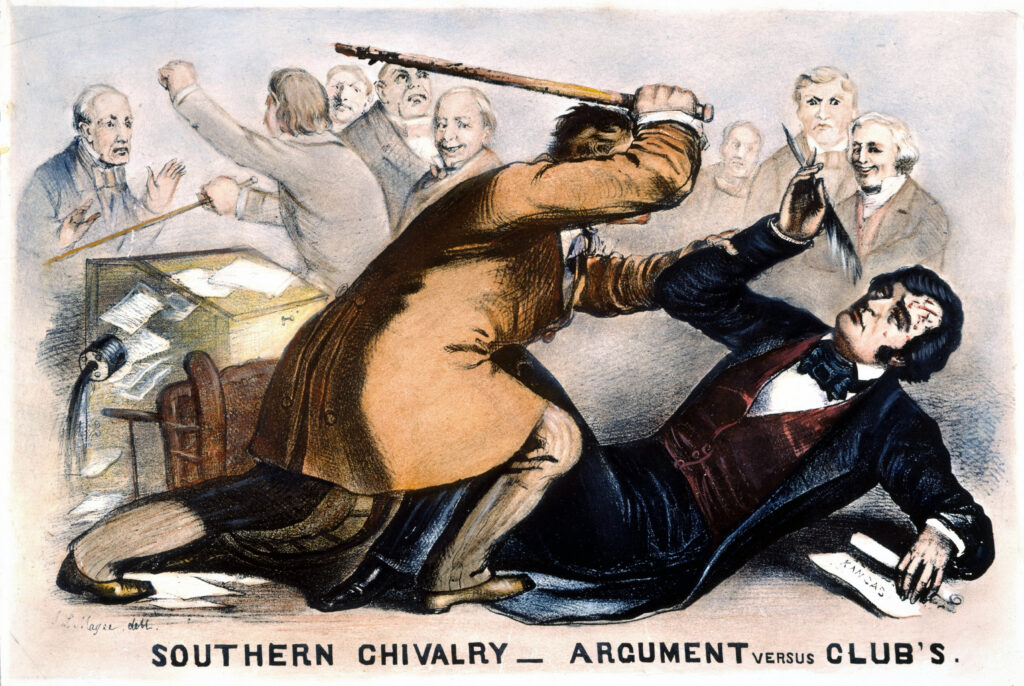
And both paid a terrible price for their beliefs: Sumner was beaten within an inch of his life on the Senate floor in 1856 by a proslavery congressman wielding a cane; Lincoln made the ultimate sacrifice for vanquishing a rebellion whose foremost goal was the perpetuation of the South’s “peculiar institution” of human bondage.
While President Lincoln has been, justifiably, the subject of countless biographies, thousands of essays, and lavish praise about his wisdom and leadership from scholars and schoolchildren alike, Charles Sumner’s life and accomplishments have faded, an unfortunate historical occurrence—this is the first full biography of Sumner in more than a half century. This slight becomes more perplexing when Sumner’s enormous contributions and his overall body of work during America’s most dramatic and volatile era are taken into account.
His unrelenting efforts to abolish slavery and fulfill the nation’s promise of civil, political, and racial equality; his expertise in foreign affairs that helped the United States avoid a potentially devastating war with England even as the country battled the Confederacy; his influence in virtually every major debate and issue that the country tackled in the decade prior to the Civil War, the war itself, and during Reconstruction— all of these place Charles Sumner among a handful of the most influential non-Presidents in American history, alongside Benjamin Franklin, Alexander Hamilton, Martin Luther King, Jr., and Susan B. Anthony.
***
For a quarter of a century, including twenty-three consecutive years in the Senate from 1851 until his death (which encompassed a three-year absence as he recovered from his caning injuries), it was Charles Sumner— not Lincoln, William Lloyd Garrison, Frederick Douglass, Lydia Maria Child, or anyone else—who was the nation’s most passionate and inexhaustible antislavery and equal rights champion.
Before and during the Civil War, at great personal sacrifice, he was the conscience of the North and the strongest and most influential voice in favor of abolition. Throughout Reconstruction, no one championed the rights of the emancipated freedmen more than Charles Sumner. Through the force of his words and his will, he moved first his state, and then the nation, toward the twin goals of abolitionism—which he achieved in his lifetime—and equal rights, which eluded him and the country, but for which he fought literally until the day he died.
In so doing, he laid the cornerstone arguments that civil rights advocates would build upon over the next century as the country strove to achieve equality among the races.
To Sumner, the two concepts of abolitionism and equal rights were inseparable and could not be untethered. Freedom and equality embodied the founding principles of the United States as stated in the Declaration of Independence and in the Constitution’s guarantee of a republican form of government; only by enshrining these rights forever could the United States survive. This view was first considered radical and unworkable, dismissed as the ranting of rabble-rousers on the fringe—as a position held not even by Lincoln and other antislavery Republicans.
But Sumner’s influence gradually took hold, permeated the party’s dogma, and finally became the prevalent and official view of Lincoln and the nation.
***
Charles Sumner stood tall and ramrod straight at the center of events that millions of Americans would learn about and study for the next century and a half: the Fugitive Slave Law; the Kansas-Nebraska Act; the battle for the soul of Kansas that became a symbol of abolitionist and proslavery tensions; the founding of the Republican Party; Lincoln’s election in 1860; the secession of Southern states; the Trent Affair, in which he was the primary force in averting war with England; the Emancipation Proclamation, which he repeatedly beseeched Lincoln to issue and whose language he helped shape; Lincoln’s remarkable and unexpected reelection in 1864; the President’s assassination; the crafting of Reconstruction policy; the impeachment of President Andrew Johnson; and the Reconstruction amendments. He also served as head of the Radical Republicans throughout the war, as chairman of the Senate Foreign Relations Committee, and as the architect of a proposed sweeping civil rights bill that called for an end to all government and private sector discrimination.
As the nation literally fought for its life, Charles Sumner influenced, altered, and often defined America’s course—in the moment and for the future.
From the moment he stepped onto the public stage, he made his fight America’s fight.
Where others preached compromise and moderation, he never wavered in denouncing slavery’s evils to all who would listen and demanding that it be wiped out of existence. Where others muttered cautious, even insipid, platitudes, his voice was clear and strong. Where others wilted under the onslaught of political attack, he stood fearless, a bulwark against the slings and piercing arrows of those who targeted him—Southern slaveholders, as well as many Northerners who placed economic interests ahead of their moral outrage.
He was beholden to no one, sought no ill-gotten gains, was unbribable and unbuyable, and had little interest in currying favor even to advance his own political fortunes.
His was a career, a life, supported by the twin pillars of courage and authenticity.
***
Charles Sumner was the boldest, most controversial, and most influential voice of America’s most turbulent two decades: the 1850s and 1860s. No one else came close.
As great events played out across the land during this period, Sumner seized the national narrative, refused to let go, and repeatedly held a mirror up to the country’s aspirations and ideals. He inspired those who agreed with him, swayed fence-sitters, and eventually converted millions of naysayers. He had a particular understanding of the power of words and big themes to move people, to challenge their ways of doing things.
It was Charles Sumner who first used the phrase “equality before the law” in the United States, who first argued that “separate but equal” violated the precepts of the Declaration of Independence, and who infused the concept of “equal protection” for all into the language of the Fourteenth Amendment.
His oratory was his gift, if occasionally his undoing. He never backed down, never tempered his remarks, never prevaricated. Throughout his career, he was responsible for passing almost no significant legislation (though as a legislator, he is often underrated), and yet for two decades, in an era when senators often wielded more power than presidents, he was the most powerful man in the U.S. Senate.
Sumner understood politics, but he had little patience for the political process or in nourishing personal relationships that made the process run smoothly. Yet, merely uttering the words “U.S. Senator Charles Sumner of Massachusetts” was enough to stop both his allies and his enemies in their tracks. Supporters trumpeted his courage, his resilience, and his moral certitude. Detractors detested his arrogance, his seeming lack of empathy, and his utter contempt for those who disagreed with him.
But without question, when Charles Sumner spoke, everyone listened.