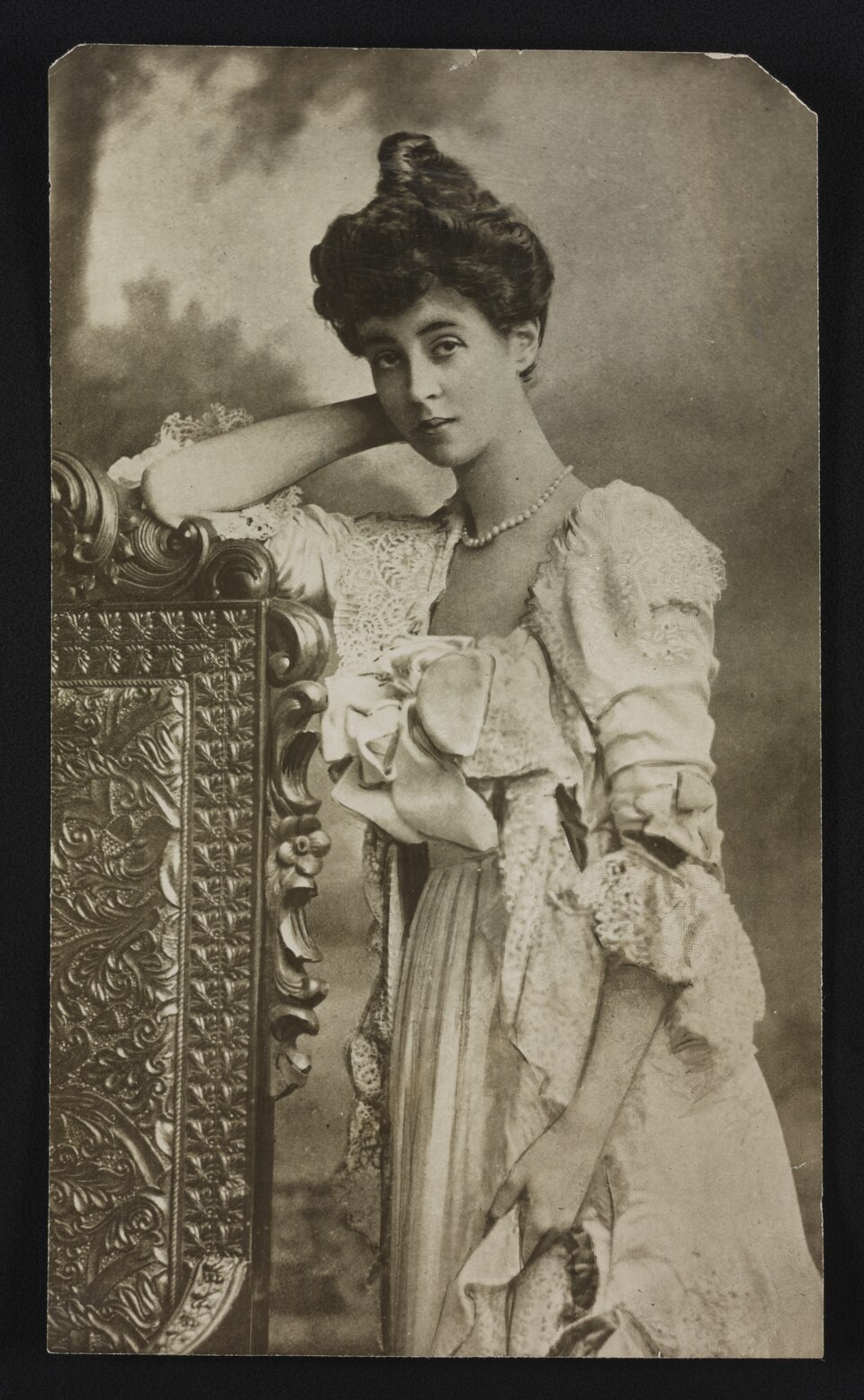
Shakespeare’s line from the Merchant of Venice, “All that glitters is not gold” rings true for the life of Consuelo Vanderbilt Balsan. As a young American heiress, she was forced to marry an English duke by her mother when she loved someone else. This position as the Duchess of Marlborough placed her among the highest echelon of society, but it was a position of loneliness and misery. Read on for a featured excerpt from Balsan’s memoir (written in her own words) that covers Consuelo’s strict upbringing to her later years spent in America after divorcing the duke as she sought her own happiness.
1
The World of My Youth
In trying to recount events that have influenced my life, it is humiliating to find that I remember very little of my childhood. Watching my great-grandchild Serena Russell at play, so sure of herself, even at the age of three, I wonder if, when she reaches my age, she also will have forgotten events that now appear important to her. That we are both in America – she the child of my granddaughter Sarah Spencer-Churchill, who married an American, and I the wife of a Frenchman – is due to World War II, and to events little anticipated at the turn of the century when I left my native land.
Memories of myself at Serena’s age recall a picture painted by Carolus Duran of a little girl against a tall red curtain. She is wearing a red velvet dress with a square décolleté outlined with Venetian lace. A cloud of dark hair surrounds a small oval face, out of which enormous dark eyes (much bigger than they were) look out from under arched brows. A pert little nose and dimples accentuate the mischievous smile. There is something vital and disturbing in that small figure tightly grasping a bunch of roses in each fist. ‘You were un vrai petit diable, and only kept still when I played the organ in my studio!’ Carolus Duran exclaimed, when again he painted me, this time at seventeen. The second portrait was a very different affair from the first, for the red curtain which had become his traditional background was at my mother’s request replaced by a classic landscape in the English eighteenth-century style, and I am seen a tall figure in white descending a flight of steps. For my mother, having decided, in the fashion not uncommon at the time, to marry me either to the man who did become my husband or to his cousin – generously allowing me the choice of alternatives – wished my portrait to bear comparison with those of preceding duchesses who had been painted by Gainsborough, Reynolds, Romney and Lawrence. In that proud and lovely line I still stand over the mantelpiece of one of the state-rooms at Blenheim Palace, with a slightly disdainful and remote look as if very far away in thought.
It is well that my Aunt Florence Twombly, now ninety-eight, could remember not only the street but also the number of the house where I was born, for my birth had never been officially recorded. This information was required when I took back my American citizenship after the French armistice in World War II. It was in one of those ugly brownstone houses somewhere in the forties, which was then the fashionable district of New York, that I first saw the light of day.
My father’s family was Dutch and had its origin in the Bilt – that northern point of Holland whence comes our name. It was about the year 1650 that the first member of the family came to the New Netherlands, and succeeding generations lived in the vicinity of New Amsterdam, as New York City was then called. In the first part of the nineteenth century my great-grandfather Cornelius Vanderbilt founded the family fortune, moved from New Dorp, Staten Island, to New York and changed the spelling of our name from van der Bilt to its American version. In later years I met a Professor van der Bilt who taught at a Dutch University. He told me that there was only one family bearing our name in Holland, and in looking through his family archives he had become convinced that the Dutch and American branches had descended from a common ancestor. In the Patriciat, a book that is the Dutch equivalent of the British Landed Gentry, the Professor pointed out our coat of arms, the three acorns, and the names Gertrude, Cornelius and William, which repeatedly figure in our family Bible.
My grandfather, William H. Vanderbilt, had, considering his numerous philanthropic gifts, an unmerited reputation for indifference to the welfare of others. It was, as is often the case, founded on a remark shorn of its context. This is the version of the ‘public be damned’ story that was given me by a friend of the family. Mr. Vanderbilt was on a business trip and, after a long and arduous day, had gone to his private car for a rest. A swarm of reporters arrived asking to come on board for an interview. Mr. Vanderbilt sent word he was tired and did not wish to give an interview, but would receive one representative of the Press for a few minutes. A young man arrived saying, ‘Mr. Vanderbilt, your public demands an interview!’ This made Mr. Vanderbilt laugh, and he answered, ‘Oh, my public be damned.’ In due course the young man left and next morning his article appeared in the paper with a large headline reading, ‘Vanderbilt says, “The Public be damned.” ’ That he was not so black as painted I have from a cousin to whom my grandmother after her husband’s death said, ‘Your grandfather never said an unkind word to me during all the years we were married.’
In ‘The House of Vanderbilt’ by Frank Crowninshield, I find a reference to my grandmother in which he says, ‘She was an amazing woman who brought up her children to become people of the greatest cultivation and taste. She had been born Maria Louisa Kissam, the daughter of a clergyman of the Dutch Reformed Church. The Kissams were an old and distinguished family, Mrs. Vanderbilt’s father having descended from the Benjamin Kissam who, in 1786, married Cornelia Roosevelt, the daughter of the patriarchal Isaac, and the President’s great-great-grandfather.’ Of my grandmother’s eight children my father, W. K., as he was known to his friends, was the second son. I remember my grandmother very well, and our visits to her in the big house on Fifth Avenue directly opposite St. Patrick’s Cathedral where she lived. She was a lovely old lady, gracious and sweet as old ladies should be. All her grandchildren – we were, I think, twenty-six – loved her. After my grandfather’s death in 1885 she lived alone with her youngest son, George. Uncle George was quite different from my other uncles and aunts. With his dark hair and eyes, he might have been a Spaniard. He had a narrow sensitive face, and artistic and literary tastes. After my grandmother’s death in 1896 he created Biltmore, a great estate in North Carolina where he built model houses and fostered village industries.
My father’s eldest brother Uncle Corneil, as we called him, was a stern and serious person, or so we thought. He was not gay like my father and Uncle Fred. Of my four aunts I loved my Aunt Emily Sloane best, for, like my father, she was of a joyous nature and had the look of happy expectancy one sees on the faces of those who love life. She and my Aunt Florence were always perfectly dressed, and, with their slight figures and quiet distinction, reminded me of Jane Austen’s charmingly prim ladies. Some time before her death I went to see Aunt Emily. She was sitting at a window overlooking Central Park. It struck me that her days must have been very long, now that she was widowed and that the bridge game she loved was no longer possible because of her failing memory. But when I sympathised with her, she folded her hands and softly smiling answered – ‘I have such lovely thoughts to keep me company,’ and when I crept away, fearing to disturb them, I heard her murmuring, as if conversing with ghosts of the past. She lived to be over ninety. At her memorial service the Rector of St. Bartholomew’s in New York paid a well-deserved tribute to her lovely character and generous charity.
My maternal grandfather, Murray Forbes Smith, was descended from the Stirlings, and both my mother’s given names – Alva Erskine – are Stirling names. The Scotch tradition of large families is borne out in two volumes on the Stirlings in America. This prolific family overflowed from Virginia into the more southern states and produced several governors and people of importance. All this accentuated in my mother a pride in her Southern birth and a certain disdain for the mercenary spirit of the North. Her father, who owned plantations near Mobile, was ruined by the liberation of the slaves and, after the Civil War, moved to Paris. There my mother’s eldest sister made her début at one of the last balls given at the Tuileries by Napoleon III. My mother and I used to attribute our love for France to a Huguenot ancestor who escaped to America after the revocation of the Edict of Nantes. Indeed we were happier in France than in any other country, and, following the example of an aunt and a great-aunt, we both returned to live there.
Why my parents ever married remains a mystery to me. They were both delightful, charming and intelligent people, but wholly unsuited to each other. My father, although deep in his business interests, found life a happy adventure. His gentle nature hated strife. I still feel pain at the thought of the unkind messages I was made the bearer of when, in the months that preceded their parting, my mother no longer spoke to him. The purport of those messages I no longer remember – they were, I believe, concerned with the divorce she desired and with her wishes and decrees regarding custody of the children and arrangements for the future. My father had a generous and unselfish nature; his pleasure was to see people happy and he enjoyed the company of his children and friends, but my mother – for reasons I can but ascribe to a towering ambition – opposed these carefree views with all the force of her strong personality. Her combative nature rejoiced in conquests. She loved a fight. A born dictator, she dominated events about her as thoroughly as she eventually dominated her husband and her children. If she admitted another point of view she never conceded it; we were pawns in her game to be moved as her wishes decreed. I remember once objecting to her taste in the clothes she selected for me. With a harshness hardly warranted by so innocent an observation, she informed me that I had no taste and that my opinions were not worth listening to. She brooked no contradiction, and when once I replied, ‘I thought I was doing right,’ she stated, ‘I don’t ask you to think, I do the thinking, you do as you are told,’ which reduced me to imbecility. Her dynamic energy and her quick mind, together with her varied interests, made her a delightful companion. But the bane of her life and of those who shared it was a violent temper that, like a tempest, at times engulfed us all.
One of her earliest ambitions was to become a leader of New York society. To this end she gave a fancy dress ball for the opening of her new house, 660 Fifth Avenue, on March 26, 1883. In contemporary newspapers I have read how eagerly invitations to this party were sought after. It proved to be, they said, the most magnificent entertainment yet given in a private house in America. My parents, gorgeous in medieval costumes, received the élite of what then was New York society. My godmother, who as Consuelo Yznaga had been my mother’s bridesmaid, was our house guest and the ball was given in her honour. She was then Viscountess Mandeville and soon after, when her husband succeeded to the dukedom, became Duchess of Manchester. Beautiful, witty, gay and gifted, with the ability to play by ear any melody she had heard, she delighted us with her charm. Her lovely twin daughters who died so tragically young and her son Kimbolton spent that winter with us. Kim had early acquired the sense of importance a title is apt to confer, and one day when the postman left a letter for Viscount Mandeville with the comment, ‘How I would like to see a real live lord,’ he was astonished to see a diminutive figure in a sailor suit approach him exclaiming, ‘Then look at me.’
Now firmly established as a social leader, my mother, wishing still further to dominate her world, assumed the prerogatives of an arbiter elegantiarum, instructing her contemporaries both in the fine arts and the art of living. Ransacking the antique shops of Europe, she returned with pictures and furniture to adorn the mansions it became her passion to build. She thus set a fashion for period houses, which at that date were little known in the United States. Once she was successfully installed in the three homes she had built, her restless energy must, I imagine, have turned to other projects. It was perhaps then that plans for my future were born.
Courage was one of her prominent characteristics – a courage that was physical as well as spiritual. I shall never forget an incident when I had occasion to realise how intrepid and quick were her reactions. It took place at Idlehour, our home on Long Island. One day when I, aged nine, was out driving, my pony started to run away with me, making straight for a water hydrant. My cart would undoubtedly have been overturned; but without the slightest hesitation my mother, who was standing near-by, threw herself between the hydrant and the racing pony and seized his bridle, thus preventing a serious accident.
Reminiscences relating to one’s childhood are apt to be tinged with a self-conscious pity, which in my generation might be considered justified, for we were the last to be subjected to a harsh parental discipline. In my youth, children were to be seen but not heard; implicit obedience was an obligation from which one could not conscientiously escape. Indeed, we suffered a severe and rigorous upbringing. Corporal punishment for minor delinquencies was frequently administered with a riding-whip. I have a vivid memory of the last such lashing my legs received as I stood while my mother wielded her crop. Being the elder, I had the privilege of the first taste of the whip – Willie followed. We had, my brother and I, been sailing in our boat on a pond. Our governess, Fraulein Wedekind, wished to bring us home, but, lost in the pleasure of the sport, we paid no attention to her calls. At length, as we neared the bank, she caught us and, imprudently straddling the water with one leg on shore, she tried to stop us. Alas, how could one prevent the wicked impulse to give a sudden shove with an oar, setting the boat free and seating Fraulein in the water? It seemed very funny at the time, but as we neared home, our governess trailing her wet skirts straight up to our mother, the incident lost its charm.
I bore these punishments stoically, but such repressive measures bred inhibitions and even now I can trace their effects. It is a melancholy fact that childhood, so short when compared with the average span of life, should exert such a strong and permanent influence on character that no amount of self-training afterwards can ever completely counter it. How different is the child’s education today! Prejudiced as I am by my own experience, I still think that, although my mother’s standard was too severe, it was preferable to the complete lack of discipline I see in many homes today.
Punishments, which were private affairs, were more easily borne than ridicule suffered in public. I remember an occasion when, dressed in a period costume designed by my mother – for it was her wish that I should stand out from others, hallmarked like precious silver – I suffered the agonies of shame that the ridicule of adults can cause children. Then again I was particularly sensitive about my nose, for it had an upward curve which my mother and her friends discussed with complete disregard for my feelings. Since nothing could be done to guide its misguided progress, there seemed to be no point in stressing my misfortune. I developed an inferiority complex and became conscious not only of physical defects but also of faults that with gentler treatment might have been less painfully corrected. Introspection and heart-searching caused hypersensitiveness and a quick temper to cloud an otherwise amiable disposition.
My brother Willie was my junior by eighteen months. He had inherited my father’s charm and sweet temper. The wistful look of his big green eyes was appealing, but he was mischievous and recklessly daring. He used to ride one of those old-fashioned highwheeled bicycles at such speed that he took many tosses. One day my mother threatened to confiscate the bicycle at the next fall, and Willie went through a lesson before his tutor discovered that in falling he had broken his arm. I had for him the love little girls expend on their juniors and we shared a keen sense of fun.
My brother Harold was born seven years later. Returning from a walk on a Sunday in July, 1884, we found him in my mother’s arms. Nor were we further enlightened until Boya, my sainted nurse, informed me that God had sent him to us. What could be more pleasing than so poetic a version of birth and creation? Though we experienced a certain curiosity as the years went by, modesty was not sacrificed to the precocious knowledge sex education now confers. Harold, being so much younger than we, took little part in our games. In our eyes he was encircled by the halo his adoring nurse Bridget placed round his lovely head. She was an ardent Catholic – a faith that inspired her with sufficient courage one day to tax my mother with the number of houses she was building: ‘You have so many houses on earth, Mrs. Vanderbilt, don’t you think it is time to build one in heaven?’ To which my mother replied: ‘Oh no, Bridget – you live in my houses on earth, but I look forward to living in yours in heaven’ – an answer of classic realism.
We did not live for long in the little nondescript house in which I was born. Choosing Richard Morris Hunt as her architect, my mother built a large ornate white stone house in the French Renaissance style at the north-west corner of Fifth Avenue and Fifty-second Street. It was demolished after my father’s death to make room for office buildings. This house stood back from the avenue and was approached by wide steps leading to an iron-grilled entrance. Inside, one saw on the right a great stairway running up three flights. I still remember how long and terrifying was that dark and endless upward sweep as, with acute sensations of fear, I climbed to my room every night, leaving below the light and its comforting rays. For in that penumbra there were spirits lurking to destroy me, hands stretched out to touch me and sighs that breathed against my cheek. Sometimes I stumbled, and then all went black, and, tensely kneeling on those steps, I prayed for courage to reach the safety of my room.
In comparison with this recurrent nightmare, how gay were the gala evenings when the house was ablaze with lights and Willie and I, crouching on hands and knees behind the balustrade of the musicians’ gallery, looked down on a festive scene below – the long dinner-table covered with a damask cloth, a gold service and red roses, the lovely crystal and china, the grown-ups in their fine clothes. The dining-room was enormous and had at one end twin Renaissance mantelpieces and on one side a huge stained-glass window, depicting the Field of the Cloth of Gold on which the Kings of England and France were surrounded with their knights, all not more magnificently arrayed than the ladies a-glitter with jewels seated on high-backed tapestry chairs behind which stood footmen in knee-breeches. Next to this big dining-room was a small breakfast-room adorned with Flemish tapestries and Rembrandt’s portrait of the Turkish Chief. Then came a white drawing-room hung with a fine set of Boucher tapestries; here were the beautiful lacquer secrétaire and commode, with bronzes chiselled by Gouthière, made for Marie Antoinette. Next-door our living-room, a panelled Renaissance salon, looked out on Fifth Avenue.
My father’s small dreary room saddened me – it seemed a dull place for so gay and dashing a cavalier who should, I thought, have the best of everything life could give. He was so invariably kind, so gentle and sweet to me, with a fund of humorous tales and jokes that as a child were my joy. But, alas, he played only a small part in our lives; it seemed to us he was always shunted or side-tracked from our occupations. It was invariably our mother who dominated our upbringing, our education, our recreation and our thoughts. With children’s clairvoyance we knew that she would prove adamant to any appeal our father made on our behalf and we never asked him to interfere. The hour we spent in our parents’ company after the supper we took with our governess at six can in no sense be described as the Children’s Hour. No books or games were provided; we sat and listened to the conversation of the grown-ups and longed for the release that their departure to dress for dinner would bring.
Occasionally Willie and I were permitted to join my mother in her handsome bedroom and watch her evening toilet. There was one memorable evening when the safe in which her jewels were kept could not be opened. My mother was going to a big dinner at which it would almost have been considered an offence to wear no jewels. Something of the prevailing feeling of panic must have reached me, for I ran to my room and prayed fervently that a miracle would open the safe. And when I returned the safe was opened and my mother decked in her beautiful pearls. Small wonder that I believe in the efficacy of prayer.
When I was old enough for a room of my own I was moved from the nurseries next to my mother to a room above hers, to which she had access by a spiral staircase in one of the towers that adorned the house. On this floor there was a colossal playroom where we used to bicycle and roller-skate with our cousins and friends. But the chief memory it holds is of a Christmas tree that towered to the roof and was laden with gifts and toys for us and for every one of our cousins.
After heavy snowfalls there were joyous sleigh drives to which we looked forward – the horses with their bells, the fat coachman wrapped in furs, and Willie and myself in the back seat with our small sleigh on which we were allowed to toboggan down slopes in the Park.
After the holidays there were matinées at the Metropolitan Opera House to look forward to, when in my best dress I sat in my father’s box near the stage. My earliest operatic recollection is of hearing the great Adelina Patti sing Martha. Her birdlike trills evoked scenes of wild enthusiasm, and mountains of bouquets were heaped round her diminutive form. Gounod’s Faust was one of my favourites, but Mephistopheles terrified me and folly became associated with love after seeing Marguerite and later Lucia de Lammermoor in their affecting mad scenes.
Every Saturday my mother made me recite endless poems in French, German and English, and in my tenth year there was a memorable occasion when our solfège class gave a concert in honour of our parents. Whether from stage fright or emotion, I gave a rendering of ‘Les Adieux de Marie Stuart’ with so much feeling that I burst into tears. Somebody tossed me a bouquet and I am sure no prima donna ever felt a greater thrill.
Willie and I also went to a weekly dancing class conducted by Mr. Dodsworth, an elderly and elegant instructor who had taught succeeding generations of New Yorkers how to dance and how to behave when in company. Willie disliked being dressed in his best sailor suit and having to dance with elderly girls who steered him around, but I liked wearing my prettiest dress, and the competition of boys who wished to dance with me gave me a sense of superiority I did not often enjoy at home.
Sundays were special days. We went to morning service at St. Marks-in-the-Bouwerie, a long drive in the landau with Willie and myself in our best clothes facing my mother in an elegant costume and my father in a frock-coat, top hat and an overcoat with a fine fur collar. Those long drives were always frightfully tiring, for I was made to sit up very straight and was not allowed to relax for a moment. When my legs began to fi dget in uncontrollable twitches, I was strictly admonished against what for some unknown reason my mother dubbed ‘Vanderbilt fidgets’, as if no other children had ever been afflicted thus. Sitting up straight was one of the crucial tests of ladylike behaviour. A horrible instrument was devised which I had to wear when doing my lessons. It was a steel rod which ran down my spine and was strapped at my waist and over my shoulders – another strap went around my forehead to the rod. I had to hold my book high when reading, and it was almost impossible to write in so uncomfortable a position. However, I probably owe my straight back to those many hours of discomfort.
Upon our return from church, we children lunched with our parents in the company of two boys of our age, and after a Scripture lesson spent delirious hours marching armies of tin soldiers across the carpet that represented land, or sailing them over the seas of parqueted floors to fight furious battles for the possession of the forts we built out of blocks.
In contrast to this city life there was the welcome liberty we enjoyed at Idlehour, my father’s place at Oakdale, Long Island, where we spent the early summer and autumn months. It was a rambling frame house close to a river; green lawns swept away to the gardens, stables, woods and farms. Here we crabbed and fi shed in the river and learned to sail a boat. We had ponies, which I rode side-saddle, and a garden to plant, but we were bad gardeners, for my brother Willie, who was of an impatient nature, would pull up the potatoes long before they were ripe. Our earliest bets were made on the number we would fi nd on each root.
Good behaviour found its reward in the pleasure of cooking our supper in the playhouse. Our German governess presided and indulged her taste for sauerkraut, which we did not appreciate, but as compensation I was allowed the chocolate caramels I loved to make. This playhouse was an old bowling alley, and when my mother handed it over to us she insisted as a matter of training that we should do all the housework ourselves. Utterly happy, we would cook our meal, wash the dishes and then stroll home by the river in the cool of the evening.
Boya, my nurse, as near a saint as it is possible for a human being to be, shared these outings with us. High-minded, simple and kind, she had none of the mawkish sentimentality that caused my governess to take affront at the slightest provocation.
There were times when, possibly influenced by Boya, I reflected with some discomfort on the affluence that surrounded me, wondering whether I was entitled to so many of the good things of life. This feeling was sharply accentuated by a visit I paid to the sick child of one of our Bohemian workmen, whose duty it was to cut the grass lawns that surrounded the house. One morning when wishing him good day I noticed how sadly he answered. ‘Is anything the matter?’ I inquired. Then he told me of his little girl, aged ten – ‘just my age,’ I commented – a cripple condemned for life to her bed. The sudden shock of so terrible a lot overwhelmed me, and when the next day I drove with my governess to see her, the pony-cart filled with gifts, and found her in a miserable little room on a small unlovely cot, I realised the inequalities of human destinies with a vividness that never left me. How much I owe to Boya! It was from her I learned the happiness helping others brings. For she gave her all in alms and kindness, and later, when she left us, spent her last years directing a Home for Swiss Girls in New York.
When my grandfather died in 1885 leaving the bulk of his fortune equally divided between his two elder sons – Cornelius and my father – my mother was able to give full vent to her ambitions, and the yacht Alva, of 1,400 tons, was one of the first results of our new affluence. She was a beautiful and luxurious ship with appointments in simple good taste, but she was a bad sea boat, as we soon found to our discomfort, and was eventually sunk in a collision in a fog. On our first trips we visited the West Indies. In following years we crossed the Atlantic and cruised in the Mediterranean. On one occasion as we left Madeira and headed for Gibraltar a frightful storm overtook us. The waves broke over the high wooden bulwarks in such rapid succession that there was not enough time for the water to drain out through the freeing ports before the next wave hit us. I was lying in the forward deck cabin with my brother Willie and his tutor, who was both frightened and sick. ‘If we have seven such waves in succession,’ he informed us, ‘we must sink.’ Willie and I spent the rest of the day counting the waves in terrorised apprehension as the green water deepened on our deck. There were several casualties among the crew and the doctor who always accompanied us on our voyages was kept busy.
These yachting expeditions were excessively boring to us children. The doctor, my brother’s tutor, my governess and three men friends of my parents made up our party. Heavy seas provided our only escape from the curriculum of work, for even sightseeing on our visits ashore became part of our education, and we were expected to write an account of all we had seen. Harold, still being in the nursery, was free to amuse himself within the limits a yacht made possible.
On one of our cruises we visited Algiers, Tunis and Egypt. I recall being deeply impressed by the magnificent proportions of the temples of Egypt, but the tombs of the kings gave me the worst kind of claustrophobia and I was terrified by the hundreds of bats that clung to the low ceilings. There was something pathetic about the richly caparisoned mummies surrounded by the worldly possessions they deemed necessary to their future lives, and it seemed positively indecent to disturb the dignified seclusion they had taken such infinite precaution to insure.
On leaving Egypt we went to Constantinople. At the entrance to the Dardanelles our yacht was rudely halted by two shots across the bow, for warships were then not admitted into the Bosphorus and we had been mistaken for a small cruiser. After a twenty-four-hour delay during which the authorities were placated, we were allowed to proceed and soon anchored in that beautiful bay, with Constantinople and its lovely palaces and mosques spread before us. My parents had gone on shore when an anxious captain brought me the news that a pasha had arrived and wished to see my father. As the captain could not speak a word of French nor the pasha a word of English, it was arranged that I should entertain him, since he refused to leave without tendering the Sultan’s apologies to my parents for the incivility of our reception. It must have been a new experience for the haughty and sophisticated Turk to talk to a little girl for an hour or more, and it was a proud moment when later a beautiful box of sweets arrived as a tribute to my exertions. At that time Turkish women were strictly secluded, their emancipation from the purdah only being accomplished by Mustapha Kemal in his policy of Westernisation during the first quarter of the next century. My father had an audience with the Sultan, who showed us every courtesy, even having us visit palaces not usually opened to the public.
Our cruise that year ended at Nice, where we arrived in time for the carnival and all its grotesque and riotous gaiety. We took part in the Battle of Flowers and greatly enjoyed throwing what in time became rather dusty nosegays at passers-by. Suddenly a well-meant but clumsily aimed package hit me in the eye. Neither the chocolates it contained nor the compliment attached to it, ‘Pour la jolie petite fille,’ were allowed to console me, for my mother, fearing that compliments might lead to conceit, said, ‘It must have been meant for Harold.’ Harold, aged three, was, I admit, a beautiful child; still I hoped he had not been mistaken for a girl, and had doubts of my mother’s veracity.
From Nice we went to Paris, where in recurrent years we spent the months of May and June at either the Hotel Bristol or the Continental. When I think of spring it is of Paris, with its sweet scents of budding chestnut trees and flowering lilac, and of the lilies the hawkers vend in the streets, those sprigs of muguet one wears on the first of May. The lovely city has for me a beauty that makes my heart ache. The gracious harmony of its ancient buildings, the shimmering lights, the soft green of the trees, and the fast-fl owing Seine glowing red in the evening sun, all nurture a sad and tender reverence. For the beauty of spring is evanescent and loveliness is a fragile thing.
The Glitter and the Gold Copyright © 2026 by Consuelo Vanderbilt Balsan. All rights reserved.