
Introductory Excerpt
The story of David George and his efforts to escape bondage is riveting and inspiring while offering a vital perspective on early America. He is not a household name, but his exploits rival those of Revolutionary War heroes for daring and commitment to liberty, and his enslaved perspective offers a critical angle on the national founding. The escapes of David George were plural because his will to resist captivity was bottomless, yet colonial America offered no logical place for a fugitive to go. When George fled Virginia slavery at the age of nineteen, there were no free states in the North yet. In fact, there were no states at all. France still claimed Canada and Louisiana, Spain had outposts in Florida, and Indigenous nations controlled most of the continent. Unlike thousands of freedom seekers from later generations who would run from slavery to the so-called free states in the North, George ran south from Virginia, across the backcountry of North Carolina, South Carolina, and Georgia, on the margins of the colonial world. He spent years on the run. He was captured and recaptured, so he escaped and re-escaped. In the process, he lived in six different British colonies, as well as Muscogee Creek and Natchez communities. He worked on plantations, in the fur trade, at sawing timber, and as a preacher. He survived battlefields of the American Revolution. As a result, his story of resisting slavery offers a travelogue of early America, with glimpses of tobacco farms, hunting camps, Indigenous towns, sailing ships, and frontier trading posts. In some ways, the vast terrain that David George crossed makes his story unique, but his relentless motion also makes him emblematic of a quintessential American experience, in which so many people migrated, often serially, in quests for opportunity, belonging, and autonomy in new lands.
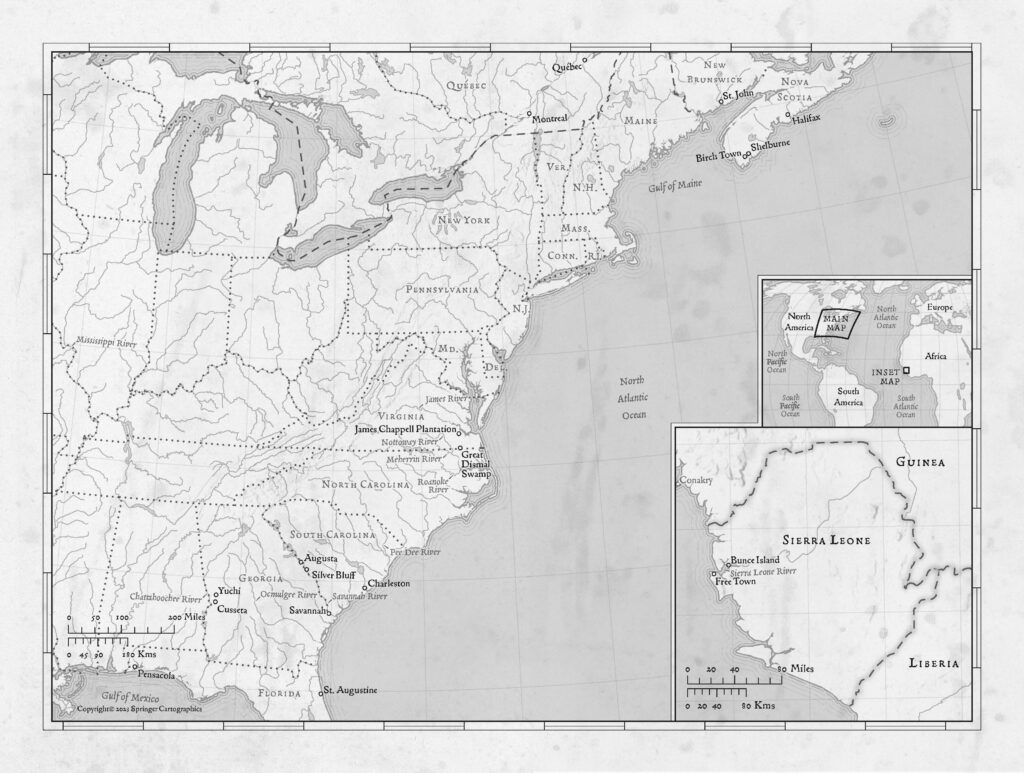
Beyond his story of escape and adventure, there are deeper reasons to follow David George’s odyssey. He eventually gained emancipation during the American Revolution, but tellingly, he did not find freedom with the people who proclaimed “that all men are created equal, that they are endowed by their Creator with certain unalienable Rights, that among these are Life, Liberty and the pursuit of Happiness.” David George fled this new land of “liberty” and ran to the British. And when Britain lost the war, he evacuated with them, escaping the United States in the moment of its creation. With thousands of other refugees, George settled first in Nova Scotia and eventually in Britain’s experimental anti-slavery colony of Sierra Leone. As a result, George’s story offers a powerful reminder of the limits of understanding the American Revolution through the stories of white founding fathers. When the authors of the Declaration wrote that “all men are created equal,” they did only mean men, as they denied women the right to vote or hold office, and they did not truly mean all men. The early United States maintained property qualifications on voting to deny political participation to poor men and preserved a system of racial slavery that not only denied most Black men the right to vote but also defined them as the property of wealthy white men.
David George’s view of the American Revolution reveals that its meaning was subjective—a matter of perspective. The stated principles of the Revolution, such as “all men” being “endowed . . . with certain unalienable rights,” sounded universal, but they were selectively applied. The Revolution was indeed a watershed moment in the development of democracy and for enshrining the idea that individuals had rights that a government was bound to honor and protect, but not all people within the nation’s borders were invited to participate in that democracy or to enjoy the protection of those rights. Over time, excluded Americans would fight for inclusion in the democratic experiment, with property qualifications removed from voting rights after several decades, slavery outlawed after nearly a century, women securing the right to vote several decades after that, and legislation spurred by the civil rights movement eroding Jim Crow–era restrictions on voting for non-white citizens in the mid-twentieth century. In modern conflicts over voting rights, racialized incarceration rates, and pathways to citizenship for immigrants, such struggles over inclusion and exclusion in American democracy continue.
To understand the roots of such struggles, it is crucial to view the American Revolution not only from the vantage of Washington, Jefferson, or another political founding father. Most, after all, were slaveholders. In many ways, they defined their ideals of freedom and liberty in contrast to the bondage they perpetuated for Black people. The Revolution looked quite different to the people they enslaved. Understanding these multiple perspectives on and varied realities of the American Revolution is incumbent on all Americans, if we ever hope to address the inequalities plaguing our society. The history of slavery is not only important for the descendants of enslaved people. As Martin Luther King Jr. noted: “Whites, it must frankly be said, are not putting in a similar mass effort to reeducate themselves out of their racial ignorance. It is an aspect of their sense of superiority that the white people of America believe they have so little to learn.” Investigating David George and the history of slavery more generally offers a modest attempt at such reeducation. George’s story offers more than just African American history, although it certainly is that. In his struggle for freedom in early America, and ultimately his flight from the United States, David George can help all modern Americans see our society and the legacies of the revolution we inherit, warts and all.
The Escapes of David George copyright © 2026 by Gregory E. O’Malley. All rights reserved.