When people think of fashion designer Emilio Pucci, it is of his bright, swirling colors and easy, freeing fabrics, and everyone from Sophia Loren to Jackie Kennedy donning the eye-catching dresses that personify La Dolce Vita. What few know about Pucci, however, is that before creating his world-famous fashions, he played a critical role in the war against the Nazis, risking his life to smuggle out to the Allies one of the most important documents of World War II.
Read on for a featured excerpt from Emilio Pucci: The Astonishing Odyssey of a Fashion Icon by Terence Ward and Idanna Pucci with a foreword by Suzy Menkes.
Prologue
On this frigid afternoon in January 1944, a lonely figure staggers along the snow-blanketed Italian-Swiss border. The Italian lieutenant’s dark gray eyes stare straight ahead. His chiseled chin and nose signal his Tuscan roots. Mist billows from his breath. The scent of fear blows in the wind. An air force officer’s winter coat covers him below the knees. His ordeal across northern Italy has left him emotionally drained. Adrenaline keeps his exhaustion at bay. Atop his cap a light dusting of snow. At his hip, he carries a Beretta.
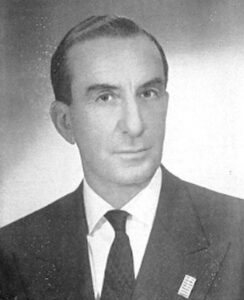
Emilio Pucci’s age, twenty-nine, belies what he has witnessed: pitched air battles, falling planes, exploding torpedoes, sinking ships. Spilled blood and oil staining the blue Mediterranean. As a fighter pilot, he has flown missions over bleak African deserts, where desperate men fought to the death in sandpits of infernal heat. Each air squadron in which he served has been decimated. He is one of the few pilots still alive.
During these dark days, the country has imploded. Fear and carnage stalk the peninsula. Nazi troops have occupied all of north and central Italy for the last five months since the German invasion on September 9, 1943. A terrifying phase has begun: the massacre of Italians by Italians in their homes, on the streets, in the fields, and the dark woods. Hundreds of thousands have been deported to German labor camps.
On October 16, SS troops burst into the Roman ghetto at Portico d’Ottavia while petrified families hid at the back of their shuttered shops. Hounded from their homes at gunpoint, the unlucky ones were forced into trucks. That same day, several Jews found shelter in the nearby Fatebenefratelli Hospital. When the SS stormed in to check the rooms, Dr. Giovanni Borromeo stopped them, shouting that all the patients were suffering from the deadly K syndrome, an extremely contagious disease. He had invented it at that very moment. The SS ran off, terrified. While those inside the hospital were saved, 1,023 Roman Jews were put on trains destined for Auschwitz.
Under the supreme command of Field Marshal Albert Kesselring, German soldiers now patrol the heart of the capital while the Allied forces battle their way up the peninsula from the south, tearing asunder the fabled landscape. South of Rome, the tenacious Germans hold fortified positions on the murderous Gustav Line that stretches from the Adriatic to the Tyrrhenian Sea. Between these two antagonists, Italian civilians are trapped in brutal killing zones.
It is late afternoon, and all is silent. The tired sun casts enough light for Emilio to find his car. A long hour has passed since Countess Edda Ciano safely crossed the frontier into neutral Switzerland. In parting, Emilio placed a spare revolver in her hand, saying, “Don’t let the Germans capture you alive.” The frightened countess is carrying the diaries of her husband, Galeazzo Ciano, Mussolini’s former foreign minister. Charged with treason, Ciano now languishes behind the ancient walls of a prison in Verona. Soon, he will be executed.
Emilio knows one thing: if Ciano’s personal war diaries can reach American hands, the world will understand how the reluctant Italians were abused by Nazi leaders and dragged into war. These sensational pages will destroy all illusions of a united Axis and reveal Mussolini’s humiliating servitude to the Third Reich. In these documents lie Italy’s only hope for redefining herself by ripping away the mask of Fascism, bringing its tragic legacy to an end.
The air force pilot carries a price on his head: dead or alive. Despite the biting cold, his body seethes with heat, gripped by fever.
He faces one more mission that might well be his last.
Emilio Pucci copyright © 2026 by Terence Ward and Idanna Pucci. All rights reserved.