
When the Roman statesman Cicero was murdered in 43 BCE, his head was cut off, and his tongue pierced with pins – a final, brutal act of revenge against a man whose words had shaped a generation and made him many enemies. But beyond this gruesome end, who was Cicero and how did he become such a powerful figure in Ancient Rome? Classical historian Catharine Edwards brings Cicero to life in this gripping biography of the statesman, which you can start reading below.
Introduction
Marcus Tullius Cicero had in the year 63 bce achieved Rome’s highest elected office, the consulship. He was at the peak of his stellar career, having made his name as Rome’s premier advocate and orator. Now, as consul, he was for twelve months one of Rome’s two chief executive officers, responsible for the safety of the state. In the face of a looming crisis, on 8 November Cicero summoned a meeting of the Senate. Rome’s senators were to assemble in the Temple of Jupiter Stator (‘Jupiter the Steadier’). The choice of location signalled that Rome was in danger. Anxious crowds surrounded the building. Cicero was positioning himself as the city’s saviour.
Addressing his fellow senators, Cicero put his phenomenal verbal skills to devastating use. Those gathered were being alerted to the threat posed by one of their own number. Thwarted in his attempt to secure high office by legitimate means, Catiline, an aristocrat of military distinction and personal charm, was laying a plot to overthrow the Roman state. But Cicero had learned of his plan.
How far then, Catiline, will you go on abusing our patience? How long, you madman, will you mock at our vengeance? Will there be no end to your unbridled audacity? Is it nothing to you that the Palatine has a garrison at night, that the city is patrolled, that the populace is panic-stricken, that all honest citizens have rallied to the standard, that the Senate is meeting here behind stout defences, and that you can see the expression on the faces of the senators? Do you not appreciate that your plans are laid bare? Do you not see that your conspirators are bound hand and foot by the knowledge every man here has of you?
Catiline, Cicero declared, was fomenting a conspiracy aimed at armed revolution. It was utterly shocking that a man who had served in high offices of the Roman state – and had even put himself forward for election to the consulship – should now be engineering Rome’s ruin. Catiline responded vehemently in his own defence. But over the weeks, evidence mounted against the conspirators. In a bid to seize power they were planning to kill senior officials, including Cicero himself, and set fire to Rome. Cicero obtained compromising letters, which were read out to the Senate, and several of the ring-leaders (men of grand old senatorial families) were arrested and imprisoned. Not Catiline himself, however, who had by this point withdrawn from Rome to the Italian countryside.
The Senate was made up of around 600 men who had previously served as senior elected officials. Theoretically they advised the consuls and drafted legislation. Though they were not sovereign, in practice their decisions were rarely challenged. In this moment of crisis, senators debated how best to punish the men who had been arrested. Marcus Cato (a young senator known for his uncompromising nature) argued for their execution, while Julius Caesar (a rising star both in debate and on the battlefield) contended it was better to keep them incarcerated. Those arguing for execution won the day. Emergency circumstances were invoked to justify dispensing with a formal trial. Cicero, as consul, oversaw the executions, accompanying the condemned men down into the Mamertine prison in the bowels of the Capitoline Hill. Here, they were strangled to death. Catiline and his armed followers in Tuscany were defeated in battle by Cicero’s fellow consul Gaius Antonius; Catiline, a leader renowned for his formidable military valour, died at the forefront of his men.
Cicero had masterminded the containment and suppression of the conspiracy with a cool head – or so it seemed. His unmatched ability to persuade, to rouse the emotions of his listeners, served to marshal opinion within and beyond the Senate against Catiline, who, for all his aristocratic lineage, was cast as an enemy of Rome (rumours spread that Catiline planned to free slaves, as well as setting fire to the city). The crisis was averted. Cicero was the hero of the day. He was acclaimed as ‘father of the fatherland’.
That first speech against Catiline has gone on to have an astonishing life of its own. In 63 bce, Cicero spoke as the voice of the establishment, a protector of order – and property rights – against revolutionary threat. Countless others have adopted and adapted his words in later centuries. In 1794, for instance, Alexander Hamilton denounced those who protested against paying tax to the federal government of the fledgling United States as promoters of anarchy: ‘How long, ye Catilines, will you abuse our patience?’ When the parliament building for the newly united nation of Italy was being decorated in the late nineteenth century, its fresco cycle featured Cicero denouncing Catiline in the Senate. Cicero’s speeches have served as a model for advocates and politicians of many stripes for two millennia.
Oratory, the art of speaking in public, had pride of place in the political life of republican Rome. Individuals rose to prominence in the law courts, where their skill as advocates played a key role in determining the outcome of trials and success often served as the platform from which to launch a political career. Ambitious Roman politicians regularly brought court cases against one another, accusing their rivals of bribery and corruption, or worse. Trials took place in public. Anyone who wished could listen in. Orators deliberately aimed to attract crowds of passers-by with their eloquence, seeking to entertain with jokes and vivid character assassination. Persuasive speeches, appealing to Roman citizen voters, could also play a key role in winning elected office and thence entry to the Senate. Within the Senate, individual senators might be persuaded in favour of or against a particular proposal by one another’s speeches.
For several centuries, the political system of the Roman republic was acclaimed as a hugely successful ‘mixed constitution’. All adult male citizens had a say in government – at least officially. They were entitled to vote in the people’s assemblies to elect officials. These elected officials were powerful; some of them led Rome’s formidable armies. But they served for a term of just one year and were expected to defer to the authority of the Senate as a body. All the same, tensions might arise between an individual official and the Senate. Sometimes officials overrode senatorial opposition, leveraging the powers of the people’s assemblies to vote on legislation. Here too, however, the power to speak persuasively was a formidable political tool.
No matter what audience he found himself in front of, Cicero adapted himself brilliantly. For decades the acknowledged master of the spoken word, he was adept at addressing the Senate, the law courts or ordinary Romans in the run-up to voting on a new law in the people’s assembly. Through years of study and practice he had forged a style of speaking which cast a spell over his listeners. Long, rhythmic sentences seemed to carry his audience to an inescapable conclusion. ‘How often did you attempt to kill me when I was consul elect and how often after I was consul?’ he demanded of Catiline. ‘How many of your thrusts, so aimed that they seemed unavoidable, I escaped by a slight movement and a dodge, as they call it!’ The accusations he made against Catiline in such vivid terms were compelling, the emotions of his hearers raised to fever-pitch.
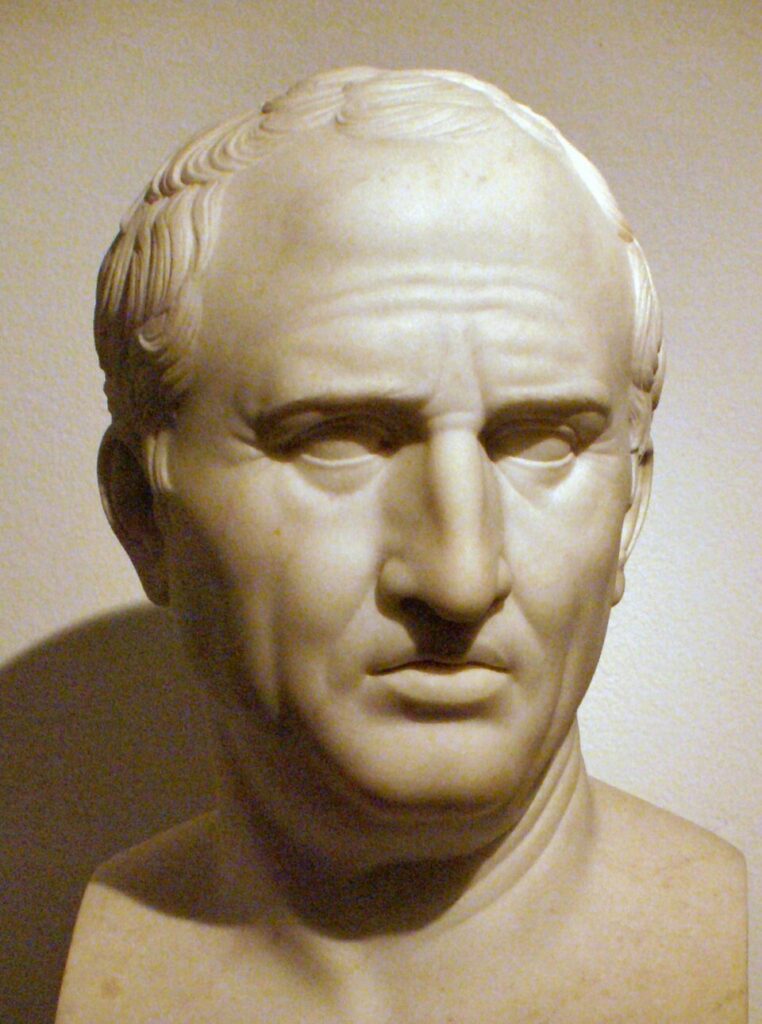
The one surviving portrait of Cicero which has any claim to authenticity shows a middle-aged man. His bearing is lively and assured, his presence substantial. Swathed in a toga, he shines in the Forum and Senate House. He is a performer who knows how to hold an audience in thrall, but his expression is serious. This marble portrait bust is idealised, to be sure. Yet it shows a man with receding hair, crow’s feet, a double chin. His face is handsome but bears signs of ageing. Romans prided themselves on valuing the wisdom of experience over the beauty of youth.
Years of listening to others, of practice as a speaker and of immersion in ancient Greek writings (philosophy, as well as speeches) informed Cicero’s vision of the orator’s role. The ideal orator, he claimed, was not just a man skilled in speaking, in persuading a crowd. He also possessed the wisdom and judgement which enabled him to offer the best guidance to his fellow citizens. He combined deep respect for Roman political tradition and Roman law with a mastery of reasoned argument equal to that of Greek philosophers. The ideal orator would serve the best interests of the state. In an emergency, he might prove the state’s saviour. As he proclaimed in the last of his speeches against Catiline: ‘Others have received thanks for having served the country well – but I alone for having saved it.’
Though Rome’s political system was soon to be transformed with the establishment of the principate (a form of one-man rule) under Julius Caesar’s adoptive son Augustus, for centuries ancient Roman students would dutifully commit to memory the works of Cicero and emulate his techniques in their own speeches. It did not matter, it seems, that Cicero was fundamentally opposed to one-man rule and had strained every sinew to preserve Rome’s traditional political order of government through shared, time-limited office-holding, overseen by the Senate. The biographer Plutarch, writing in Greek 150 years after Cicero’s death, heralded him as the Roman counterpart of the pre-eminent Greek orator Demosthenes (also a fierce critic of one-man rule). Cicero’s speeches continued to figure prominently on the curriculum for the male offspring of European elites from the early modern period to the mid-twentieth century.
But, twenty years after his consulship, Cicero’s eloquence would also be his undoing. On 7 December 43 bce, in the chaotic aftermath of Julius Caesar’s assassination, having denounced Caesar’s associate Mark Antony (another man he cast as an enemy of the state with tyrannical ambitions), Cicero met a violent end, cut down as he attempted to escape in a litter from his villa near Caieta (on the coast between Rome and Naples). No contemporary account survives but later writers vividly describe the bravery with which, when it was evident there was no escape, Cicero abandoned his attempt to flee and faced up to his assassins, offering them his neck.
Cicero’s severed head and hand were put on display on the rostra, the speaker’s platform in the Forum in the heart of Rome, from which, just a short time previously, his potent oratory had held sway over crowds of listeners as he rallied them against Antony’s bid for power in the wake of Caesar’s death. In less turbulent times, statues adorned the rostra, honouring the great and the good. This grimly parodic arrangement of body parts was the ultimate act of dishonour and a gruesome illustration of the violence being done to Roman institutions.
According to one report, Fulvia, Antony’s wife, even had Cicero’s tongue (a weapon so eloquently deployed against her husband) pierced with pins. It was Antony who had persuaded Octavian (the youth who would later be known as the emperor Augustus) and Marcus Lepidus, the other two members of the three-man committee (known as the triumvirate) now in charge of the Roman state, to let him add Cicero’s name to the list of the proscribed. This list was written up and posted on white boards in the Roman Forum in November 43 bce. More than 2,000 names were included. Any individual on the list at once forfeited their citizenship and all its protections. Those who informed on the whereabouts of the proscribed could hope for a reward; a larger reward was payable on production of a proscribed person’s head. Cicero’s head meant a cash prize for his killers. How had it come to this?
Marcus Tullius Cicero started out as an engaging young man of dazzling talent, huge energy and fierce ambition. Born in 106 bce to a wealthy family in Arpinum, a small town around 110 kilometres south-east of Rome, he went off to the city to study with Rome’s leading orators. A landmark victory in a politically sensitive case in 80 bce launched his glittering career as an advocate. Following an interval studying Greek rhetoric and philosophy in Athens and Rhodes, he was elected quaestor for 75 bce. This position (held for one year) brought a period of administrative responsibility, looking after finances and supply issues in Sicily, one of Rome’s subject territories. It also brought a lifetime seat in the Senate, where Cicero soon made a name for himself in debates. Despite his lack of aristocratic background, he secured election to Rome’s highest office, the consulship, for 63 bce. This was an eventful year, as we have seen.
But while the threat posed by Catiline was successfully averted, Cicero – and most of his fellow senators – were largely oblivious to the root causes of the uprising. Catiline had attracted support from diverse sources, including impoverished aristocrats, other individuals who had been banned from politics (as a punishment imposed on their fathers twenty years previously by the dictator Sulla), many among the urban poor, army veterans struggling to make a living and farmers whose lands had been confiscated. Catiline proposed a redistribution of land, appealing to those who had lost their farms or could not make a living from the land they had. He also proposed a cancellation of debts. Indebtedness was endemic in Roman society in the late republic, and not just among the poor. Many among the Senate borrowed eye-poppingly large sums. Successful political careers demanded great expenditure: the provision of spectacular entertainments, the distribution of handouts to voters and substantial gifts to down-at-heel aristocrats whose influence might prove useful.
Cicero regarded the balance of powers in Rome between elected officials, Senate and citizens’ assemblies as pretty much the perfect recipe for good government. And yet things had not been running smoothly. Champions of the Senate’s authority were increasingly at odds with those who wanted ordinary Romans to have a greater say. These disruptors were resented by conservatives. From the late second century bce, outbursts of political violence left the city reeling. In the heart of Rome, elected officials seeking to enact radical legislation were killed by their fellow citizens. The killers claimed to be acting within the law. Could consensus, even about the rules and norms of politics, be restored? Had consensus ever really existed? Some thought traditional ‘consensus’ was a mirage, an excuse for protecting the ascendancy of a small group of established families.
But the context in which Rome’s political institutions operated had certainly changed. By the time of Cicero’s consulship, Rome controlled a vast geographical area, stretching across the Mediterranean and beyond. In the west, besides most of Italy, Sicily and Sardinia, they occupied parts of southern France, Spain and North Africa. In the east, Roman territory now included many of the lands once occupied by Alexander the Great, Greece and territories far beyond, where Greek had become the language of the elite and of local government. Many Romans, Cicero included, were rather in awe of Greek culture; Roman education and the vibrant Roman literary culture which flourished in Cicero’s time took much inspiration from Greek models.
As well as cultural influences, the Roman empire under the republic (and later too) sucked resources from the territories it conquered with devastating effect. And yet the Roman state was not hugely wealthy. The silver, the gold, the artworks, the human captives were concentrated in the hands of private individuals, particularly the generals who led Rome’s legions to victory after victory. While the Roman state imposed taxes on its provincial subjects, individual Romans made huge fortunes as loan-sharks, lending money at extortionate rates of interest to tax-payers.
Within Rome, extremes of wealth and poverty were dramatically juxtaposed. Many of the city’s huge population lived lives of unimaginable squalor and deprivation. According to Cicero’s contemporary Sallust, Catiline, trying to rally the poor to his cause, had pointed to such contrasts, aligning himself with the homeless. Rome’s rich and powerful few, he claimed, ‘join together two or even more houses to form a mansion, and yet we have nowhere a hearthstone’. Profits from campaigns in the region of the Black Sea funded the lavish estates of one general, Lucullus. The landscape gardening of his seaside villa near Naples left contemporaries open-mouthed: ‘he suspended hills over enormous tunnels, circled his residences with moats linked to the sea and with streams for the breeding of fish’. Lucullus, it seemed, aspired to the kind of luxury associated with eastern tyrants, thereby earning the moniker ‘Xerxes in a toga’.
And in the political sphere too Rome’s generals, the men who led those hugely profitable campaigns, despite all the conventions of Rome’s unwritten constitution, came to set their own rules. Powerful figures such as Pompey and Julius Caesar, away from Rome for extended periods at the head of their legions, sought to influence decisions back in the city through allies, often those serving as tribunes, officials with a particular scope to propose – and to disrupt – legislation. The tribunes’ official role was to serve as protection for ordinary Romans. Some among them understood well the desperation of Rome’s poor and, especially when it came to key votes in the assemblies of the people, were more than ready (or so their critics claimed) to exploit the worries of anxious city-dwellers for their own political ends.
Cicero made a dangerous enemy of one particularly influential tribune, Clodius. In the aftermath of his consulship, a law was passed in 58 bce, on the initiative of Clodius, under which Cicero was threatened with indictment for executing some of Catiline’s associates without following due process. Cicero was forced to flee into exile. Utterly crushed by this experience, he eventually managed to secure a recall, thanks to the intervention of the hugely powerful Pompey. In the early 50s bce, Pompey was Rome’s pre-eminent general, trailing clouds of glory from his extensive conquests in the east. He had brought under Roman subjection Syria and Bithynia-ontus – a large zone on the Black Sea coast – as well as extending Roman control in western and south-eastern Türkiye. But he needed allies in the Senate to ensure his arrangements for the government of these new territories were fully implemented – and to guarantee a proper reward for his soldiers. Cicero’s rhetorical skills and moral authority could come in useful.
On his return from exile, Cicero’s career was relaunched. But his confidence had been profoundly shaken. Siding too decisively with Pompey was potentially a dangerous option. It would not do to antagonise Pompey’s great rival, Julius Caesar, who would turn out to be still more formidable. Pompey’s conquests in the east were soon being outshone by Caesar’s all-out assault on Gaul (France and Belgium). By the end of his nine-year campaign (58–50 bce), Caesar was enormously wealthy and had under his command eleven legions whose unshakeable loyalty to their general was a powerful weapon. Anxiety about Caesar, and those who came in his wake, would permeate the remaining years of Cicero’s life.
Of all those who lived in Roman antiquity (at least before Augustine wrote his Confessions in the early fifth century ce), Cicero is the one about whom most is known. Not only did he leave a huge number of speeches, philosophical works and even some fragments of poetry, we also have access to a breathtaking quantity of his personal letters. After his death, several collections of his letters were put into circulation, and were well known to educated Romans of later generations. One includes around 425 letters, all addressed to Cicero’s close friend Atticus, a man of immense education, wealth and diplomatic skill who, though never a Roman senator, nevertheless had a large network of very influential friends. To Atticus in particular Cicero seems to confide all his hopes and worries, along with gossip and detailed speculation about the latest political happenings. Another collection, To Friends, includes around 435 letters, addressed to a large number of different individuals, most of them Roman senators. But there are also some to Cicero’s wife Terentia, and his children, and to his secretary Tiro, who worked closely with Cicero and who for many years was enslaved. Not all the items in this collection are written by Cicero: some are letters addressed to him by his friends and acquaintances. Another, smaller, collection is addressed to Cicero’s brother Quintus, and yet another includes letters to Marcus Brutus, the man who took a lead in the assassination of Julius Caesar. It is above all Cicero’s correspondence which enables us to have such astonishing access to the world in which he lived.
What follows is both an account of the great orator’s life and an attempt to offer a Cicero’s-eye view of the world he inhabited. It is a world of compelling contradictions, and one whose challenges often seem to resonate disconcertingly with those of the early twenty-first century. The checks and balances of a political system which had developed piecemeal in the context of a much smaller state were strained to breaking point when Roman power extended over much of the Mediterranean world. Amid extremes of wealth and poverty, individuals of towering ambition sought to manipulate the grievances of their fellow citizens as a means to achieve money and power beyond their forefathers’ wildest dreams. Cicero, for all his compromises and self-deceptions, his vacillations and hesitations, remained staunchly attached to the rule of law – at least in theory – almost to the very end. Perhaps less imaginative than he might have been when it came to ways the state could be reformed, he did all he could to solve Rome’s problems through negotiation and persuasion rather than violent conflict.
Cicero’s reputation as a powerful speaker has lasted well. Many have modelled their own oratory on his speeches. For centuries Cicero was quoted by politicians, lawyers and others showing off their learning, and flattering their audience. ‘The good of the people is the chief law’, ‘there is nothing so absurd but some philosopher has said it’ – such Ciceronian phrases were repeated endlessly. A Ciceronian tag might signal status, education and perhaps, too, establishment politics. O tempora! O mores! (‘Oh, what a time we live in!’), as he exclaimed in his first speech Against Catiline. But as a politician Cicero has had detractors as well as fans. At times in more recent centuries he has been held up as a champion of constitutional government, yet accusations of inconsistency, even hypocrisy, in his attitude to Julius Caesar have also dogged his reputation. And many have blamed him for underestimating Caesar’s adoptive son. Cicero tried unsuccessfully to manipulate this young man in an attempt to thwart what he saw as the existential threat to Rome posed by Mark Antony. Quite possibly these maneuverings served to facilitate the rise of a youth who, as Augustus, would himself bring about lasting one-man rule. Cicero’s political reputation sank particularly low in the nineteenth century. The hugely influential German historian Theodor Mommsen criticised him as ‘a statesman without insight, idea or purpose’ and had no time at all for his ‘journalistic’ writings.
Cicero left not just speeches and letters but also a host of other works, grappling with a huge range of topics in politics, ethics and the philosophy of religion. Dismissed though they may have been by Mommsen, these have proved a vital part of Cicero’s legacy, serving as a point of departure for philosophers and political theorists from Machiavelli to Voltaire and beyond. He has been celebrated as the premier exponent of Natural Law. Shelley hailed him as a ground-breaking advocate for atheism.
In the following chapters I have aimed to root Cicero in his times in the light of recent scholarly research which has offered new insights into issues such as the place of slavery in Roman society, the economic impact of the Roman empire on its subject peoples and the sophistication of Cicero’s philosophical writing. Specialists in the field may feel I have oversimplified the complex political events of Cicero’s time, in particular through omitting mention of many individuals who played an important part in what was happening. Roman names are complex and confusing. Individuals, sometimes not closely related to one another, often have the same name. Wanting to avoid overwhelming the reader, I have tried to include names only when they are essential to understanding what was going on for Cicero. As well as a list of key names, and a glossary of Roman political terms, there are at the end of the book suggestions for further reading in relation to each chapter.
Many aspects of what made Cicero who he was must remain beyond our grasp. We know nothing of his relationship with his mother, for instance, and can glean only the haziest sense of his formative early years. The Ciceronian self which emerges even from the letters is a fragmentary one. And yet he remains the ancient Roman about whom we know the most. His own understanding of the world he lived in has also had a hugely disproportionate influence on our sense of society, politics and intellectual life in the late Roman republic. In fact, it is to a large extent through his writings that this particular ancient Mediterranean state has had such a profound influence on ways of writing and thinking in later western societies. But every age finds its own version of Cicero, its own version of the Roman republic. At a time when contemporary political structures feel increasingly under pressure, when questions about the place of persuasion and appeals to the popular will in politics are especially pressing, Cicero’s life and times – and his extraordinarily varied writings – have perhaps never seemed more relevant.
Cicero’s Tongue. Copyright © 2026 by Catharine Edwards. All rights reserved.