
Once Upon a Town author Jane Ziegelman credits her studies in cultural anthropology for making her aware of how the most mundane item is still culturally significant. In a similar approach, the writers of yizkor books aimed to write every detail about their mostly Jewish towns, no matter how seemingly insignificant, so that nothing would be lost in history. While studying yizkor books, Ziegelman noticed how mud, such a ubiquitous substance, played an important role in shaping the daily lives of residents in these predominantly poorer Jewish towns.
One of my early ambitions was to be an anthropologist, and for a short while it looked like that might happen. After college, I entered a grad school program in cultural anthropology, and for several years plowed ahead. The middle of the fourth year is when I decided academics wasn’t for me. But while I left academia, what I learned in anthropology shaped how I approach writing about history.
Anthropologists have long recognized the cultural importance of even the most ordinary seeming artifacts, a glass bead, a cooking pot, a street sign. I credit that attention to the ordinary with my own focus on the day-to-day existence of other people in other times.
In my new book, Once There Was A Town, I write about shtetls, the small, predominately Jewish towns once strewn across Eastern Europe. Before World War II, there were thousands of these towns. By the end of the war, this unique form of Jewish community no longer existed.
My depiction of shtetls relies heavily on a primary source known as yizkor, or memory books; books written by former shtetl residents, many of them survivors, to preserve the memory of their fallen hometowns.
Anthologies of a sort, yizkor books are made up of essays, memoirs, poems, stories, and testimonials. The towns they describe were, for the most part, poor communities made up largely of tradespeople and small-time shopkeepers. Shtetl dwellers worked feverishly just to put food on the table and fire in the stove. Yizkor books deal extensively with the daily trails of shtetl existence, hunger, cold, disease, and, at certain times of year, mud.
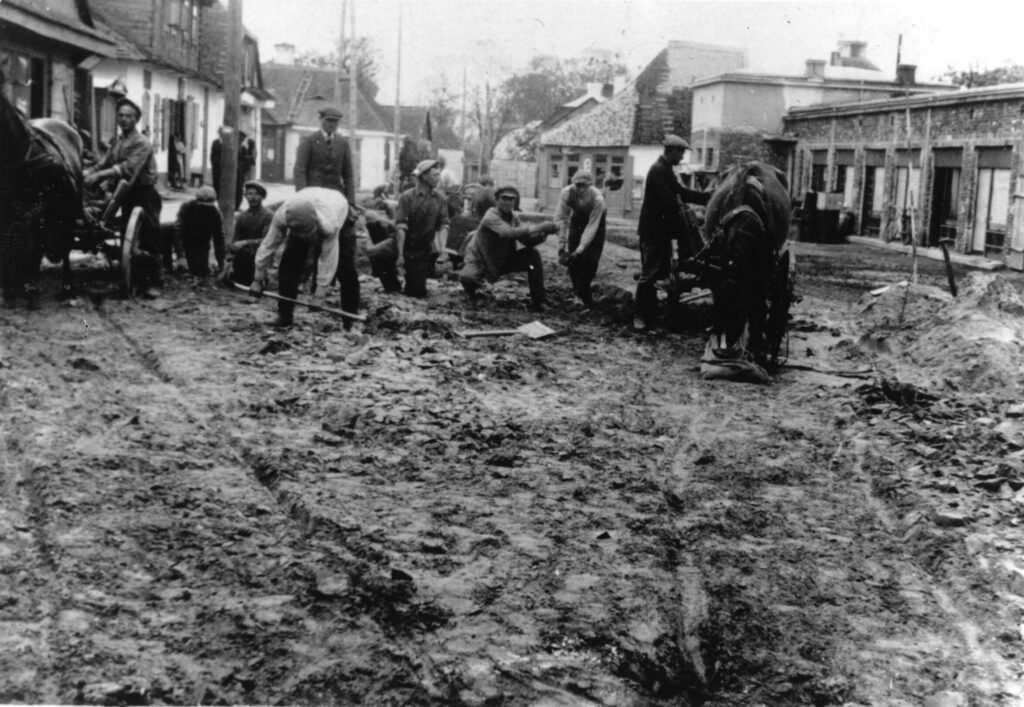
Over the course of my research, I read hundreds of yizkor books, and though I can’t give an exact number, many talk about mud, a perennial nuisance in towns where streets were unpaved.
Mud plagued the drivers of horse drawn carriages and carts, whose wheels sunk into the muck and became immobilized. For pedestrians, the mud was so deep that it pulled the boots off their feet. Mud became mixed with the contents of chamber pots, and other pollutants. Take, for example, mud season in this industrialized shtetl in western Ukraine. Boryslaw was a bustling town of energetic workers in the oil industry. The Jews of Borysław grew up in busy, winding streets, soaked in deep mud. The mud puddles flooded the roads with slime, a shiny, gray grease like sour cream mixed with crude oil, which bubbled up out of the ditches. There was always a sharp, biting smell in Borysław. You could walk only on narrow, unsteady, wooden boardwalks, which were suspended on nothing and were always shaky.
But mud also had its admirers. Yizkor books tell us that shtetl children—like children everywhere—used it as sculpting medium to make “cakes” and castles. And if conditions were right, there was a certain beauty to mud. In the shtetl of Tiszowic, on clear nights, the “moon was reflected and shone so brightly on the mud, that it seemed there was no earth and no sky, but two skies, and two moons…”
Hitler’s ambition was to erase East European Jewry so completely that no trace of it would be left. Total obliteration. Yizkor book writers saw it as their responsibility to prevent that from ever happening. Working on the theory that anything they omitted was at risk of being forgotten, they aimed to document everything. As a result, we learn from yizkor books that children played games with buttons; that homes were heated by masonry stoves which people slept directly on top of; and that shtetl homemakers kept coins in their apron pockets so they would always have something to give to beggars.
Writing a yizkor book required perseverance. Between one thing and another, they often took years, sometimes decades to complete. Their authors, however, were fiercely committed to what they felt was their life’s mission: To ensure that both their descendants and the world would never forget what had been an immensely rich and vibrant way of life, mud and all.