
Today, Eaton Square is London’s most sought-after address due to its beautiful garden squares and its location just minutes away from Buckingham Palace. In his new book, The Secrets of Eaton Square, Windsor biographer Alexander Larman reveals the scandalous social and political history of Eaton Square that begins in the eighteenth century and runs right up until today. With a cast of characters that includes everyone from Neville Chamberlain, Joachim von Ribbentrop (the lover of Wallis Simpson), Diana Mitford, Vivien Leigh, Margaret Thatcher, and even James Bond, Larman’s book brings Eaton Square alive. Read on for a featured excerpt of this entertaining book.
Prologue:
The Balloon (Nearly) Goes Up: The Five Fields
Around half a century before Eaton Square ever came into existence, the area that would become the toast of the beau monde was a committed haunt of the demimonde instead. If, that is, the brigands, chancers, rapscallions, and downright rotters who lurked in the area even deserved such an appellation. Belgravia, as it was subsequently called, spent centuries existing not as its own highly desirable part of London high society but as a near-forgotten, semi-rural enclave that was most notable for buffering the journey between Westminster and Chelsea, and where market gardens were laid out to provide London’s citizens with fresh food.
Had this been all it was known for, it would have been harmless enough—Covent Garden, before that district became London’s largest fruit and flower market—but where there is proximity to wealth, there is the temptation to commit all manner of wickedness. The area on which Eaton Square itself was built was a large patch of marshland known as the Five Fields, which was synonymous with highwaymen, cutpurses, and opportunistic crime. It had acquired especial notoriety in 1728 for a murder that took place at the so-called Bloody Bridge, which crossed the Thames tributary the Westbourne, not far from present-day Sloane Square; it acquired its evocative name after a man’s corpse was found with both its face and fingers removed.
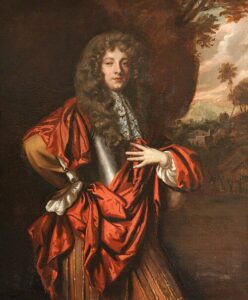
Owned by Sir Thomas Grosvenor, who had acquired the “swampy meads” thanks to his marriage in 1677 to the then twelve-year-old Mary Davies, who brought it as part of her dowry—Grosvenor was twenty-one at the time—the Five Fields remained unexploited by Grosvenor and his descendants for more than a century. The acquisition of nearby Buckingham House in 1761 by George III as a private home for his wife, Queen Charlotte, and its subsequent informal renaming “the Queen’s House,” saw the once-unspeakable locale acquire, if not quite respectability, the attention of the emergent middle classes, as well as the more aspirant end of the aristocracy. After all, jockeying for social position was as much a sport—or a vocation—as any other activity that could be undertaken with one’s clothes on in Georgian England. It would take an ambitious, intelligent man, who was smart enough to commission one of the leading master builders of his time, to capitalise on the opportunities that the area could offer.
Before then, however, the Five Fields exchanged one group of disreputable ne’er-do-wells for another. The footpads and outlaws slunk away to other, less visible parts of London, and they were replaced by brightly clad and seemingly shameless con artists who sought to elicit money from curious passers-by with displays of prowess and apparent skill, although competition from one’s peers meant that such endeavours had to be ever more ambitious in nature. It was the right time for such bravado. London in the late eighteenth century was a riot of colour, novelty, and fashion, with the youthful George, Prince of Wales, simultaneously delighting and appalling society salons with his profligacy, high-profile mistresses, and frankly questionable aesthetic taste. Yet where the future king led, his future subjects, of varying levels of legality, sought to follow.
In the summer of 1784, the idea of ascending into the heavens in a hot air balloon had become the most talked-about venture in London. As with many things fashionable, the concept had originated in France. “Balloonmania,” as it was called, had gripped the country from 1783, thanks to Joseph-Michel and Jacques-Étienne Montgolfier, two brothers who had, after numerous public displays and unmanned flights of varying degrees of success, managed to launch the first manned voyage of a hot air balloon on 21 November 1783. It led to an international aeronautical obsession but also tacitly suggested that it was only the French who had the chutzpah and technical skills to pull off such a daring feat. This meant, naturally, that when a man calling himself the Chevalier de Moret announced his intention to stage the first manned balloon flight in Britain from the future site of Eaton Square, it was greeted with an unusual amount of interest and enthusiasm, even from those who should have exhibited a healthy degree of scepticism.
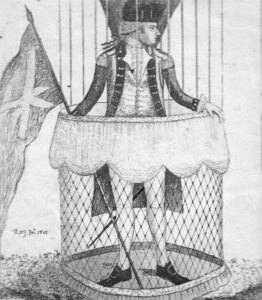
One man who was more than usually equipped for such wariness was an Italian named Vincenzo “Vincent” Lunardi, who called himself the Daredevil Aeronaut. Along with his friend George Biggin, he planned to make the first manned flight from the Artillery Ground of the Honourable Artillery Company in Finsbury in the City of London on 15 September 1784. Lunardi was accordingly irked when Moret announced that he would make his own launch from the Five Fields a month earlier. He wrote to his guardian Gherardo Compagni to complain, “A Frenchman whose name is Moret; and who may possibly have assisted at some trials at Paris to launch Balloons in the manner of Montgolfier, advertised as it were in competition with me; and fixed on a day for ascending with his Balloon, previous to that, on which I had the permission of Sir George Howard to make my excursion from Chelsea-Hospital.”
Lunardi knew that his own balloon was not yet ready for the contest but decided to gamble on his rival failing. “To hasten my own undertaking would have been entering into a ridiculous race with Moret; and if I had been inclined to such a measure, it was probable, that the day appointed for me would not have been changed, without a better reason than could have been assigned from the competition. I therefore waited, with as much patience as I could command, the event of Moret’s experiment; imagining, however it would fail, from a view of the Balloon; but having no apprehension of such consequences as might involve my disappointment, or my ruin.”
When Moret arrived at the site of the launch on 10 August, his endeavour was greeted with all imaginable excitement and publicity, to say nothing of its lucrative potential, but also with understandable scepticism. An estimated—and probably exaggerated—fifty to sixty thousand people* came, after a bold advertisement offered “a Clear and Entertaining Description of that wonderful Invention, as it is to be launched and navigated.” Lunardi, who was not present, commented, “The gardens and field around the place were crowded . . . not so much from economy, as incredulity and suspicion, of the undertaking. That was greatly owing to his manner of anticipating my design, which threw on him and me, undeservingly, the imputation of imposture.”
One anonymous bystander wrote of the event, “Yesterday the signals were given for the experiment of the aerostatic machine of Chevalier de Moret, in consequence of which an immense crowd of people, of all ranks, set off for Chelsea. They stationed themselves on all the heights and open grounds in the neighbourhood, and about one hundred of the most inquisitive and liberal paid their money to have admission to the garden, where the machine was preparing, from whom the Chevalier might receive in guineas, half-guineas, and crowns, about 50l.”
The balloon itself did not look like an airworthy contraption. The bystander observed, “The machine was constructed of very coarse canvas, porous and rotten, with a slight covering of paper. It had not substance to bear the weight of the air, if there really had been any serious intention to launch it into the atmosphere. It was elevated between two perpendicular poles, and filled with the smoke of straw. It presented a very beautiful spectacle when in this condition, but it had no motive of ascension. The smoke filled it indeed, but there was no pressure, the cords were not in the smallest degree strained.”
It soon became clear that Moret was ill-equipped for the magnitude of the task that he had professed himself capable of. “The poor Chevalier feeing this, was taken suddenly ill; the burning machine (and it was certainly warm work), had overcome him, and he threw himself on the grass panting for breath, and groaning in the spirit.” Those who had paid money to see the spectacle were sanguine about their disappointment—“ The company in the gardens had compassion on the misery of the adventurer”—but those around had less patience.
Rumours spread that Moret was a fake—some suggested that he was nothing more than a mountebank doctor passing himself off as an aristocrat—and violence erupted. “The circumstance being rumoured, the mob which were scrambling on the tops of the hedges and trees which surrounded the place, burst through the fences, and in three minutes the balloon was turned into a bonfire [sic], torn and scattered to all the winds of heaven; the wretched Chevalier himself would have fallen a victim to their rage, if he had not been rescued from their hands by the humanity of Sir Harry Englefield, and two or three other gentlemen.”
Lunardi, perhaps relieved that his own endeavour was not threatened, saw events in a grimmer light. He observed, “when every effort was seen to fail, and the Balloon sunk into the fire which expanded it, the mob rushed in; tore it in a thousand pieces; robbed many of the company; levelled with the ground all the fences of the place and neighbourhood; and spread desolation and terror through the whole district.” The event did little to make him believe that Londoners were a suitable audience for his aeronautical ambitions. “I saw into many of the consequences which would affect my own undertaking. Though the people of England are comparatively well informed and enlightened; yet the multitude in all nations is nearly alike. The misfortune of Moret was attributed to imposture; and suspicion of similar nature was extended to me. I felt all the immediate inconveniences of guilt . . . though nothing could be farther from my thoughts than any intention to be concerned in an imposition.”
Those around him took the matter less seriously, and the sport of the day was heightened by the disappointment. The anonymous bystander took the opportunity to indulge in some anti-French sentiment, observing that “the humorous spirit of John Bull turned the matter to a good account; and every person who had been fooled out of his money was made the subject of their pointed ridicule. Thus concluded the first boasted flight into the English air, and which, although it did not answer what was expected, by floating with the Chevalier beyond the clouds, and which perhaps was never intended, yet this celebrated Frenchman may boast of having made as many fools as any bubble that ever was attempted for the purpose of imposing on the credulity of poor John Bull, the famous Bottle Conjurer not excepted.”
Moret scurried away, disappearing once again into obscurity, the fashionable crowd shrugged off their losses and dispersed, and Five Fields lay in anticipation of its greater purpose a few decades later. Lunardi, meanwhile, made a successful solo flight, without Biggin, on 15 September, in the presence of the Prince of Wales. George III even interrupted a cabinet meeting to allow his ministers to watch the ascent, saying, “We may resume our own deliberations at pleasure, but we may never see poor Lunardi again!”
The events of 10 August even had international reach. The botanist Joseph Banks suggested to his American friend Benjamin Franklin that the mob’s rage was stagey at best, observing that “a most numerous assembly got together especially on the outside of the Enclosure it seemed however that the Chevr. knew by Previous experiment that his Machine was so ill Constructed & so heavy that it Could not raise even its own weight above 10 feet from the Ground . . . [The crowd] became quite outrageous & tore to pieces in a few minutes the whole apparatus.”
Eaton Square would never be the site of any further balloon launches. Its carefully manicured and preened gardens would have been wildly unsuitable for the spectacle; and, in any case, advances in aeronautics meant that by the time the square had attained its popularity and renown, such activities were almost commonplace. Yet Moret’s actions at the square’s former site would inadvertently anticipate much of what would happen there over the next two and a half centuries.
Eaton Square would be home, and play host, to some of London’s finest men and women, as well as some of its most refined (and on occasion desperate) lowlives. Brigadiers would rub shoulders with actors, and Nazis would find themselves crossing the road next to former prime ministers. All would know the value of presenting themselves as plausibly and ostentatiously as possible, to obtain the preferment and success that they so desperately longed for, and to maintain their elevated standing in the square.
If only some of them had looked to Moret’s example, trying desperately to make his gaudy and useless balloon ascend into the sky while increasingly restless people around him lost their tempers, they may have learnt something from the perils of such vanity of presentation, and acted in more modest and moderate fashion. This may have been wise. Yet if they had done, Eaton Square, and London, would have been wholly different and far less interesting places. Moret’s balloon remained resolutely earthbound, but the trajectories of the square’s inhabitants would often be stratospheric. Still, gravity has a habit of bringing even the most volitant of vessels down to earth, often with a bang.
The Secrets of Eaton Square Copyright © 2026 by Alexander Larman. All rights reserved.