
From players avoiding foul lines to never uttering the dreaded words “no hitter” to fans refusing to wash their favorite lucky jerseys, baseball is stepped in superstitions.
In The Magical Game, journalist and converted baseball fan Addy Baird turns her reporter’s eye to her favorite sport: baseball. For more than 150 years, a magical culture has been central to the the sport. Baird investigates the roots of these magical practices and tells the story of baseball’s long history of superstition, rituals, curses, jinxes, hoodoos, and hexes. Read on for a featured excerpt shared with The History Reader.
Introduction
John McGraw’s Giants were struggling. The team wasn’t hitting, and McGraw was running out of ideas for pulling them out of their prolonged downward spiral.
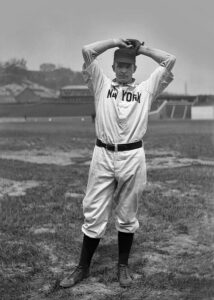
“The batting of all the players slumped at the same time,” pitcher Christy Mathewson wrote in his 1912 memoir. “None could hit, and the club was losing game after game as a result, because the easiest pitchers were making the best batters look foolish. One day [catcher Frank] Bowerman came into the clubhouse with a smile on his face for the first time in a week. ‘Saw a big load of empty barrels this afternoon, boys,’ he announced, ‘and just watch me pickle the pill out there to-day.’”
At the time, seeing a load of empty barrels on the move was considered good luck, and for Bowerman it turned out to be: According to Mathewson, the catcher went out that day and managed four hits in five plate appearances. This gave McGraw an idea. The next day, several more players arrived at the clubhouse and announced they, too, had seen a load of barrels. “They, then, all went out and regained their old batting strides, and we won that afternoon for the first time in a week,” Mathewson wrote. It happened again the next day: Giants players saw a load of empty barrels on their way to the Polo Grounds and went on to play well. “At last all the members of the team had met the barrels, and men with averages of .119 were threatening to chisel into the three-hundred set,” the pitcher wrote. “With remarkable regularity the players were meeting loads of empty barrels on their way to the park, and, with remarkable regularity and a great deal of expedition, the players of opposing clubs were being driven to the shower baths.”
It seemed like magic—but there was something strange about the whole ordeal, as second baseman Billy Gilbert noticed: He was always seeing the barrels on a carriage driven by the same horses, one white and one brown. Third baseman Billy Lauder confirmed he was seeing the same. Finally, McGraw spoke up.
“I hired that load of empty barrels by the week to drive around and meet you fellows on the way to the park,” he told them. “You don’t think I can afford to have them change horses every day, do you?”
The team had a laugh, and McGraw soon stopped paying for the barrels to be carted around outside the stadium, but the trick had worked. “His scheme stopped a batting slump and put the club’s hitters on their feet again,” Mathewson wrote. “And just seeing those barrels gave them the idea that they were bound to get base hits, and they got them.”
I love this story. It is, for one thing, a perfect encapsulation of baseball’s long-standing culture of superstition, but it also captures something deeper: There is magic, evidently, in believing in magic.
Baseball as we know it is more than 150 years old, and its history has been consistently marked by powerful spells superstitious rituals, generational curses, and attempts to bend the forces of luck and fate—attempts to form the unknowable universe into a knowable and controllable one— and to win baseball games in the process.
This remarkable history of occult practice and magical thinking is made all the more novel by the fact that, over the last three decades, Major League Baseball has undergone a transformation, the result of a statistical revolution that changed the way teams scout and value players, how managers construct lineups, and how baseball people everywhere understand the game. What was once a sport grounded in tradition, nostalgia, and vibes has become the most statistically advanced on the planet, but there remains at its core something illogical and un-algorithmizable.
This magic survives in the face of technological and scientific advancement, and its roots can be traced back eons, to the earliest days of the game, and the earliest eras of human civilization. It defines the history of baseball and defines our relationship to it.
We see it in the at-bat rituals of players across the league, and we catch a glimpse of it in the rally caps and the untouched foul lines and players wearing the same cleats today as they wore in last night’s win. McGraw’s players sensed it in their not-so-coincidental lucky barrel sightings, and, more than a century later, I tasted that magic for the first time one night in Queens that changed my life and led me to write this book. If you’ve ever watched your team hit a walk-off home run or refused to stand up during a no-hit game or sat in the sun at the ballpark on a Sunday afternoon, you’ve tasted it, too.
One of the few scholarly pieces on the subject of baseball magic—titled exactly that, “Baseball Magic”—was published in 1971 by former minor league baseball player George Gmelch. It opens: “On each pitching day for the first three months of a winning season, Dennis Grossini, a pitcher on a Detroit Tigers farm team, arose from bed at exactly 10:00 am. At 1:00 pm he went to the nearest restaurant for two glasses of iced tea and a tuna sandwich. Although the afternoon was free, he changed into the sweatshirt and supporter he wore during his last winning game, and, one hour before the game, he chewed a wad of Beech-Nut chewing tobacco. After each pitch during the game he touched the letters on his uniform and straightened his cap after each ball. Before the start of each inning he replaced the pitcher’s resin bag next to the spot where it was the inning before. And after every inning in which he gave up a run, he washed his hands.”
Today, Gmelch is an anthropologist, and he saw in his fellow baseball players a type of magical practice that reminded him of Bronislaw Malinowski’s research about Trobriand Islanders’ fishing habits. Malinowski found that when the islanders fished in the safer and more plentiful inner lagoons, they did not engage in magical rituals hoping to ensure safe and plentiful fishing. When they fished in open waters, however—more dangerous and less consistent—they frequently called upon the supernatural for support.
“We find magic whenever the elements of chance and accident, and the emotional play between hope and fear, have a wide and extensive range,” Malinowski wrote. “We do not find magic whenever the pursuit is certain, reliable, and well under control of rational methods.” See: baseball, a game of chance and accident played on the wide spectrum between hope and fear.
For starters, baseball is the only major North American sport in which the defense, not the offense, has the ball, and that defense has a lopsided amount of power—nine players spread across the field—while the offense has between one and, at best, with the bases loaded, four. (Consider, on the other hand, football, hockey, soccer, and basketball, all of which have equal numbers of offensive and defensive players on the field at any given time.)
This is the thing about baseball: It is really, really hard. The most successful hitters in Major League Baseball succeed just three in every ten tries. A 90-mile-per-hour fastball (which would be considered slow at the highest echelons of today’s game) is in the strike zone for just ten milliseconds, and making contact hardly guarantees success. “I’ve always said that hitting a baseball is the hardest thing to do in sports. The hardest thing,” Ted Williams— one of the greatest hitters in the history of the game—once said. “Round ball, round bat, curves, sliders, knuckleballs, upside down and a ball coming in at 90 miles to 100 miles an hour, it’s a pretty lethal thing.” And, unfortunately, lethal it has been: Players hit by pitched balls, particularly in the head, have faced serious and sometimes career-ending injuries—and, in the horrific case of Cleveland Indians shortstop Ray Chapman, even death.
In the face of this difficulty and danger, baseball people of all stripes turn to magic.
***
Before we fully turn to the subject of baseball magic, it’s important that we define what magic is. “We see no easy origin to magic, because it has always been with us,” archeologist Chris Gosden wrote in his book Magic: A History. “Magic is crucial: people did not just aim to survive in the world, but to make sense of it, to explore their modes of participation with other substances and species.”
The root of our English word “magic” comes from the Latin root magus, which comes from the Greek word μάγος (magos), which in turn descended from the Persian word maguš or magi, referring to priests: Magic was the work of the magi. In the Roman era, “magic” took on a more derogatory tone, and came to mean the invocation of demons. By the early common era, Christian leaders had turned the word around and used “magic” to refer to anti-Christian practices and beliefs.
Theologian St. Augustine led this charge. “It doesn’t matter if it’s good or bad,” said Exeter professor Catherine Rider, an expert on the history of magic in the Middle Ages. “If it doesn’t work naturally, then you must have demons involved somewhere.” This, as you might imagine, can be a complicated stance for Christians to take: Religious practices do not “work naturally,” and many Christian traditions—like, say, Christmas and Easter—are “magical” pagan traditions adopted and adapted by the church. So, too, Rider said, were the healing charms of the ancient world, which originated as appeals to pagan gods and were later reformed by the church to call on saints or the healing power of Christ. “There’s this idea that if you can say powerful words and direct them to the right person, that’s okay,” Rider said. “They all believe that there are supernatural beings out there, and it’s about who you’re talking to and how you are talking to them.”
Getting a good sense of magic and superstitious practices in the Middle Ages can be difficult, however, given the way the Christian church dominates the narrative. “It’s mostly the church who can read and write,” Rider said, and thus it’s the church recording history from its own perspective. But, she added: “It’s fairly clear from the amount of complaining they do that there’s quite a lot of magic going on.”
With the Protestant Reformation of the sixteenth century, that critique of magical practice was turned on the Catholic Church. “[The Protestants] say, ‘Well, if you’re going on pilgrimage to a saint, you’re not really worshiping God, you’re worshiping the saint, and that’s magic,’” Rider said. “Or, you know, ‘Ringing church bells to keep storms off, that sounds like magic.’ So Protestants really try and redefine a lot of what the medieval church used to do as a way of criticizing it and distancing themselves from it.”
Today, despite thousands of years of magical practice and debate under our collective human belt, magic remains difficult to define and debated by scholars, psychologists, practitioners, religious leaders, grifters, artists, and baseball players. For psychoanalyst Sigmund Freud, magic was a sort of “infantile neurosis,” not unlike the illusory form of wish fulfillment he saw in religion. Magic, Freud argued, was a primitive stage of religion itself: He believed human civilizations progressed through three stages, beginning with magic, then transitioning to religion, and finally to science. (Never mind that Freud and many of his disciples had a long history of occult interests.)
Carl Jung, meanwhile, tended to a more spiritual view of the psyche, defining the practice of magic in his seminal work The Red Book as “making what is not understood understandable in an incomprehensible manner.” This view, he admits, is confusing, “but this is what magic is like.” We need it, he wrote, to be “able to receive or invoke the messenger and the communication of the incomprehensible.” He concurred with Malinowski: “Where reason abides, magic is not necessary.”
One distinction worth making is the difference between magic in a supernatural sense and magic in an illusionary sense. I asked Charlie Ross, a D.C.-based stage magician, how he defines magic, and I expected him to make a distinction between the performance of magic as entertainment and truly magical beliefs, but his answer surprised me: “There is no reality except the one contained with us,” Ross said, quoting the poet Hermann Hesse. Ross is an illusionist, and his act focuses on card tricks and visual deception, but that performance, he told me, has made him realize how much we see every day that we don’t really process—how much happens right in front of us but never becomes real.
“A lot of visual illusions kind of break this spell, and show us that our perception isn’t 100% [correct], that we miss these things, and we take these large leaps and assumptions throughout the day and throughout our lives,” he said. “Magic shows us that we have these little hiccups. We have these little holes that stuff falls through all the time.” Illusions show us what we miss, he said: “It comes off as a total difference between reality and the world that [we] perceive.” This form of magic is alive and well in baseball, too. Take, for example, the curveball: At first, it looks like it’s coming straight across the plate, only to suddenly, at the last moment, bend away, bend the laws of nature.
But real magic has not just an illusionary element but a fundamentally supernatural one. As Major League Baseball’s official historian John Thorn put it to me, magic is “the art and/or illusion of connecting with a world of spirit: leaving the body and the physical bounds of earth.” In this sense, he said, sports and sex—and a “variety of ecstasies,” like, I’d argue, drugs and sleep—can be seen as magical.
“When attached to an object, magic is sublimated to a thing that enables a transference of power (or its illusion),” Thorn wrote. “This is why Amazonian headhunters shrink the skulls of those they have vanquished in battle and wear them around their waists in a belt. This is akin to the practice of collecting—baseball cards, autographs, game-worn this and that. Calling Dr. Freud.”
Traditionally, this form of power transference through an object is known as sympathetic magic, a term that comes from The Golden Bough, an expansive and controversial study of religion and mythology first published in 1890 by anthropologist Sir James George Frazer. “If we analyze the principles of thought on which magic is based, they will probably be found to resolve themselves into two,” Frazer wrote. “First, that like produces like, or that an effect resembles its cause; and, second, that things which have once been in contact with each other continue to act on each other at a distance after the physical contact has been severed.
Baseball players have long tried to work with sympathetic magic: Gmelch recounts the story of Pacific Coast Leaguer Alan Foster, a pitcher who forgot his usual shoes at a game one night, borrowed a teammate’s, and went on to pitch a no-hitter. Foster, of course, bought the shoes from his teammate after the victory. Similarly, in 2019, Phillies infielder Brad Miller brought a potted bamboo plant to a game and declared that the plant would break the team’s losing streak—a move that Miller said had worked for him as a minor leaguer. It worked in the big leagues, too: The Phillies notched thirteen runs that night and soon began to orient a messy season.
Among all these definitions of magic, the one that stuck with me came from Gosden, who defined magic as “human participation in the universe.” I love the expansiveness of this definition, which encompasses changing perspectives on magic over the course of history and allows for a wide range of magic practices. It also speaks to every form of baseball magic: the superstitions adhered to by athletes and fans alike, the legacy of baseball’s great curses, and the ephemeral magic of pure presence and timelessness offered by the game.