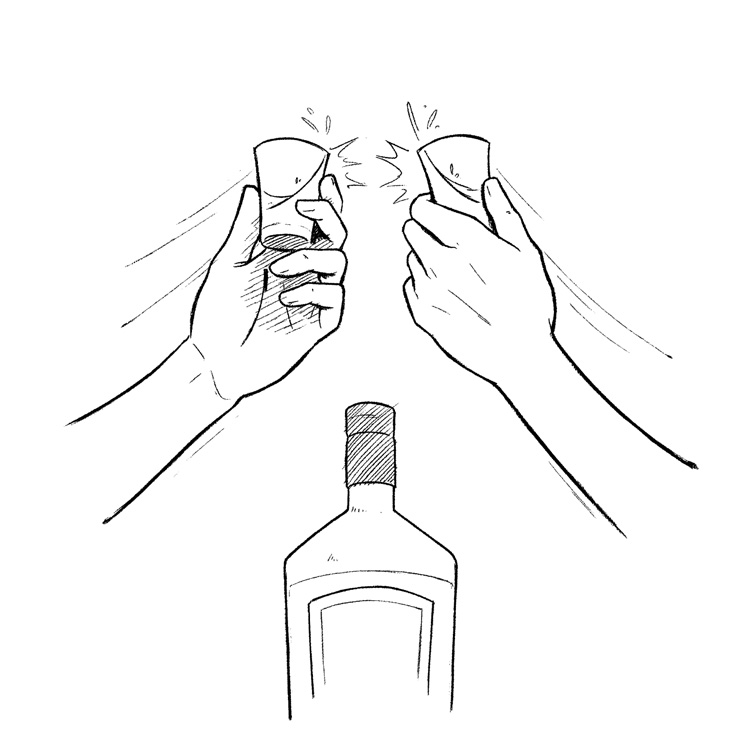
The very next time you’re invited to a symposium (an Ancient Greek drinking party), you can look forward to quite the evening of music, debate and poetry, all washed down with Greece’s finest sediment-rich organic wine. Classical civilisation is synonymous today with sophistication, but, as you consider your sandal choices before heading out, you should also prepare yourself for the difficult, messy and sometimes romantically charged drinking game of Kottabos, and yes, you should probably bring a spare toga.
Ancient Greek civilisation spanned a period from 1200 BCE, following on from the earlier Mycenaean period, until 323 BCE, usually marked by the death of Alexander the Great. At its glittering heights, around the fifth to third centuries BCE, Ancient Greece comprised a collection of over a thousand city-state territories spreading from Sicily across to modern-day Albania, Greece, the islands of the Ionian and the Aegean, to parts of North Africa and right across the western parts of modern-day Turkey. The most significant of these polis, or city states, included Athens and Sparta, as well as Syracuse, Argos, Rhodes, Elis and Corinth. They shared a common culture, language and series of grudges and were linked by trade, religion and diplomatic ties.
Greek city states were strongly militarised and independent, so wars between them were common. In fact, in 431 BCE, the drinking game of Kottabos was blamed as the cause of a major war between Athens and Sparta due to the kidnapping of Simaetha – sometimes referred to as a courtier and other times as an Ancient Greek slave – who was involved in the game.
Despite their bickering, the city states were highly organised societies with systems of government that protected their independence (and the power of local leaders). Systems were different from state to state but all had in common a form of male, aristocratic rule based on military survival; for example, the state of Sparta was ruled by two kings and an assembly of warriors. Athens, the most populous state, developed a sort of democratic(ish) system, where all male citizens (not all men were citizens) could vote on the leadership of the political system. Its large population and wealth supported the development of a booming artistic, literary and philosophical scene which became the model for much of what we think of as ‘Ancient Greece’ today.
In these militarised and male-dominated societies, sporting success was highly prized, and so too were male companionship and loyalty. In addition to battlefield exploits, men would compete for sporting prowess in competitions such as the original Olympics and socialise in the same close-knit groups of comrades and competitors. It was within groups and the wine- and music-filled parties they held, known as symposia, that men, and some women, would play the messy, drunken and sometimes scandalous game of Kottabos.
As ancient drinking games go, Kottabos is one of the best recorded, with some serious classical endorsers – Pindar, Sophocles and Euripides all mention the game and its amorous allure. Pindar, for example, wrote of Kottabos and its links to love, noting how one dedicated one’s ‘turn’ in the game to a member of the group one might have a romantic interest in: ‘while getting drunk with Chimarus, I may toss the cottabus for Agathonidas.
At its most popular in the sixth and fifth centuries BCE, the game originated in Grecian Sicily before becoming fashionable across the Ancient Greek world, particularly in Athens, where it had become a trendy pastime for high society by 431 BCE. Kottabos was a serious endeavour and had become so well known that in its heartlands special circular buildings were constructed to play the game.
Kottabos was developed to make use of the particular qualities of Ancient Greece’s most popular tipple, wine.
Winemaking arrived in Greece (with grapes) during the Mycenaean era, having been first developed near modern-day Georgia around 6000 BCE. Greek wines were categorised by region, with the finest stuff coming from the island of Chios and costing around two drachma (two days’ wages for ordinary folk) for a chous (something close to three litres). Distinctions were also made between young wine, often for mass consumption by armies, and older wine, for the more discerning palate.
Ancient Greeks prided themselves on drinking their wine diluted, roughly one part wine to three parts water, with numerous ancient sources noting how this separated Greeks from the barbarous Macedonians, who dared to drink their vintages neat. In addition to its wateriness, Ancient Greek wine had another feature, which is central to the game of Kottabos: it was unfiltered and contained large amounts of sediment made up of yeasts, grape residue and other materials, which would settle at the bottom of wine cups known as kylixes.

The game focused on a single target, generally in the centre of a room, around which players arranged themselves. Each player would take their kylix (emptied of wine but with a residue of wine sediment still inside) and fling the sediment at the target using their right hand. Only the index finger could be in the hook of the cup and the other fingers had to be stretched out, palm flat. The player also had to be lying back on a couch, not unlike a chaise longue, and moved only their right forearm to launch the sediment at the intended target.
Kottabos Katakos (Kottabos with a pole) was the traditional and most commonly referenced variety. In this version the target of the game was a small bronze disc balanced atop a pole (the plastinx) in the style of a lampstand, with a larger disc (the manes) suspended halfway down the pole. A player would aim their sediment missile at said small disc. If they did so just right, the lumpen wine-residue would then fall with the dislodged target disc onto the larger bronze plate suspended below. This satisfying splat would create a bell-like sound, which was called a latax, the same name given to the residue itself, and which was the resounding marker of a successful launch.
Several other variations of the game existed, including Kottabos Oxybapha (Kottabos in a bowl), which was generally considered easier than the pole-mounted target. In this version a basin containing a number of floating saucers was placed in the centre of the group, and the object of the game would be to sink the saucers using the same sloppy projectiles. More unusual targets have also been found in Etruscan versions of the game (in pre-Roman Italy), perhaps the most innovative of which had the target as a bird statuette with a head in the shape of a penis, atop a tripod in a flat pan.
Players would fling their wine lees (another term for sediment) in rapid succession, so having the dexterity for a hit was cause for celebration and kudos, not least because success or failure in the game was often considered an omen of success or failure in love. Before a player flung their sediment, they would dedicate their turn, often to a lover or pal. The prizes that might be up for grabs were as varied in both value and ethics as eggs, slaves and romantic and risqué favours from other guests at the symposium. In one inscription on a vase, a Kottabos host exclaims, ‘There are ticklings and the smack of kisses, there are the prizes I set up for the one who best shoots the Kottabos.’ In another depiction, a naked servant or sex worker holds in place the target disc, and a woman holding a kylix, poised to throw, declares, ‘I am flinging this for you Leagros.’ Similarly, the master Greek poet Cratinus once wrote of a hetaira (an Ancient Greek courtesan) dedicating her shot in honour of the tackle, so to speak, of Corinthian men.
The wine cups themselves were also part of the jovial and saucy fun of the party. Some believe players would bring their own kylix to Kottabos games, and some kylixes found in museums today include risqué pictures of scantily clad and rowdy symposia, while others have eyes drawn on the underside so as to continue a stare while the player drinks the dregs of their wine.
The popularity of Kottabos had waned by the time of Alexander the Great, and Roman sources were pretty snooty about the bawdy game of their classical predecessors. More modern re-enactments of wine sediment flinging in togas, such as the work of Dr Heather Sharpe, have demonstrated what a messy situation this game was, with wine lees likely splattered across all sides of the symposium and the players. Nonetheless, the wealth of surviving evidence around Kottabos allows us to understand the game in all its close, messy and sometimes steamy detail: as a bonding exercise for elite groups of aristocratic warrior men, and surely also as a way for them to avoid rinsing the dregs out of their kylixes before topping them up with yet more wine.
History’s Greatest Drinking Games © 2026 by Elliot Martyn. All rights reserved.