
For fans of historical mystery, a perfectly poured cup of tea or a soothing nighttime tonic often signals impending doom. But the prevalence of poison in Victorian-era mystery novels isn’t just a convenient plot device—it is a reflection of how readily available poison was in the 19th century. Charles Finch, author of the Charles Lenox mystery series, shares with The History Reader some of the most popular Victorian poisons available at that time.
When I wrote my first Victorian-era mystery novel, two decades ago, there was only one murder weapon I considered: poison.
Flash forward to last year. I’m writing my sixteenth mystery in the same Charles Lenox series, Midnight in the House of Commons, and I need a clever murder on the floor of Parliament. Only one weapon will do: poison.
Am I just the kind of sneaky person who would kill with an undetectable poison, given the chance? No. Or—not exclusively. Consider at random a few of the items you could buy off the shelf in Victorian times.
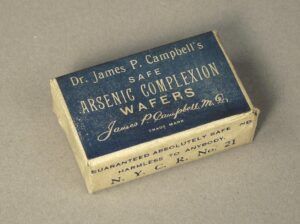
- James P. Campbell’s Arsenic Wafers. These wonder wafers “cleared blemishes” and give women a pale, romantic coloring—by destroying their red blood cells, leading to anemia, and eventually, with overuse, death. And this was only one of a dozen poisons in those deadly cosmetics, including cinnabar, mercury, and nightshade. The Ugly-Girl Papers, a wildly popular column in Harper’s Bazaar offering beauty tips that I love to consult for research, can sometimes read more like a catalogue of poisons.
- Winslow’s Soothing Syrup. This was one of the era’s infamous solutions to soothe “fussy” babies. These were all incredibly effective—unsurprisingly, considering they usually contained some admixture of morphine, cocaine, and cannabis. Many of the mothers ended up addicted, too.
- Tanglefoot Flypapers. These flycatchers contained deadly quantities of chloroform. In one famous case, a woman named Adelaide Bartlett was acquitted of her husband’s murder because they could only find chloroform externally on his body, not in his mouth or stomach. The case remains unsolved. “Now that it is all over, she should tell us, in the interest of science, how she did it,” said Sir James Paget, of St. Bartholomew’s Hospital.

In other words, poison was everywhere in Victorian England. Arsenic was the most common, easily found in rat killer, wallpaper, and dozens more products. The Arsenic Act of 1851 and the Pharmacy Act of 1868 provided some first restrictions on its use, but neither made it unavailable.
And if it was there was strychnine, chloroform, belladonna, opium…all available in local shops on the high street.
Needless to say, Victorian-era writers were among the first to notice the possibilities of this strange fact. Perhaps the century’s most famous novel, Madame Bovary, features an arsenic poisoning, and there are poisonings in Dickens, Conan Doyle, Poe, and Collins, among innumerable other writers.
It became the mystery novelist’s most common means of murder. But it was a stroke of luck that permanently established it the next century, because the greatest mystery novelist we have ever had established it as the means of murder in her dry, intricate British mysteries.
Her name, of course, was Agatha Christie, and she killed more than 80 people with poison. Indeed, it is the murder weapon in 41 out of her 66 books.
That’s unsurprising when you consider that Christie had formal training in the apothecary arts. During World War I, in fact, she worked on behalf of the nation in an army hospital as a pharmacist. Even then she must have been hatching the ingenious poisonings that dominate the Poirot and Marple tales.
After Christie, there was a craze for mystery novels about poisonings. By the end of the last century it had become a venerable tradition in the mystery novel. My own favorite poisoning novel is Monk’s-Hood by the great Ellis Peters—her detective, a 12th-century monk, is an herbalist, and uses those skills to unravel a murder plot in his monastery.
But the tradition continues: The Sweetness at the Bottom of the Pie, Alan Bradley’s unforgettable novel, soon to be a movie, is one, and Elizabeth George continued the tradition in two great poisoning novels, Missing Joseph and A Banquet of Consequences.
It makes sense that these are British mysteries. The traditional British detective novel (though they have recently come to love serial killers and violence!) is often a little less dark, a little more comforting, than its American counterpart, and poison is less brutal than a knife or a gun. It is more pre-meditated, and so can point to a clever murderer, or a long-standing grudge, rather than momentary anger, which is a more satisfying plot.
And it is very pleasant to have a detective trace the murder weapon to something as harmless as an apple, a pot roast, a cup of tea…
Christie was famous for her scrupulous accuracy in using poison, down to the number of grains it would take to “dose” a poison. (Incidentally, “grain” doesn’t mean that the poison comes in granules—it’s the old British word for a quantity equal to about 65 milligrams.) In The Mysterious Affair at Styles she gets even more detailed, having the killer calculate just how much precipitate of strychnine it would take to kill.
When I wrote A Beautiful Blue Death, by contrast, I invented bella indigo, a poison with mysterious properties that leads to the murderer. It just seemed romantic and intriguing! Sixteen books later, though, for Midnight in the House of Commons, I used a real poison.
I wonder why. Perhaps as you get older it gets harder to murder, even fictionally—and if a cup of tea is going to kill someone, a little realism seems in order. We owe that much to the dead. Even the made up ones.
