
Alexander the Great was a wide-eyed boy from the hills of Macedon who ruled most of the known world by his mid-twenties. For centuries, historians, refugees, poets, and explorers have told his story, and yet Alexander himself has remained a mystery. However, thanks to a series of recent, remarkable discoveries, author Edmund Richardson is able to thrust readers into Alexander the Great’s world in ways which have never before been possible. Start reading an excerpt below of Alexander, a revelatory retelling of one of the most famous and elusive stories in history.
I
The Watchers
Babylon & Issus, 5 November 333 bce
They had watched the sky for generations. Night after night, they had stared up at the stars. Now, in the early hours of 5 November 333 bce, the astronomers of Babylon looked to the heavens again, trying to glimpse the future.
It was 1 a.m. The moon was setting. The constellation of the Lion shone high in the sky. Like all the signs of the Zodiac, it had first been named in Babylon. Beneath the stars, the city slept. Babylon, the shimmering heart of the Persian empire, was built in a vast square, sprawling across the plains either side of the Euphrates river. Along its northern walls, the ramparts of the Ishtar Gate glowed blue and gold in the moonlight. The courtyards of the great palace of Nebuchadnezzar lay undisturbed, apart from the tread of an occasional watchman. In the temples, the sacred fires crackled quietly. To the south, the ruins of a colossal brick ziggurat, the Etemenanki, loomed up in the darkness. The Babylonians called it ‘the foundations of heaven and earth’. Others called it the Tower of Babel – a structure so monstrous that it must have been built to steal knowledge from heaven. That night, the astronomers were doing just that.
In 333 bce, Babylonian astronomy was already over a thousand years old. Every day, the astronomers recorded their observations on small clay tablets, writing in wedge-shaped cuneiform script, one of the earliest writing systems in history. Writing was invented – according to the legend of Enmerkar and the Lord of Aratta – because, one day, a messenger was overwhelmed by how much he had to remember. ‘The messenger, whose mouth was weary, could not repeat the message. Because his lips were heavy, and he could not remember it, the lord of Kulaba shaped some clay and inscribed the message on it, as though on a tablet. Before then, no one had written messages on clay. But on that day, beneath the sun, it became so.’1 The astronomers’ observations, inscribed on hundreds of cuneiform tablets dating back centuries, formed one of history’s first databases: an archive of comets and asteroids, stars and omens.
Many constellations still carry the names given to them by the Babylonians. Leo is the Babylonian Lion, Gemini is the Great Twins, and Libra is the Scales. (Some constellations have not retained their Babylonian names: the Wild Boar, the Lord of Battles and the Mad Dog can no longer be found on star-maps.) Four hundred years earlier, the Babylonians had begun to develop elaborate mathematical models to predict the course of the planets and eclipses of the moon. By 333 bce, even when the night was cloudy and neither the stars nor the moon could be seen, the astronomers could still chart the sky above their heads with pinpoint precision: often, their archives record the positions of the stars on a given night, along with the ancient Sumerian phrase ‘nu pap ’ – ‘I could not see.’ The first horoscopes were cast in Babylon: astronomers calculated the positions of the sun, the moon and the planets at the time a person was born, and used that information to predict the course of their life. ‘If, when a child is born, an eclipse of the sun occurs in the first moments of his life,’ one tablet warned, ‘he will die far from home, and his father’s house will be dust in the wind.’ For Babylonians, the sky was an engine for understanding the future.
But that night something more than the stars preoccupied the Babylonians. For months, they had been hearing rumours from the west. An army had poured into the Persian empire – men from the cold, rocky lands near the edges of the earth. No one was sure why they had come, or what they wanted. Their king was said to be a young man called Alexander, or Aleksandaris as the Babylonians knew him. City after city had fallen to the invaders. Eventually, the Great King of Persia, Darius III, had gathered an enormous army and led it into the west, to drive the strangers from his lands. Tens of thousands of soldiers, drawn from across the Persian empire, had marched from Babylon one autumn morning: young men in purple, chariots decorated with gold and silver, infantry in shimmering armour. The retinue of the Great King stretched for miles: Darius’s chefs and flower- arrangers and bodyguards, his mother, his wife, his daughters and his young son. And Darius himself – tall in his royal chariot, dressed in gold and purple and white, carrying his bow. Behind the army, hundreds of mules laden with gold and silver plodded wearily into the west. Now, every day, Babylon waited for news.
During the hours of darkness, uncertainty and dread crept into the world. In the sky, in the constellations of the Eagle and the Dead Man, the Babylonians saw the souls of the dead travelling across the stars on their long journey to the afterlife. Night, in Mesopotamia, did not just belong to the astronomers; it belonged to the demons, and to the ghosts:
The watcher in the darkness
Who scratches at the door like a wolf,
Who flashes like lightning,
Who flickers like flame,
Who shines like the sun,
Who glimmers like a star,
Who is shadow,
Who is nothingness itself . . .
Who has been erased from the world.
Hours passed, and the stars wheeled overhead. Sharru, ‘the royal star’, known today as Regulus, hung in the eastern sky. It held the fortunes of the king: whether Darius would find success in battle, or peace at home. Nearby was the constellation of the Serpent, a warning of coming death and destruction. But the stars did not always bring answers. Sometimes, the future was hard to see, even from the Tower of Babel.
While the astronomers watched the sky, hundreds of miles away, near the shores of the Mediterranean, Alexander was praying. The moon had set a little before 2 a.m. Above his head hung many of the same constellations that shone over Babylon: Leo, which Greeks called the Nemean Lion, after the mythical beast strangled by Heracles; where the Babylonians saw the Serpent, Alexander saw the Hydra, the many-headed monstrous snake, also killed by Heracles. But, while the astronomers glimpsed the future unfolding and the shadow-world beckoning, Alexander’s mind was on the earth below.
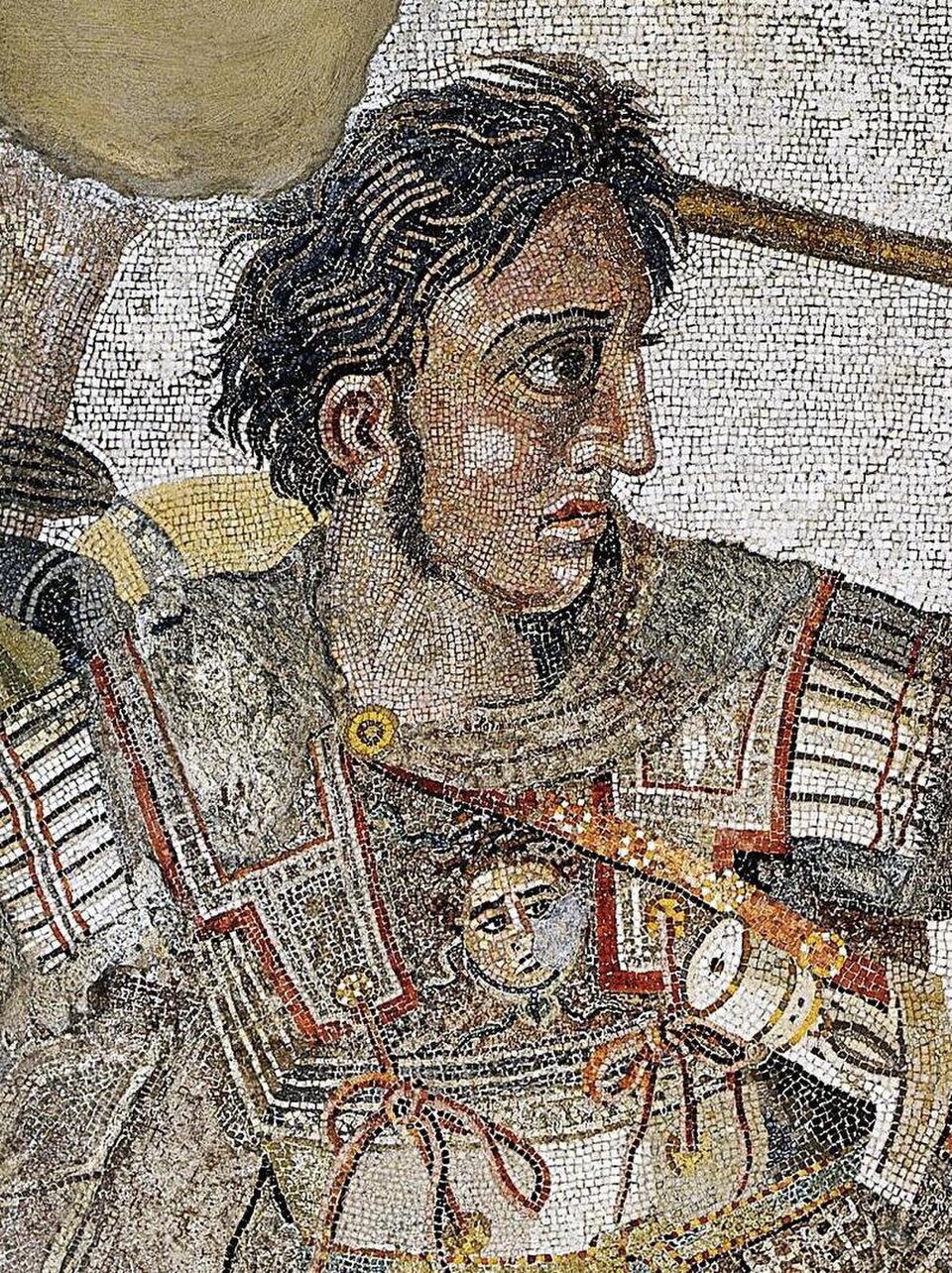
He knew that the coming day would bring the greatest battle of his life: the army of Darius was drawn up ahead of him on the narrow coastal plain of Issus, in the south-west corner of modern Turkey. The plain was crossed by the Pinarus river and hemmed in by the Mediterranean to the west and steep green hills to the south and east. Behind the hills, steeper still, dusty grey mountains rose, cutting off the coast from the Syrian deserts, which stretched east for hundreds of miles. Alexander was outnumbered and far from home. Unable to sleep, he had climbed to the top of a hill in the middle of the night. There, alone, surrounded by flaming torches, he prayed, knowing that it might be the last time he saw the stars. ‘His confidence had given way to dread,’ wrote Quintus Curtius Rufus. ‘Fortune had made him – but now he feared it.’
Alexander was twenty-three. Three years earlier, his father, King Philip II of Macedon, had been assassinated. Alexander had inherited a tumbledown kingdom, a pile of debts and an army which answered to nobody. He was a slight, wiry young man, whom no one had thought much about until he suddenly came to the throne. His face was pale and intense, quick to flush red, with a sharp nose and huge eyes. He wore his curly hair long. Alexander’s portraits all conceal as much as they reveal. But one fragmentary bust, known as the Delos Alexander, captures something of the young king beneath the stars. Alexander’s neck is thick, and his body is solid muscle. His face is full and open. His hair is brushed back in a tangle of curls: not so much artfully styled as matted with dust and rain. His eyes are wide but sunken, with puffy shadows beneath the eyelids. His mouth is tightly closed and his jaw is clenched: he is holding his pose like a raft. He looks like a young Achilles. He looks tired.
(Alexander hated having his portrait taken. Apelles, one of the greatest artists of the ancient world, had recently painted him with his horse, Bucephalus. When Apelles showed Alexander the finished work, the king mumbled some grudging praise. Apelles was used to his work being rapturously received. But, instead of arguing, he sent for Alexander’s horse. When Bucephalus was brought in, ‘the horse neighed at the horse in the picture, thinking it was real. That was when Apelles said, “My king, your horse knows more about art than you do.” ’)
Soon after he claimed the throne, Alexander led his army east, into the vast Persian empire. For Greeks in the fourth century bce, Persia was a land of wonder, of dreams made real, where nothing was too strange to be believed. It was a place of uncountable wealth and unimaginable luxury – Aeschylus imagined the walls of the Great King’s court to be pure gold. Legend had it that the Persians were even born from gold. And, while many Greek city-states had no more than a few thousand inhabitants, the Great King ruled over around 50 million people. It was no wonder, the Greeks told themselves, that he believed he was more than human.
Persia had threatened to swallow up Greece on more than one occasion. Now Alexander promised the Greeks they would have their revenge. He led his army south from the Hellespont, now known as the Dardanelles Strait, through the empire’s western provinces and down the coast of Asia Minor: looting and liberating, in roughly equal measure. He barely survived a battle with Darius’s governors at the Granicus river, coming within a second of losing his head. He had just spent weeks laid up with fever, shaking and helpless. His treasurer had run off with as much gold as he could steal. Dissent and rebellion were everywhere; the campaign seemed to be teetering on the brink of collapse. Then Alexander began to hear rumours that a vast army was bearing down on him.
Alexander had set out in search of Darius. The last few days had been miserable. Rain had fallen steadily, and the Greeks were cold and anxious. As they struggled through the hills, looking one way and then another, the giant Persian army remained elusive. Alexander began to worry ‘that they would be defeated not by their enemies’ bravery, but by their own exhaustion’. The army’s baggage train fell further and further behind. Then Darius made his move.
Under cover of darkness, in the early hours of 4 November, the Great King led his army through a narrow pass in the Amanus mountains and on to the coastal plain of Issus. He was now within a few hours’ march of Alexander, but the Greeks had still not detected him. Alexander’s rearguard – his baggage and supplies, his sick and injured soldiers – were straggling south along the coast when Darius fell on them. The Greeks never stood a chance. Some were killed, others were taken prisoner. The prisoners ‘were horribly mutilated’: their hands were cut off, then the bloody wounds were cauterised with pitch. Scarcely able to stand, they were dragged in agony through the Persian army. Then Darius turned them loose and sent them to Alexander, ‘to tell the king what they had seen’.
The first Alexander knew of any of this was when a mutilated soldier staggered into his camp. The prisoners arrived one after another, each man with the same story, and the same nightmarish black-stained stumps where his hands had been. At first, Alexander did not want to believe that the news was real. He sent some soldiers down the coast in a small boat to find out what was going on. Surely this was a ruse, or an advance guard, not the Great King himself. But around 6 p.m., as the sun began to set, his men saw the Persian army’s campfires from their boat – thousands upon thousands of them, stretching across the plain of Issus, so many that ‘the whole world seemed to be ablaze’. There was no longer any doubt: Darius had out-thought and outmanoeuvred Alexander. Now the Greeks only had the food they had been carrying with them; in a few days they would begin to starve. Their options were to fight or flee. But the Great King was on his own ground, Darius’s army massively outnumbered their own – and he had blocked their path home to Greece.
In the cold November dusk, Alexander walked up and down the ranks of his soldiers. To his commanders, he spoke of the past: the victories they had already won together, and the battles Greeks had won against Persia. To his soldiers, he spoke of the future: the glory and the wealth which would be theirs if they won the day. ‘And if any of the men had previously done remarkable things in battle, in pursuit of glory, then Alexander would single them out by name, for special praise.’ Soon the soldiers were crowding around him, pressing through the throng ‘from every direction, to grasp Alexander’s right hand’. Alexander clasped their hands, one after another – cold from the November chill, calloused, scarred, marked by years on the march. He tried not to think about the other men, the ones with the missing hands. Then he ordered the army to turn around and march straight for the Great King.
Around midnight, the Greeks reached the pass which led down into the plain of Issus. There they set up camp. Alexander made sure that his men had eaten, then he let them settle down for a few hours of rest. But he could not sleep. He left his tent and went to stand under the stars, to pray and wait for the dawn.
When he was a child, Alexander had been taught by Aristotle. The philosopher was fascinated by courage; for him, it was the most important virtue of all. But what did it mean to be brave? Aristotle thought that some things ought to be feared: one’s family being hurt, or one’s own humiliation. Courage did not even mean being fearless in battle – instead, it meant facing down your fear, and inspiring those around you to do the same. ‘The courageous man, in consequence,’ argued Aristotle, ‘the most truly courageous man, will be the man who faces a worthy death, without fear.’ That night, beneath the stars, Alexander tried to quiet his fear and to ready himself for death. ‘He was far from sure that he would be victorious,’ wrote Quintus Curtius Rufus, ‘but he was sure of one thing: that if he died, it would be as a man should die, gloriously.’
He did not know it yet, but Alexander was about to become a legend. Within a few brief years, the young man from the hills of Macedon would rule the greatest empire in history, stretching from Athens to the plains of India. His campaign would transform the world: from the stars in the sky to the words on this page, to the dreams in our heads, Alexander reshaped reality more profoundly than almost anyone else in history.
For centuries, historians, refugees, poets and explorers have told Alexander’s story. It has been unfolded by ambitious Roman politicians, by Jewish scholars, by Icelandic bards, by Ethiopian monks, by Tibetan craftsmen and by Persian courtiers. It has become one of the world’s foundational tales, cherished by a multitude of cultures and religions, for over 2,000 years.
Driven by hope, desperation and desire, Alexander would lead his army further than any Greeks had yet travelled, to the very edges of the known world and beyond. He would accomplish things which even the gods and the heroes of legend had not dared to attempt. His journey would also unleash violence on a scale never before seen: almost 1 per cent of the world’s population would die as a direct result of his campaign. Cities would be levelled to the ground. Hundreds of thousands would be enslaved. And Alexander himself would be lifted up to the heavens, only to fall. The king would become a hero, the hero would become a living god, and the god would die, broken-hearted, in Babylon.
For now, though, Alexander was still just a frightened young man, standing alone beneath the stars, praying to every god who might listen. As the hours passed, the torches began to gutter and die. By 5 a.m., the sun had still not risen. Venus, Mars and Jupiter hung shining in the east. Looking up at the sky, Alexander wondered if his luck had run out.
Alexander. Copyright © 2026 by Edmund Richardson. All rights reserved.