
What do the famous figures of Vivien Leigh, Ian Fleming, Andrew Lloyd Webber, and Diana Mitford have in common? They all lived at Eaton Square, London’s most sought-after address. Windsor biographer Alexander Larman shares with The History Reader what drew him to write about Eaton Square as well as introduces readers to some of the famous figures that called this area home from the 18th century to current times.
Having written several books to date about the goings-on inside Buckingham Palace, the temptation to adjust my focus less than half a mile away to Belgravia’s most upmarket place to reside, the famous (some might say infamous) Eaton Square was irresistible. Ever since its construction two centuries ago, this hugely expensive and fashionable square has played host to some of Britain’s (and America’s) best-known figures. From actors to musicians and Nazis to politicians, this has been a place of event and incident, and my intention was to explore some of the stories that lie behind its stuccoed porticoes and glistening facades in greater detail than anyone else has ever done before.
It is a source of some surprise to me that mine is the first book to focus solely on the denizens of Eaton Square, given how many household name figures have lived there at one time or another. The likes of Diana Mitford, Raymond Chandler, Ian Fleming, Andrew Lloyd Webber, W.S Gilbert, Vivien Leigh and, many would argue, James Bond have all been residents at some time or another, and exploring their stories – sometimes funny, sometimes tragic, always fascinating – made for a feat of research and writing that ranks amongst the most challenging yet satisfying tasks I have ever undertaken in my career.
It took me all over the United Kingdom, from libraries and archives in London to the National Library of Scotland in Edinburgh, where – bizarrely – Lord Boothby, the bisexual Conservative peer and blackmail target for the gangster Ronnie Kray, chose to donate his papers. And, of course, it took me repeatedly to Eaton Square, to walk around the imposing buildings and well-manicured lawns, as I continually sought to discover the history that lay barely concealed underneath the ever-present scent of money that hangs thickly over the square today.
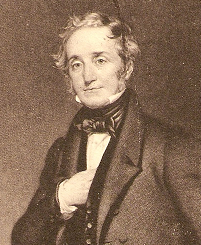 Some of my characters are more likeable and sympathetic than others. I suspect many readers will warm to the square’s gruff but decent builder, Thomas Cubitt, and some will have admiration for the witty and glamorous Diana Mitford, whose political sympathies were undoubtedly dubious but whose personal charm seduced many into forgiving him for them. There are others who are harder to like, whether it’s Hitler’s right-hand-man Joachim von Ribbentrop, the antiquities collector and slave trader Ralph Bernal or the selfish and venal Rex Harrison. Yet, I have tried to avoid casting judgement on the people whose stories I’ve told – even the supposed murderer Lord Lucan, whose disappearance after the killing of his children’s nanny remains one of Britain’s most intriguing unsolved mysteries. I hope that I have offered, if not a solution, at least some likely pointers to what really happened.
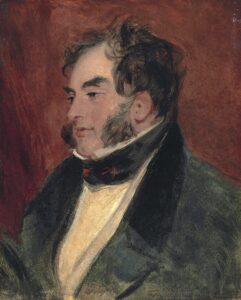
The dissipated Lord Alvanley may once have been a bosom companion to Lord Byron and the Prince Regent, but by the time he arrived in Eaton Square, he was a diminished figure. Courtesy of Wikimedia Commons. Public domain.
There are people who I have written about here, such as Terence Rattigan and W.S. Gilbert, who I have always wished to feature in a biography, and I am delighted that The Secrets of Eaton Square has allowed me to give these great men of theater and literature their moment in the spotlight. And there are those who have emerged, fully formed, from the pages of history and have demanded inclusion in a book of this nature, such as Byron’s friend Lord Alvanley, a determined sybarite whose love of self-indulgence led to his undoing, and George Peabody, the legendary philanthropist whose generosity was matched by a hard-nosed approach to charity that saw him succeed in that sphere as spectacularly as he did in his business career. And there are poignant stories, too; the decline and death of Vivien Leigh, misunderstood by those around her – not least her husband Laurence Olivier – is a stark reminder that Eaton Square was not always (or indeed often) the happiest of places.
There are stories that I would have loved to include in the book but was unable to pin down, either because of a lack of cooperation from present-day residents of Eaton Square – who guard their neighbors’ privacy with a zealousness that is only matched by their own discretion – or because some fascinating historical figures have left little behind them in terms of letters, diaries or other documents. All of these are to be mourned, but several have found their way into the book in miniature. And what I remain proud of is that this is a book, ultimately, about people: flawed, fascinating people, in all their forms, and delving into their lives has been. One of the greatest privileges of my career. I hope that you enjoy reading The Secrets of Eaton Square as much as I enjoyed writing it.