From Darwin to Pasteur to modern-day scientists, Matt Kaplan’s I Told You So! is an energetic, historical exploration of overlooked scientists who have had to fight for their revolutionary ideas to be accepted. Read on for a featured excerpt focusing on Hippocrates and how his ideas had a resurgence during the Renaissance period, which was a disaster for the field of medicine.
Chapter 1
We like to consider Hippocrates as the father of medicine. Thought to have been born in Greece in 460 bc, we actually have precious little evidence from the time when he was alive. We have just a few mentions of him by Plato indicating that he existed at all. Yet, after his death, the tales of his works grew immeasurably. He is said to have done a great deal of good for patients by arguing that diseases, rather than being punishments dished out by the gods, were natural occurrences that could be countered with the right treatments. He also worked out that diet and exercise were important for maintaining health. It is because of him that the ill started being tended by doctors rather than priests. With that said, this is the same man who purportedly said, “A physician without a knowledge of astrology has no right to call himself a physician.” So, he was on the right track, but not someone I’d be keen to have treating my kid.
Aside from believing that the seasons, winds, planets, and stars governed whether someone would survive a bout of illness or not, Hippocrates was also said to be a believer in the power of the humors. More specifically, he taught his students that phlegm, gall, bile, and blood existed in a delicate balance within the body. Illness followed when this balance was disrupted. His solution was to draw out excess humors from sick people so they could be equalized once more. With patients who were infected with upper respiratory infections and producing copious amounts of thick green phlegm, this philosophy really helped. Steam treatments and hot baths were prescribed that cleared infected airways just as they do today. With patients who were deemed to be producing too much blood, the offending vital liquid was drained from their bodies and . . . well, let’s just say that the results were better with the removal of phlegm.
Hippocrates’s ideas caught on in a big way during the Greek golden age, but had largely been forgotten by the Renaissance. It was a time when European cities were growing, sewer systems were rare, and epidemics were becoming an ever more serious problem. The field of medicine was barely even a field. Doctors, and I cringe to call them that, were giving patients random mixes of herbs and metals to try and restore health. These treatments were dangerous and sometimes fatal. In the midst of this chaos, a British physician named Thomas Sydenham emerged.

Sydenham worked out that people suffering from malaria, which was known as “ague” at the time, could be treated with bark from specific South American trees. That bark was rich with the chemical quinine, which we know today is effective at killing the parasites that cause malaria. Acutely aware of the pain that many of his patients were in, he also invented a concoction that mixed opium with wine to ease suffering.
Unfortunately, Sydenham also believed that returning to the ways of the Greeks was for the best. He helped guide astrology and the humors back to medicine, and, unsurprisingly, things did not get a lot better. Even so, the order that a return to the ways of Hippocrates brought was embraced and spread across Europe like wildfire. John Locke, the philosopher and physician, played a major part in this dissemination. So too did the Dutch physician Herman Boerhaave, whose engaging lectures transformed the medical school at Leiden into a hotbed of Hippocratic thinking.
While the Renaissance had set the stage for the brilliant art and literary techniques of the Greeks to be rediscovered and improved upon, the rediscovery of Hippocrates’s beliefs was a disaster for medicine. Rather than consider the possibility that two patients with exactly the same symptoms might be struck by the same malady, doctors again started looking to the sun, the weather, and the stars to discern the nature of their illness before draining them of whichever humor they thought was being produced in excess.
The situation was particularly dire in Austria and Hungary. Ironically, this is because of the benevolence of the region’s monarch. Empress Maria Theresa, the only woman of the Habsburg lineage to ever rule as queen, very much wanted to make life better for her impoverished subjects. As a mother herself of a whopping sixteen kids, she had a soft spot in her heart for the unmarried women of her lands. These women were all too often poor, starving, and pregnant. Looking after children in any meaningful way was virtually impossible for most of them. Tragically, many of their offspring were thrown into rivers in the middle of the night. To reduce rampant infanticide, hospitals installed drop boxes that were somewhat similar to those found at libraries today, where you can drop off books when the library is closed. Women who could not care for their newborn babies could drop them off at these sites anonymously in the hope that the state would have more resources available to give the child a life than they did. Alongside initiatives like this was a grander one to create a vast hospital built solely for the purpose of tending to the poor. The empress recognized that she could not be the one to transform her ideas into reality. She needed expert advice and found what she was looking for in Herman Boerhaave’s devoted apprentice, Gerard van Swieten.
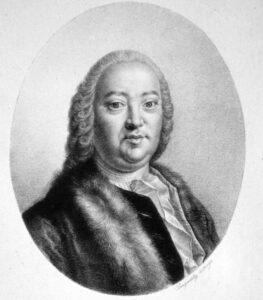
Van Swieten had tended to Governor Maria Anna of the Austrian Netherlands, who was the younger sister of the empress. Maria Anna had fallen ill with an infection after giving birth to a stillborn child. There was nothing that van Swieten could do to help her given the sorry state of medicine at the time, and she died days later. Even so, his confidence and professionalism impressed the empress enough for her to hire him as her personal physician. The two of them got on well together and, as their mutual friendship grew, so too did van Swieten’s responsibilities within the Habsburg Empire. This was how he ended up in charge of medical reform and the creation of the hospital that the empress wanted to see built.
Like his mentor, van Swieten was a firm believer in the humors and hired like-minded individuals. One of these individuals was Anton de Haen. A fellow graduate from Leiden who had also studied under Boerhaave, van Swieten installed de Haen as director of the Vienna medical school. De Haen was a real piece of work. He had what historians describe as a “corrosive fanaticism” for all that he had been taught by Boerhaave. Whether he was faced with a patient suffering from fever, typhus, or smallpox, he would almost always resort to draining away the humor that was out of balance. He had an intense aversion to those in the medical profession who proposed new techniques, and he vigorously attacked philosophers who suggested that God might not be behind all diseases. He made a habit of defending folk beliefs in demons, vampires, and witches. As I said, he was a real piece of work.
For over thirty years van Swieten and de Haen passed their ideas along to all of the doctors who served under them, and entrenched these teachings in the Empire’s medical schools. While Empress Maria Theresa herself died in 1780 before her hospital for the poor was constructed, her son carried on the torch when he, with guidance from van Swieten and de Haen, converted an old almshouse into the Vienna General Hospital.
It was a staggering feat. Upon opening in 1784, it was the largest hospital in Europe. Three stories tall and boasting enough beds for two thousand patients, it was dedicated to caring for the poor. And, just as the empress had wanted, it had a huge maternity ward that was built specifically to support the needs of impoverished single women. It is unfortunate that this extraordinary facility was rife with the teachings of de Haen, van Swieten, Boerhaave, and Sydenham, because this was where one of the most scientifically-minded doctors of the Victorian era would find himself practicing.
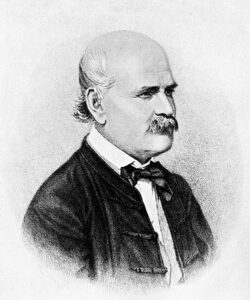
Ignaz Semmelweis was a Hungarian who initially studied in Hungary but completed his medical degree in Vienna in 1838. This was normal at the time as Hungary was a vassal state of the Austrian Empire, and it was only possible for a doctor to practice if they had a degree issued by the medical school in Vienna. This is why so many of Hungary’s best and brightest ended up in Austria. During his time training at the Vienna General Hospital, Semmelweis assisted in childbirth after childbirth. As he developed a specialty in obstetrics, he became a master of the bimanual exam, whereby the position of the fetus could be discerned by putting one hand on the woman’s abdomen while putting a finger or two up the birth canal. The fingers could feel the orientation of the child’s head while the hand could feel the position of the child’s back and bottom. The exam made it possible to easily monitor the fetal rotations as birth progressed and determine whether interventions, like manual rotation of the fetus or, in extreme situations, a Cesarean, were needed to get the baby out.
Paired with the successes provided by the bimanual exam were the losses. These were considerable. Roughly a day after delivery, women would frequently develop a fever, become nauseous, and complain of lower abdominal pain near the pubic bone. Intense shivering was common. Attentive doctors who had stethoscopes and knew how to use them would notice, if they listened to the digestive tracts of these patients, that their bowels had stopped functioning. Shortly after these symptoms emerged, women would develop pain in their abdomens that was so great that they could not stand to have their bellies touched. Even the gentle pressure of sheets or clothing was often too much for them to endure. Hours later, the patient’s fever and pulse would climb as the abdominal pain became so horrible that women would become, as one historian wrote, “frozen in speechless terror by the severity.” Swollen black and blue splotches would start to appear around their genitalia as rational thought became clouded by delirium. Patients would then begin shaking uncontrollably. Their fever would climb higher, they would experience devastating seizures, and then die. This was puerperal fever.
Puerperal fever, or childbed fever as it was sometimes known, killed roughly 15 percent of all women who gave birth in hospitals at the time. The disease came in waves, striking the women in maternity wards all at once. It was second only to tuberculosis for causing death in women. To make matters worse, when mothers fell victim to the disease, their newborn children would frequently follow them to the grave within a day or two. These were otherwise healthy women and babies whose lives were being cut tragically short by an illness that nobody could understand or treat.
Most doctors at the time coped with this misery by shrugging their shoulders and moving on to the next patient. I understand that reaction. Early on in my life, before I arrived in England and became a science journalist, I was an emergency medical technician in Northern California. You see some horrible stuff, and much of it you can do nothing about. One evening in the emergency room while doing my training hours, just a few weeks before receiving my final sign-off and license, I remember walking past a patient who was tagged as having received a gunshot wound to the head. The bullet had penetrated the skull but did not have enough energy to exit. Oddly, the realization came to me that he looked like my uncle. I started thinking that he probably had a family that would miss him terribly. Everything that I had learned made it clear that this poor man stood no chance of recovery. I asked the triage nurse by my side with a voice that, despite my best efforts, I could not keep from quavering, “Why do we have him on life support?” She shrugged in a nonchalant manner and said, “Organ donor.”
I do not want to suggest for a moment that the triage nurse supervising me was uncaring or cruel. Far from it. She was kind, tolerant of my newbie errors, and an excellent teacher. I learned so many techniques from her, but the most valuable thing she taught me was to not be “me” when working up patients. She adopted a kind of alternate persona when she stepped into her job. She shielded herself from the turmoil that exposure to constant death would cause by keeping some healthy emotional distance. Over the years, I discovered that many others working in emergency medicine did the same thing.
Semmelweis either could not do this or refused to.
Deaths from puerperal fever deeply troubled him and he made it his mission to defeat this scourge. While those running the Vienna General Hospital went about recording wind direction, barometric pressure, temperature, and planetary positions to help them ascertain what it was that gave rise to this miserable disease, Semmelweis started making notes.
He reasoned that, if the teachings of Sydenham and his followers were correct about wind, rain, and astronomy playing a part in determining where and when puerperal fever outbreaks took place, then the effects ought to be seen in multiple wards all at the same time in a single region experiencing the same environmental conditions. This was not the case. Semmelweis found that the disease could be infecting dozens in one hospital while killing none in another nearby. To his astonishment, he found that this was often even true in wards in the same building.
Within the walls of the Vienna General Hospital there were some women who had their babies delivered by doctors, and some who had their babies delivered by midwives. Time and time again Semmelweis noted that the patients having their babies delivered by doctors were more likely to catch puerperal fever than those looked after by the midwives. He could not be sure what it was about the doctors that was making it possible for the disease to take root, but he was sure of one thing: It was not the weather. Little did he realize the storm that his saying so would unleash.
I Told You So! copyright 2026 by Matt Kaplan. All rights reserved.