
Dolly Parton Knows Who She Is

by Martha Ackmann

Lifelong fan Martha Ackmann shares with The History Reader why she felt drawn to write her new book, Ain’t Nobody’s Fool, about music legend Dolly Parton.
I have loved Dolly Parton’s music for as long as I can remember. I’m attracted to the story-telling of her songs and what she calls the “lonesome chord” – that faraway, melancholy, haunting sound of her bluegrass music. I remember first seeing Dolly Parton on my grandparents’ black-and-white television in St. Louis. She was in her early twenties and the new “girl singer” on The Porter Wagoner Show. Something about her puzzled me. The big hair and curvy figure appeared at odds – it seemed to me – with who she might really be. My new biography, Ain’t Nobody’s Fool: The Life and Times of Dolly Parton, unravels what interested me in Dolly Parton all those years ago and what interests me still.
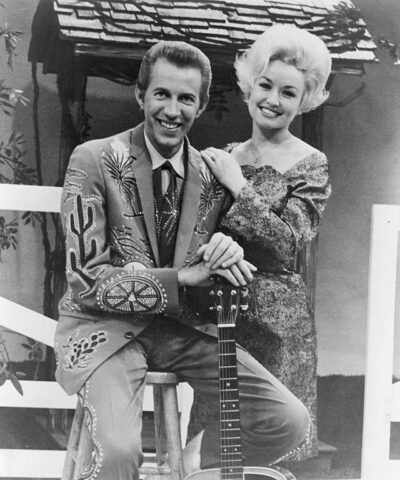
Dolly Parton and Porter Wagoner, 1969. Courtesy of Wikipedia. © Moeller Talent, Inc.
As I began researching Dolly Parton’s life – scouring archives, talking with music historians, interviewing Dolly’s friends, family, schoolmates, teachers, musicians, producers, even her first boyfriend – I discovered there was more to Dolly than meets the eye. The young woman who patiently stood behind Porter Wagoner with her hands folded was ablaze with ambition, composing songs at a feverish pace, and eager to step out from the shadows and strike out on her own. Seven years later when she eventually walked away from the popular show for a solo career, she did so with confidence. It wasn’t confidence based what she would do next but how far she knew she would go. Then there was Dolly’s decision to record pop music and appeal to audiences beyond country fans.  Nashville music executives thought she had lost her mind.  “I’m not leaving country,” she told them. “I’m taking country with me.” The genre exploded with new listeners. The head scratching about Dolly continued when she moved from music to motion pictures, then to business with the opening of her theme park in the foothills of the Smoky Mountains. Within a few years, Dollywood became nothing less than the economic engine of East Tennessee. As her wealth grew, Dolly took another unprecedented step. Instead of keeping money for herself and becoming a billionaire, she gave her fortune away. She funded research for the COVID Moderna vaccine, assisted in flood and hurricane relief across the Smokies, established health clinics, and created the Imagination Library, giving over 300 million free books to children all over the world.  “All my life,” Dolly once said, “there has been this strange thing within me that said, “Do this and that.” She knew when to walk into a room and when to leave. She knew where she was wanted and where she was not. Dolly describes her image – the towering hair, the cinched waist, the layers of make-up – as her “get up” and admits that she looks like a cartoon of a woman. But Dolly Parton always has known who she is.  The dichotomy of looking one way and being another is a strategy. It gives her something to work against, she says. She grabs people’s attention with her look and then bowls them over with how smart, creative, serious, and talented she is. Her look is a country girl’s idea of glam, she likes to say. But for Dolly – one critic noted – it is also her superpower.
Photo credit: Kevin Grady/Harvard Radcliffe Institute

Martha Ackmann is a journalist and author who writes about women who have changed America. Her essays have appeared in The Atlantic, the Paris ReviewThe New York Times, and The Washington Post. She also is a frequent commentator for New England Public Radio, and has been featured on CNN, National Public Radio, and the BBC. Martha is the recipient of fellowships from the John Simon Guggenheim Foundation and the Radcliffe Institute for Advanced Study at Harvard University. Her books include: The Mercury 13: The True Story of Thirteen Women and the Dream of Space Flight; Curveball: The Remarkable Story of Toni Stone, the First Woman to Play Professional Baseball in the Negro League; and These Fevered Days: Ten Pivotal Moments in the Making of Emily Dickinson.